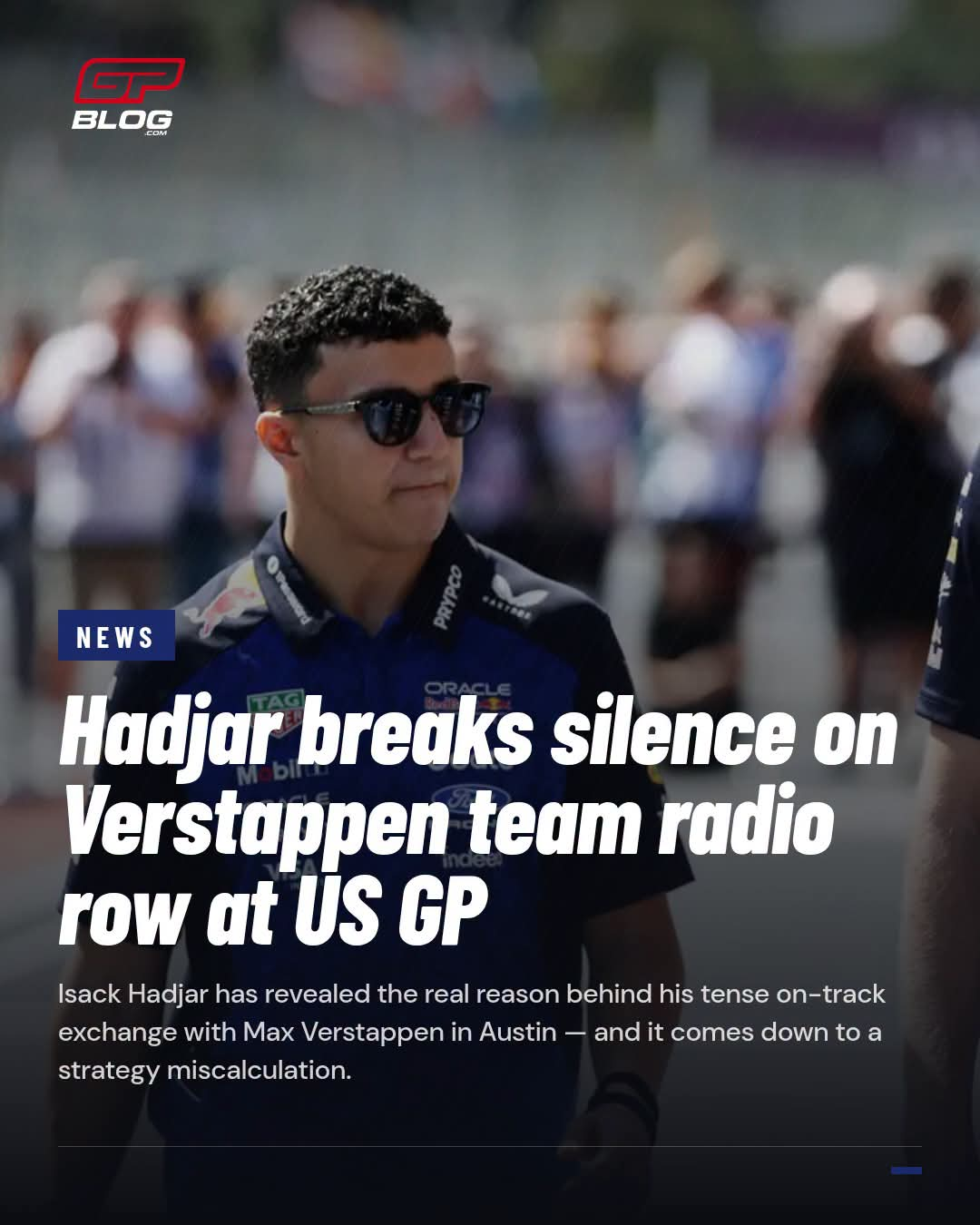
The Circuit of the Americas delivered more than just another race result in the 2026 Formula 1 season. It exposed the raw edges of Red Bull’s intra-team dynamics when Isack Hadjar and Max Verstappen found themselves in a messy, time-wasting confrontation that left the four-time champion venting over the radio.
What looked from the outside like a straightforward team-order moment was, according to Hadjar, the product of a strategic miscalculation that neither driver fully saw coming in real time. The Frenchman has now filled in the gaps, explaining why the situation turned tense and why both men lost valuable seconds in a race that ultimately slipped away from the team.
THE MOMENT VERSTAPPEN CAUGHT HADJAR ON FRESHER TYRES
During the second stint, Verstappen emerged from his first stop on fresher rubber and began closing rapidly on Hadjar. The Dutchman was committed to a two-stop approach. Hadjar, still on his original set, had grown convinced the race was evolving into a one-stopper and was trying to protect that possibility.
Red Bull instructed Hadjar to move aside. He initially pushed back, arguing that yielding would damage his own race. A few corners later he complied. The delay left Verstappen trapped in dirty air long enough to register his frustration clearly over the radio with a sarcastic “Thank you guys, really good strategy there, stuck in dirty air…” followed by an unprintable assessment of the situation.
Hadjar later described the scene without sugar-coating it. Verstappen was “coming by like a bullet.” Both drivers were operating with incomplete information in the moment. Hadjar realised too late that the one-stop was viable; the team and Verstappen had already committed the other way. The result was mutual time loss—Verstappen in the turbulent air behind his teammate, Hadjar by having to move over.
WHY THE STRATEGIC MISFIRE MATTERED MORE THAN THE RADIO EXCHANGE
This was not simply two teammates rubbing each other the wrong way. It was a symptom of Red Bull failing to read the tyre and degradation picture early enough at a track where strategy margins are razor thin. Kimi Antonelli’s one-stop victory for Mercedes underlined how expensive the misjudgement proved. Verstappen finished third. Hadjar, after a strong qualifying that put him third on the grid, came home sixth.
The incident sits inside a wider list of avoidable problems that afternoon: poor launches linked to clutch behaviour that Hadjar has openly called fragile and in need of redesign, radio communication failures that left both drivers operating with incomplete information, and tyre choices that left Verstappen on the wrong compound at the wrong time. Team principal Laurent Mekies acknowledged after the race that the squad had “a few things to tidy up.” The drivers’ post-race comments were less diplomatic.
For Verstappen, still chasing every point in a competitive championship fight, losing time behind a teammate on a different strategy is the kind of self-inflicted wound that rankles. For Hadjar, still establishing himself as a genuine front-running Red Bull driver, the episode was a high-pressure test of how hard he is allowed to fight for his own result before team priorities kick in.
THE BIGGER PICTURE FOR RED BULL AND ITS YOUNG DRIVER
Red Bull has long operated with a clear hierarchy. Verstappen is the undisputed number one. That reality does not disappear because a talented young driver qualifies well or finds himself in a different strategic window. What the Austin moment revealed is how quickly that hierarchy can create friction when information is incomplete and both cars are in the fight for strong points.
Hadjar’s willingness to explain the confusion rather than simply accept the narrative of “he should have moved earlier” shows a driver comfortable speaking his mind. That openness is useful for a team that needs accurate feedback, but it also raises the stakes for how the garage manages expectations going forward. Every time the second car is asked to yield, the optics and the internal trust are tested.
The clutch issues and radio problems compound the strategic ones. When the basics of starting and communicating are unreliable, the more complex decisions—when to pit, when to swap positions—become harder to execute cleanly. Hadjar’s post-race suggestion that the clutch needs a redesign was blunt for a reason. Repeated starts that drop drivers places through no fault of their own erode confidence and cost points that cannot be recovered later in the afternoon.
WHAT THIS MEANS FOR THE REST OF THE SEASON AND BEYOND
Moments like this rarely stay confined to one race. They shape how the team approaches future strategy briefings, how engineers communicate uncertainty, and how the second driver calibrates his aggression. Verstappen’s radio frustration was classic Max—direct, unfiltered, and focused on the lost time. Hadjar’s subsequent explanation was measured but clear: the root cause was the failure to anticipate the one-stop window early enough for both cars to align.
In a season where small margins decide championship positions, these internal inefficiencies matter. Red Bull still has the pace to fight at the front on many circuits. The question is whether it can eliminate the avoidable losses that turn potential victories or strong double points into mid-pack damage limitation.
For Hadjar, the episode is another data point in his education at the highest level. Racing alongside a driver of Verstappen’s calibre means learning when to fight and when the team order is non-negotiable. His ability to articulate the confusion without escalating it into open conflict suggests he understands the balance required. Whether that balance holds under greater pressure later in the year will be one of the more interesting subplots of the remaining races.
The US Grand Prix will be remembered for Antonelli’s dominant win and Red Bull’s self-inflicted wounds. The tense exchange between Verstappen and Hadjar was only one piece of that larger picture, but it was a revealing one. Strategy, communication, and hierarchy all collided on the same stretch of Texas asphalt. The drivers paid the price in time. The team now has to decide how much of that price was unavoidable and how much can be engineered out before the next race.