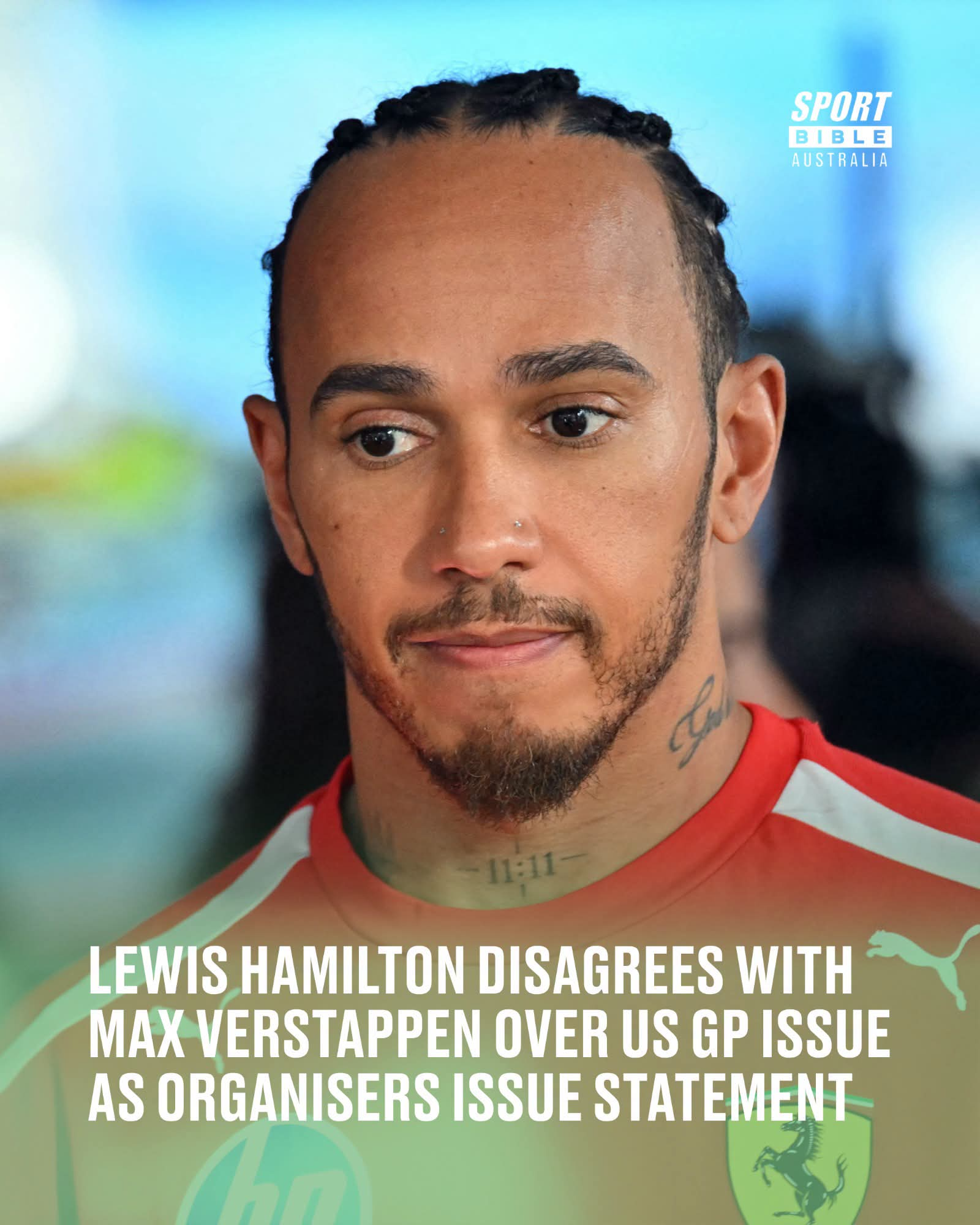
Lewis Hamilton and Max Verstappen have offered contrasting views on the condition of the Circuit of the Americas ahead of the 2026 United States Grand Prix, but the debate has taken a significant turn after circuit boss Bobby Epstein addressed the drivers’ complaints.
While Hamilton believes the bumps add character to the Austin circuit, Verstappen has raised concerns about their physical impact, revealing that medical checks on his spine have produced worrying results. Epstein has now acknowledged that one particular section of the track is unacceptable, while defending the work already carried out to improve other areas.
The disagreement has placed the condition of the Texas venue under renewed scrutiny, raising questions about driver comfort, safety and how much responsibility circuit organisers should take when competitors report problems.
HAMILTON DEFENDS COTA DESPITE VERSTAPPEN’S COMPLAINTS
Hamilton has made it clear that he does not share Verstappen’s level of concern about the bumpy surface. The Ferrari driver, who qualified fifth for the United States Grand Prix, believes the uneven sections make the circuit more challenging and rewarding to drive.
Hamilton explained that he enjoys having to correct the car when it moves over the bumps, arguing that a completely flat surface could take away some of the track’s distinctive character. He identified Turns 9 and 19 as areas where the bumps were noticeable but insisted that they had not caused him any significant problems.
The seven-time world champion also joked about his age, saying that he was 42 and his back was fine despite the complaints surrounding the circuit.
However, Hamilton’s experience does not necessarily reflect what every driver is feeling. Different cars, driving styles and physical responses can produce different experiences on the same track, meaning his confidence does not automatically invalidate Verstappen’s concerns.
VERSTAPPEN’S SPINE COMMENTS PUT THE SPOTLIGHT ON TRACK CONDITIONS
Verstappen has been among the most vocal critics of the bumps at COTA, despite praising the circuit’s layout and describing Austin as one of his favourite destinations on the Formula 1 calendar.
The Red Bull driver has argued that repeated attempts to address individual sections have not fully resolved the wider problem. He also expressed concern about the physical consequences, referring to checks on his spine and saying that the lower part did not look particularly good.
His comments have added urgency to the discussion because Formula 1 drivers already endure substantial physical forces during races. Persistent impacts from an uneven surface can make driving more uncomfortable and may affect a driver’s ability to maintain consistent control.
Verstappen’s statements do not establish a specific diagnosis or prove that the circuit caused an injury. Nevertheless, his concerns have put pressure on organisers to explain what has been repaired and what remains unresolved.
COTA BOSS ADMITS ONE SECTION IS UNACCEPTABLE
Circuit of the Americas chairman Bobby Epstein has now responded to the criticism, acknowledging that a dip at the bottom of Turn 1 is a problem the organisers would prefer not to have.
Speaking to ESPN, Epstein said the circuit had not been aware of that particular issue until the race weekend. He explained that the problem was a dip rather than a conventional bump, making it more complicated to repair quickly.
According to Epstein, a raised bump can sometimes be ground down or smoothed out, but a depression in the surface presents a different engineering challenge. He suggested that the issue could not be addressed as easily as other imperfections that had previously been repaired.
Epstein also said he appreciated Verstappen’s frankness and did not take the criticism personally. He acknowledged that the Dutchman is often direct in expressing his views and suggested that the driver might be surprised by improvements already made to other sections of the circuit.
His response represents an important distinction: while organisers maintain that much of the track has been improved, they have conceded that at least one problem remains.
ORGANISERS DEFEND REPAIRS TO THE CIRCUIT
Epstein pushed back against the broader suggestion that the entire circuit remains in poor condition. He said organisers had already addressed other bumps around the track and described the surface as being in good shape.
He also referred to feedback from World Endurance Championship drivers, some of whom reportedly did not share the same level of concern about the surface.
That difference in opinion illustrates how difficult it can be to reach a single conclusion about track conditions. Drivers competing in different categories may use different cars, suspension setups and tyres, potentially changing how they experience the same section of asphalt.
However, positive feedback from some competitors does not necessarily settle the issue raised by Verstappen and others. The key question is whether the remaining imperfections meet the standards expected of a modern Formula 1 circuit, particularly when drivers report physical discomfort.
The organisers’ response suggests that the problem is more complicated than simply resurfacing the entire venue. Even so, the admission concerning Turn 1 is likely to keep attention focused on whether further work will be required.
ANTONELLI’S TITLE BID ADDS TO THE PRESSURE
The track debate comes during a crucial weekend for Kimi Antonelli, who secured pole position for the United States Grand Prix and has an opportunity to move closer to Formula 1 history.
Antonelli beat Verstappen to the top spot by 0.179 seconds, while Isack Hadjar secured third place for Red Bull. Hamilton qualified fifth after Ferrari appeared competitive throughout practice but failed to translate that pace into the same advantage during qualifying.
The Italian’s championship opportunity depends on a combination of results, making the race particularly significant for Mercedes and its rivals. Verstappen will be looking to convert his front-row start into a victory, while Hamilton faces the challenge of moving forward from fifth.
With championship ambitions and valuable points at stake, the circuit’s bumps could become another factor influencing driver confidence, car performance and race strategy.
WILL FORMULA 1 DEMAND FURTHER TRACK CHANGES?
The disagreement between Hamilton and Verstappen highlights the challenge of balancing a circuit’s character with the need to provide a safe and consistent racing surface.
Hamilton sees the bumps as part of what makes COTA distinctive, while Verstappen believes the problem has become serious enough to warrant more substantial attention. Epstein’s response indicates that organisers recognise at least one specific issue but believe other areas have already been improved.
The next question is whether the remaining dip at Turn 1 can be properly assessed and repaired without major disruption. A quick fix may not be possible, given the difference between removing a raised bump and correcting a depression in the asphalt.
Ultimately, the debate should not be reduced to a disagreement between two world champions. Driver feedback, engineering assessments and objective safety evaluations will be essential in determining whether further action is necessary.
For now, Hamilton remains comfortable with the challenge, Verstappen continues to voice his concerns, and COTA’s organisers have acknowledged that at least one part of the track falls short of their own expectations. How they respond after the race could determine whether the controversy fades or becomes a bigger issue for future visits to Austin.