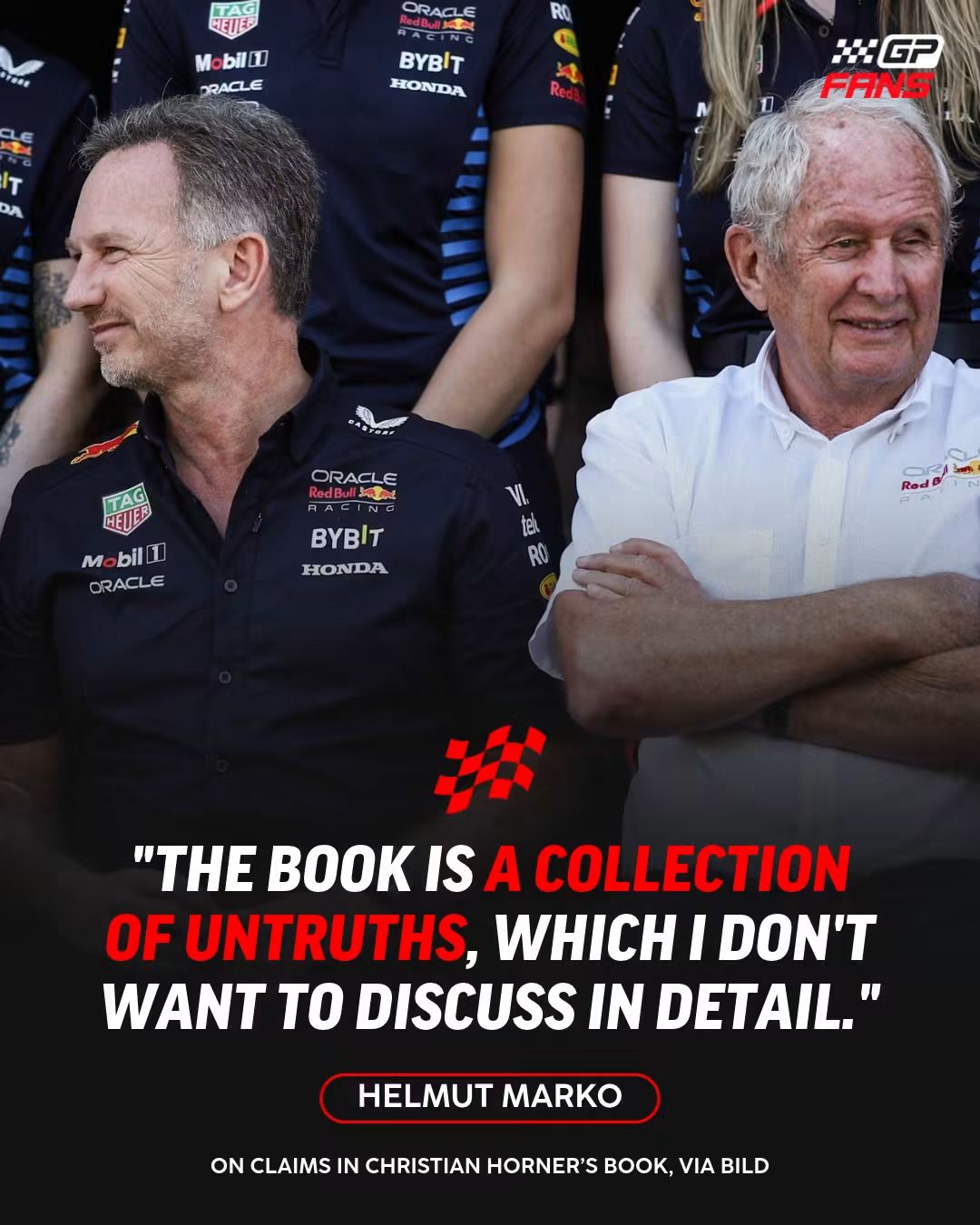
The long-simmering feud between two of Formula 1’s most powerful figures has erupted into open warfare once again. Helmut Marko has delivered a blunt, dismissive response to Christian Horner’s upcoming memoir, branding large parts of it a “collection of untruths” and refusing to engage with the personal accusations levelled against him.
As extracts from Horner’s book *Drive* circulate ahead of its October 22 release, the 83-year-old Austrian has made clear he has no interest in debating the narrative. The timing — just days before the anniversary of Red Bull founder Dietrich Mateschitz’s death — has only added fuel to an already combustible situation.
THE LATEST SALVO IN A BITTER POST-RED BULL RIVALRY
Horner, sacked as Red Bull team principal in July 2025 after two decades at the helm, has used interviews promoting *Drive* to paint a picture of a fractured relationship with his long-time colleague. He claims Marko actively worked to engineer his dismissal and failed to offer condolences after the death of Horner’s former partner, the mother of his daughter. “That wasn’t very classy,” Horner told German newspaper *Bild*.
He has also alleged that Marko leaked internal information and was overly harsh with young drivers in the Red Bull system. The pair, who once formed one of the most effective leadership duos in modern Formula 1, now say they have had no contact since shaking hands on Horner’s final day at the team.
Marko’s reply was characteristically terse. Speaking to *F1 Insider* and *Bild*, the former Red Bull motorsport adviser stated: “That’s a collection of untruths, I don’t want to address them at all.” In another version he called the book “a collection of untruths, which I don’t want to discuss in detail.”
No detailed rebuttal. No point-by-point defence. Just a flat rejection that leaves the competing versions of history hanging in the air.
WHY THIS MATTERS BEYOND THE HEADLINES
This is more than two former executives settling scores. Marko and Horner helped transform Red Bull from a novelty energy-drink entry into a dominant force that delivered multiple constructors’ and drivers’ titles with Sebastian Vettel and Max Verstappen. Their partnership produced results that reshaped the competitive landscape of Formula 1.
The public disintegration of that alliance raises uncomfortable questions about the human cost of sustained success at the highest level. Power struggles after Mateschitz’s death in 2022 created lasting fractures. Both men ultimately left the organisation in 2025 — Horner mid-season, Marko at the end of the year. The fact that their disagreements continue to play out in the media years later shows how deeply personal the rift became.
For Red Bull as a brand and racing organisation, the ongoing noise is unwelcome. The team is navigating a new era without two of its defining figures. Continued public sparring risks distracting from on-track performance and the careful management of driver talent that once defined the junior programme Marko oversaw.
THE VERSTAPPEN RECRUITMENT FLASHPOINT RETURNS
This latest exchange is not happening in isolation. Earlier extracts from *Drive* claimed Marko initially resisted bringing Max Verstappen into the Red Bull fold, reportedly citing concerns about the driver’s father, Jos. Former F1 driver Ralf Schumacher called that version “an absolute lie,” insisting Marko had approached the family when Max was still karting.
Marko backed Schumacher’s account and went further, claiming he had to overcome Horner’s reluctance to promote the teenager to the senior team for the 2016 Spanish Grand Prix. Verstappen, of course, won on debut in Barcelona — a result that settled the sporting argument rather more cleanly than the historical one.
These conflicting memories of the same pivotal moments illustrate a broader truth in elite sport: when careers end and legacies are written, self-interest and selective recollection often collide. Both men have legitimate claims to credit for Red Bull’s golden periods. Neither appears willing to share the narrative generously.
THE WIDER IMPACT ON FORMULA 1’S CULTURE OF LOYALTY AND POWER
Formula 1 has always thrived on strong personalities and intense rivalries, both on and off the track. What makes the Marko-Horner saga notable is how completely a once-functional working relationship has collapsed into mutual distrust. In an industry where long-term partnerships (think Toto Wolff and Mercedes, or the long-standing structures at Ferrari) often underpin sustained success, the Red Bull example serves as a cautionary tale.
Driver development programmes, technical leadership, and commercial strategy all suffer when key figures become more focused on personal narratives than collective progress. Young drivers still coming through the Red Bull system, and the current leadership trying to stabilise the team, are the ones who must operate in the shadow of these unresolved tensions.
There is also a commercial dimension. Memoirs from major F1 figures sell. *Drive* is positioned as a candid, high-stakes account of building a championship organisation under extreme pressure. Controversy helps sales. Marko’s refusal to play along denies Horner the extended public debate that would keep the book in the headlines for longer.
WHAT COMES NEXT?
Expect more extracts and interviews in the coming days. Horner has shown he is prepared to go into personal detail. Marko has signalled he will not be drawn into a prolonged exchange. That asymmetry may suit the Austrian: by refusing to engage, he leaves Horner’s claims unanswered in the public square while avoiding the appearance of descending into a grudge match.
For Formula 1 observers, the episode reinforces something the sport has always known but rarely states so openly: the most successful teams are often held together by fragile alliances of strong-willed individuals. When those alliances break, the fallout can outlast the on-track success they once delivered.
Marko’s terse dismissal will not end the story. It simply marks another chapter in a rivalry that continues to define the post-glory years of two of Formula 1’s most consequential figures. Whether *Drive* ultimately revises history or simply airs long-held grievances, one thing is already clear: neither man is prepared to let the other write the final version alone.