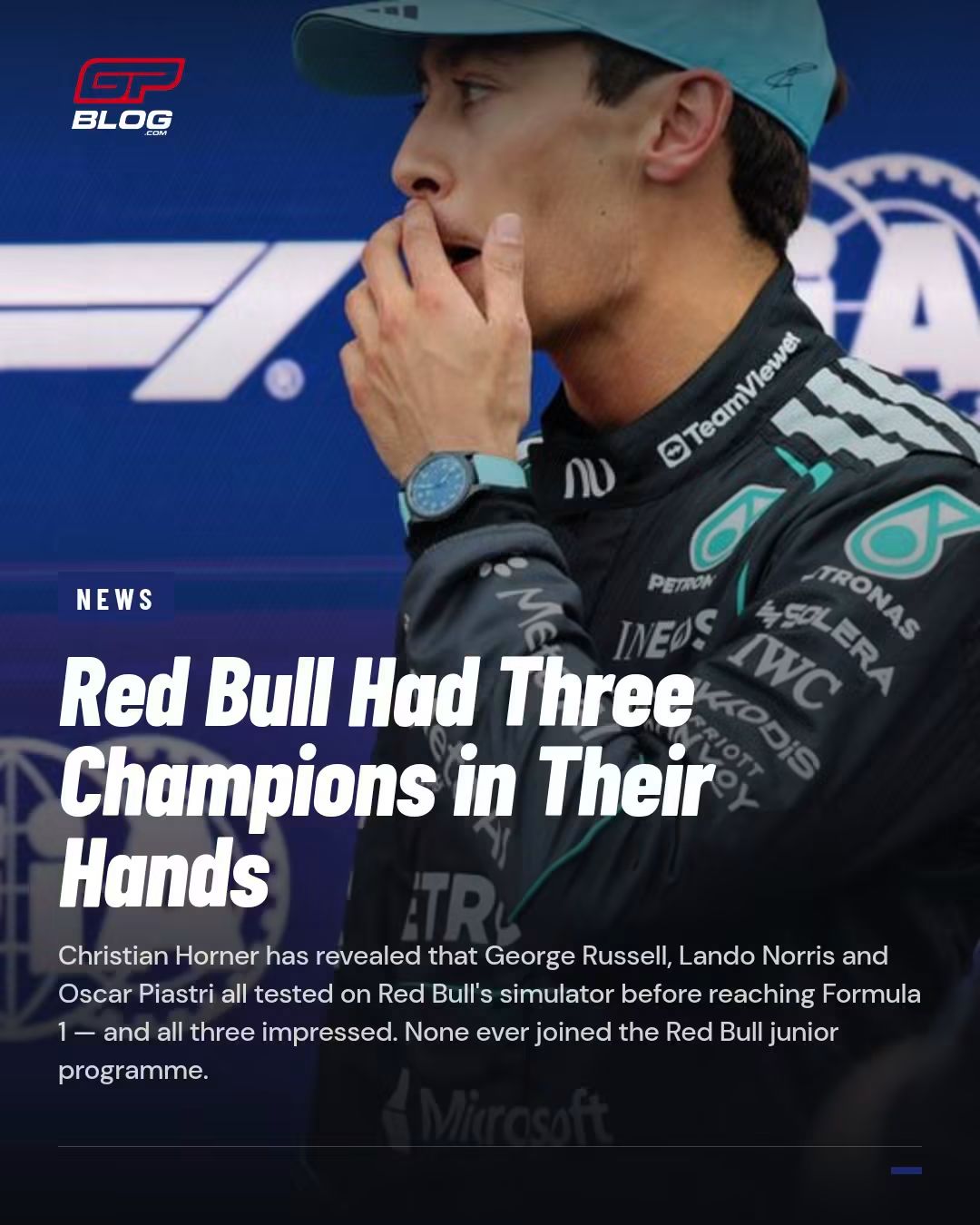
In the high-stakes world of Formula 1 talent hunting, missed opportunities can haunt teams for years. Christian Horner recently pulled back the curtain on one of the most intriguing near-misses in recent Red Bull history. George Russell, Lando Norris and Oscar Piastri all spent time on the Red Bull simulator as young drivers. They were not invited as academy prospects. They paid for the privilege. And according to the team principal, they were simply faster than the juniors already on the books.
The sim manager walked up to Horner with a clear message: these kids were better than what Red Bull had in its own program. The recommendation was obvious. Look at them. Consider signing them. They walked anyway.
That single anecdote lands like a quiet bombshell. It reframes how we view the current grid and the paths these three drivers took to the top.
WHY THE SIMULATOR SESSION MATTERS MORE THAN A SIMPLE TEST
Formula 1 teams guard their simulators jealously. These multi-million-pound machines are not toys. They form the backbone of car development, driver preparation and, occasionally, talent evaluation. Allowing outside drivers access, even on a paid basis, is unusual. Doing so and then watching them outperform your own academy drivers is rarer still.
Horner’s account paints a picture of pure performance data cutting through politics and contracts. Russell, Norris and Piastri arrived as customers rather than prospects. They left a lasting impression. The fact that Red Bull’s own junior ranks could not match them on home equipment raises uncomfortable questions about talent identification at the time.
This was not a one-off casual session. The three drivers were good enough, and consistent enough, to prompt an internal recommendation. Yet none of them ended up in a Red Bull seat.
THE PATHS THEY CHOSE INSTEAD
George Russell joined the Mercedes junior program and eventually stepped into the senior team. Lando Norris found a home at McLaren, where he has grown into a consistent frontrunner and title contender. Oscar Piastri, after a complex junior career that included a high-profile contract dispute, landed at McLaren as well and has established himself as one of the sharpest pure talents on the grid.
Each of those decisions looks smarter with hindsight. Mercedes and McLaren offered clearer pathways and, in the long run, more competitive machinery during critical development years. Red Bull, for all its dominance in the early 2020s with Max Verstappen, has often struggled to place a consistent number two driver alongside him. The second seat has seen a revolving door of talent, some of whom never fully adapted to the unique demands of the Red Bull car and culture.
Had any of Russell, Norris or Piastri joined the Milton Keynes operation, the competitive landscape of the mid-2020s might look very different. A young Russell or Norris partnering Verstappen could have created an all-British powerhouse. Piastri’s clinical racecraft might have thrived in the Red Bull environment. Instead, those three drivers have become the primary challengers to Red Bull’s supremacy in recent seasons.
THE WIDER IMPACT ON RED BULL’S DRIVER PROGRAM
Red Bull’s junior academy has produced genuine stars, most notably Verstappen himself. Yet it has also faced criticism for dropping promising drivers too early or failing to develop them fully for the senior team. The revelation that three of the current generation’s best drivers outperformed academy members on the simulator only sharpens that scrutiny.
It also highlights a commercial oddity. Red Bull effectively charged future rivals for the privilege of demonstrating their superiority. As one observer noted, it ranks among the more ironic business models in motorsport. The team collected data and revenue while simultaneously confirming that elite talent was slipping past them.
For the drivers themselves, the experience likely served as valuable preparation. Time on a top-team simulator, even as paying customers, would have provided insights into how a leading organisation operates and how its car philosophy differs from others. That knowledge travels with them.
WHAT THIS MEANS FOR THE CURRENT AND FUTURE GRID
The story arrives at a moment when driver contracts and seat availability remain constant talking points. Red Bull continues to evaluate its options beyond Verstappen. McLaren has two of the three drivers who once impressed in Milton Keynes under the same roof, creating one of the strongest line-ups on the grid. Russell remains a cornerstone at Mercedes as the team rebuilds under new regulations.
Looking ahead, the anecdote serves as a reminder that talent scouting is imperfect even at the highest level. Simulator data is valuable, but converting that data into signed contracts requires timing, chemistry, financial alignment and sometimes pure luck. Red Bull saw the numbers. The recommendation was made. The signatures never followed.
In the years since those sessions, Russell, Norris and Piastri have all delivered race wins, podium consistency and, in some cases, championship challenges. Red Bull has continued to win titles with Verstappen, yet the second seat remains a perpetual question mark. The three drivers who once paid to prove their worth on the Red Bull simulator are now the ones regularly denying the team the full domination it seeks.
Sometimes the ones who walk away become the biggest threats. In this case, they walked into rival garages and built careers that continue to shape the championship fight. For Red Bull, it remains one of the more fascinating what-ifs of the modern era. For the rest of the paddock, it is simply further proof that elite talent finds its way to the front, whether a top team signs it early or not.