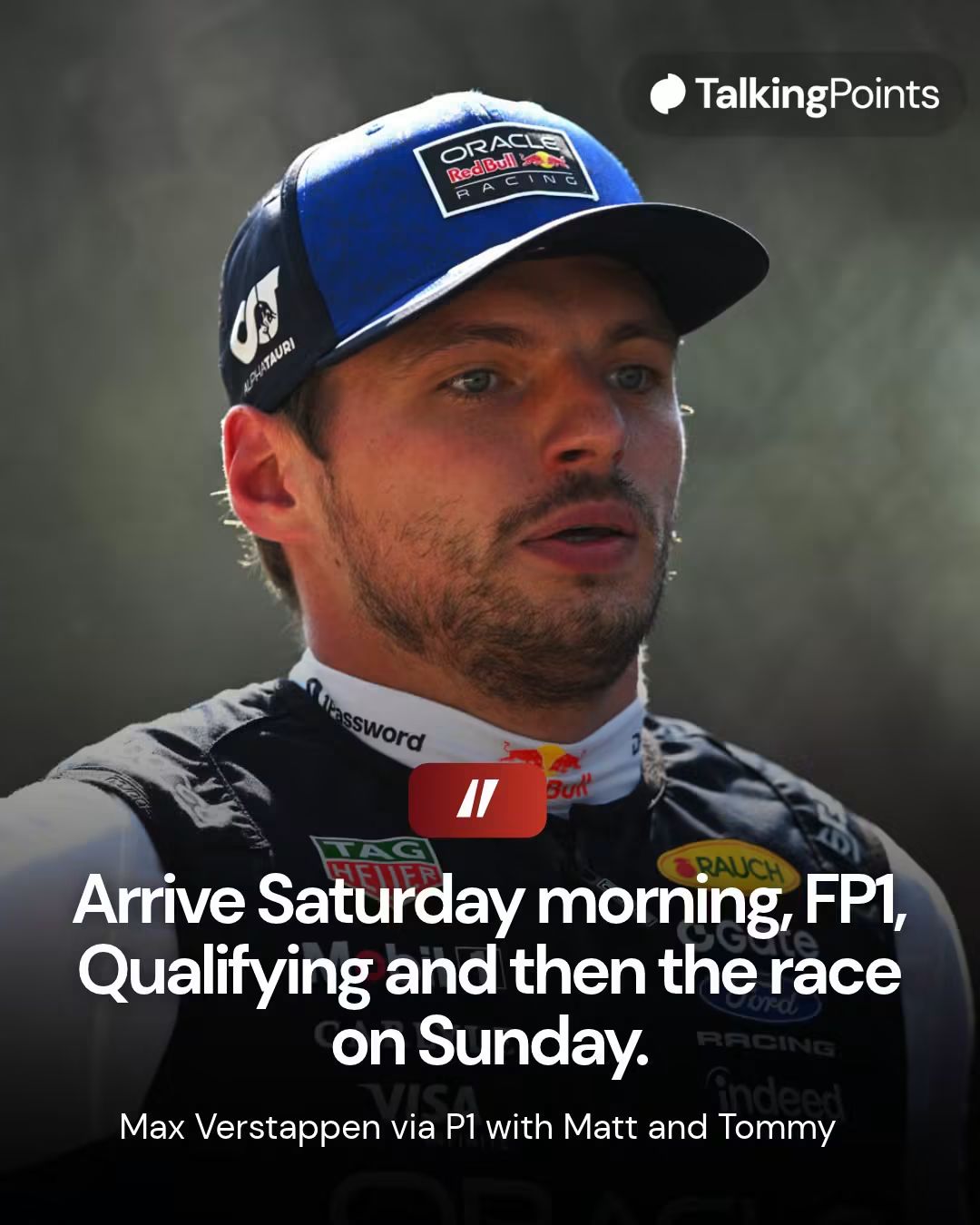
Max Verstappen does not mince words when it comes to how Formula 1 should run its race weekends. Speaking recently on the P1 with Matt & Tommy podcast, the four-time world champion outlined a stripped-back vision that would jolt the current calendar: arrive Saturday morning, run one free practice session, go straight into qualifying, and race on Sunday. No Friday. Minimal practice. Pure racing focus.
He has floated similar ideas before—two-day weekends, one practice only, no sprints, fewer races overall, and a preference for proper tracks over too many street circuits. This latest version sharpens the point. From the driver’s seat, three practice sessions can feel like padding. Get rid of at least one, he says. Yet Verstappen is realistic enough to admit the commercial problem: promoters, broadcasters, and sponsors need Friday, Saturday, and Sunday to generate revenue and keep the show alive for fans at the track.
That tension—driver efficiency versus business reality—sits at the heart of one of F1’s ongoing debates. Is Verstappen’s leaner format better than the current three-day structure (with its mix of standard and sprint weekends)? Or does the existing schedule, for all its flaws, deliver the right balance of preparation, spectacle, and income?
WHAT THE CURRENT F1 WEEKEND ACTUALLY LOOKS LIKE
On a standard Grand Prix weekend the rhythm is familiar. Friday brings two one-hour free practice sessions (FP1 and FP2). Saturday starts with FP3, followed by knockout qualifying that sets the grid. Sunday is the main event—the Grand Prix itself, usually lasting around 90 to 120 minutes depending on the circuit.
Sprint weekends compress that further. Teams get only one practice session on Friday before sprint qualifying. Saturday features the short sprint race plus the regular qualifying for Sunday’s Grand Prix. The number of these sprint events has grown, and further expansion (including Monaco) has been discussed. The format gives fans more on-track action and extra points for drivers, but it leaves less room for setup work and raises the stakes if a car is off the pace early.
Teams currently get up to three hours of free practice on a normal weekend. Engineers use that time to dial in aerodynamics, tyre behaviour, fuel loads, and balance. Drivers build confidence and feedback. Verstappen argues that experienced drivers like himself already know the cars well enough that one solid practice session would suffice for most tracks. Newer or struggling teams might disagree.
WHY VERSTAPPEN WANTS A LEANER WEEKEND
Verstappen’s preference comes from a pure driver’s perspective. Long practice sessions can feel repetitive once the car is in a good window. The calendar is already packed—often 24 races, long-haul flights, back-to-back events—and every extra day at the track adds fatigue for drivers, engineers, mechanics, and support staff. A Saturday-to-Sunday format would cut travel days, reduce hotel costs, and free up recovery time.
He has repeatedly said he is not a fan of sprints. In his view the main Grand Prix carries more emotion and meaning. Extra short races dilute that focus, even if they create more overtakes and TV moments. He has acknowledged that fans at the circuit often enjoy the extra racing, and he understands the commercial logic. But from inside the cockpit the priority is clear: more meaningful competition, less filler.
This stance aligns with earlier comments where he called for fewer races overall, only the best circuits, and a simpler travel schedule. The sport has expanded aggressively for global growth and revenue. Verstappen’s ideal pushes back toward a more traditional, driver-centric model.
THE COMMERCIAL AND FAN REALITY CHECK
Formula 1 is a business as much as a sport. Friday sessions fill grandstands, sell hospitality packages, and provide content for broadcasters and social media. Race promoters pay huge fees for the right to host an event; they need three days of activity to justify the investment and maximise local economic impact. Sponsors want exposure across multiple days. Cutting Fridays would shrink the product and potentially reduce the value of the commercial rights.
Fans are split. Some prefer the traditional build-up—watching teams experiment, seeing the cars evolve, feeling the tension rise toward qualifying and the race. Others, especially newer or casual viewers, find free practice slow and would rather see more racing. Sprint weekends already try to address that demand by adding competitive sessions. Expanding them further is one path F1 leadership has explored.
There is also the competitive fairness angle. One practice session raises the value of simulation work, previous data, and first-lap adaptability. Teams with superior resources or experienced drivers might gain an edge. Weather changes, track evolution, and unexpected issues become higher-stakes variables. That could produce more unpredictable results, which many fans would welcome, but it risks punishing smaller teams that rely on track time to catch up.
IMPACT ON TEAMS, DRIVERS, AND THE CHAMPIONSHIP
For drivers the benefits of a shorter weekend are obvious: less physical and mental wear over a long season, more time at home or training, reduced risk of burnout. Mechanics and engineers would also gain recovery days, which matters when the calendar includes triple-headers and transcontinental travel.
Teams would need to adapt. Setup work would shift more heavily into the factory and simulators. Data from previous years and other series would become even more critical. Qualifying would carry greater weight because there is less opportunity to recover from a poor session. The championship itself might become more lottery-like on certain weekends, especially at street circuits or tracks with big weather swings.
Organisations and the FIA would face pressure from promoters and broadcasters if revenue dipped. Leagues and championships in other series have experimented with condensed formats; some succeed in raising intensity, others lose atmosphere. F1’s global footprint and high production values make any change more complicated.
PREDICTIONS AND THE BIGGER PICTURE FOR FORMULA 1
Verstappen’s ideal is unlikely to be adopted wholesale anytime soon. The commercial incentives for three-day events are strong, and the push toward more sprint weekends shows leadership is moving in the opposite direction—more action, not less. Hybrid approaches are more plausible: keeping Fridays but making them more engaging (perhaps with more competitive elements or fan experiences), reducing total practice time across the board, or refining the sprint format so it feels less disruptive.
The sport has already shortened the traditional four-day media schedule in recent years. Further streamlining is possible without deleting an entire day. Technology—better simulation, more accurate tyre models, advanced data tools—could support Verstappen’s “one practice is enough” argument for top teams. For the midfield and backmarkers the story is different.
Ultimately the debate reflects a deeper question about F1’s identity. Is it primarily a pure sporting contest for the world’s best drivers, or a global entertainment product that needs constant novelty and multiple revenue streams? Verstappen consistently lands on the sporting side. Many long-time fans share that instinct. The current schedule, however imperfect, has helped the series grow its audience and commercial value dramatically.
WHICH FORMAT SERVES THE SPORT BETTER?
A Saturday-morning arrival, one FP session, qualifying, and Sunday race would be cleaner, less exhausting, and more focused on the racing that matters most. It would reduce calendar fatigue and put a premium on driver skill and team preparation away from the track. For pure racing purity, Verstappen’s version has real appeal.
The current structure—three days, variable practice, and selective sprints—better serves the business of Formula 1 and gives fans more ways to engage with each event. It is not perfect. Practice can drag. Sprints remain polarising. Travel remains brutal. Yet it funds the extraordinary level of competition and spectacle that makes F1 unique.
The healthiest path forward may not be choosing one extreme. It could be selective trimming: fewer total races, smarter scheduling to cut travel, higher-quality practice sessions instead of more of them, and a sprint format that truly adds value rather than just filling the timetable. Verstappen has put a clear marker down from the driver’s perspective. Whether the sport listens will say a lot about the balance it chooses between tradition, competition, and commercial growth in the seasons ahead.