Lando Norris’ 2025 Formula 1 World Championship will always be remembered as one of the biggest moments in McLaren’s modern history.
But behind the trophy, the celebrations and Norris’ first Drivers’ Championship was another transformation that may be just as significant for the company itself.
McLaren Racing has gone from struggling near the back of the Formula 1 field and facing serious financial pressure to becoming one of the sport’s most commercially powerful organisations.
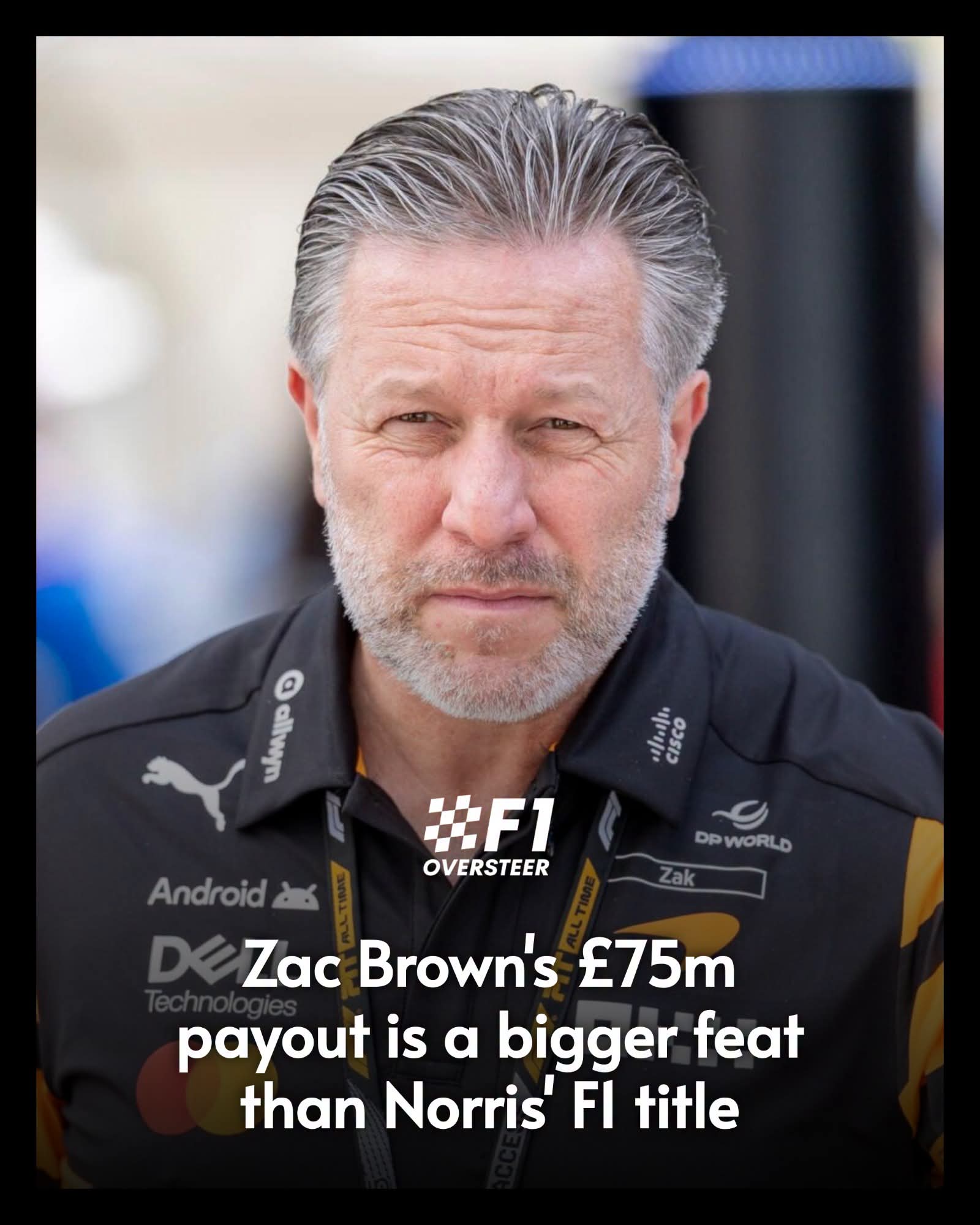
And the latest numbers surrounding CEO Zak Brown illustrate just how dramatic that turnaround has been.
Sky News reports that Brown received a package worth more than $100 million (£75.4 million) during 2025, with a large portion connected to a share award triggered by a buyout involving McLaren Racing’s minority owners. The same report says McLaren Racing is on track to generate around $1 billion in revenue during 2026.
That makes Brown’s payout much more than a story about executive compensation.
It is a snapshot of how far McLaren has travelled.
FROM STRUGGLING TEAM TO FORMULA 1 POWERHOUSE
When Brown became involved with McLaren in 2016, the team was nowhere near its current position.
McLaren had endured several difficult seasons following the end of its highly successful partnership with Mercedes, while the Honda years produced further competitive and financial challenges.
The team was fighting simply to return to the front of the grid.
The transformation did not happen overnight.
McLaren gradually rebuilt its technical organisation, improved its commercial operation and developed a driver programme that eventually produced Norris and Oscar Piastri.
The results began to change dramatically.
McLaren finished fourth in the 2023 Constructors’ Championship before taking the 2024 title and then completing the double by winning both the Constructors’ and Drivers’ Championships in 2025.
That progression is important because the 2025 title was not an isolated success.
It was the result of several years of organisational rebuilding.
THE £75.4M FIGURE NEEDS SOME CONTEXT
The headline figure attached to Brown is enormous.
But it is important to understand what it represents.
Sky News reported that Brown’s 2025 package exceeded $100 million, with much of the value coming from a share award associated with a transaction involving McLaren Racing’s minority owners.
That means it should not automatically be interpreted as a conventional annual salary of £75.4 million.
Indeed, Sky reported that Brown’s 2024 compensation consisted of a £6 million base salary and a £31 million long-term incentive award.
The distinction matters.
Executive compensation packages can include salaries, bonuses, long-term incentives and equity-related awards whose value is connected to the growth or restructuring of a company.
Brown’s reported 2025 package therefore reflects both his role and the extraordinary financial circumstances surrounding McLaren Racing’s ownership and valuation.
McLAREN’S COMMERCIAL REVIVAL IS JUST AS IMPORTANT AS ITS RACING SUCCESS
The most fascinating part of the story is what happened away from the circuit.
McLaren’s return to competitiveness made the team considerably more attractive to sponsors and commercial partners.
Sky News reported that McLaren Racing’s 2025 accounts are expected to show revenue of approximately £588 million, or $779.6 million, with sponsorship agreements contributing significantly to the business.
The company’s commercial portfolio includes major names such as Mastercard, Google, DP World, Allwyn, Intel and OKX.
That is a very different commercial landscape from the one McLaren operated in during its difficult years.
Winning races creates attention.
Winning championships creates something even more valuable: sustained global visibility.
McLaren has managed to convert that sporting success into commercial growth.
THE COVID CRISIS ALMOST CHANGED EVERYTHING
The turnaround becomes even more impressive when the pandemic years are considered.
McLaren’s motorsport operation was hit hard by the COVID-19 crisis.
According to Sky News, the group was under severe financial pressure during the pandemic, with the organisation taking steps to secure its future.
The company also explored the sale of a minority stake in the racing operation as part of its efforts to strengthen its finances.
At one point, Brown had publicly warned about the seriousness of McLaren’s financial situation.
The organisation therefore went from worrying about financial survival to being positioned for potentially $1 billion in annual revenue.
That is an extraordinary business transformation.
LANDO NORRIS’ TITLE WAS THE SPORTING PAYOFF
The financial turnaround would not have the same meaning without what happened on the track.
McLaren finally ended its long wait for the Constructors’ Championship in 2024.
It was the team’s first Teams’ title since 1998.
Then came an even bigger breakthrough.
In 2025, Norris became Formula 1 World Champion.
According to Formula 1’s official record, Norris won seven Grands Prix during his championship campaign and defeated Oscar Piastri and Max Verstappen in a remarkably close title fight.
McLaren therefore achieved the ultimate combination:
Constructors’ Championship.
Drivers’ Championship.
Commercial momentum.
A strengthened driver lineup.
Long-term stability.
That is why the Brown story cannot really be separated from Norris’ success.
WHY BROWN’S ACHIEVEMENT IS DIFFERENT FROM NORRIS’ TITLE
The original argument that Brown’s payout represents a bigger achievement than Norris’ championship needs some qualification.
They are fundamentally different achievements.
Norris won a sporting championship.
Brown’s job involved building an organisation capable of competing at that level while also strengthening its commercial foundations.
One achievement happens on the circuit.
The other happens across an entire business.
Norris could not win his title without the car, engineers, mechanics, strategists and wider McLaren organisation.
At the same time, McLaren could not have turned its commercial revival into the same global story without competitive success on the track.
The two achievements are therefore connected rather than directly comparable.
McLAREN’S BIGGEST SUCCESS MAY BE ITS ORGANISATIONAL STABILITY
Formula 1 teams often experience a cycle of success followed by decline.
A technical regulation change can destroy a competitive advantage.
A star engineer can leave.
A driver can move elsewhere.
A championship-winning concept can suddenly become obsolete.
McLaren’s challenge now is to avoid that cycle.
The team has already demonstrated that it can recover from a difficult period.
The next challenge is proving that its current success is sustainable.
That makes Brown’s commercial transformation particularly relevant.
A financially stronger McLaren has more resources to invest in technology, infrastructure, personnel and long-term development.
THE NORRIS CONTRACT SHOWS McLAREN’S CONFIDENCE
Another major piece of the puzzle is Norris’ future.
In August 2026, McLaren announced that Norris had signed a new contract extending his stay with the team until at least the end of 2030.
That is important because Norris is no longer simply a promising young driver.
He is a World Champion.
McLaren has now secured the services of the driver who delivered its first Drivers’ Championship in 17 years for several more seasons.
Oscar Piastri is also contracted through the end of 2028, giving McLaren substantial continuity at the front of its driver lineup.
That stability could become one of McLaren’s biggest competitive advantages.
ANDREA STELLA’S ROLE SHOULD NOT BE FORGOTTEN
It would also be misleading to present McLaren’s transformation as the work of Brown alone.
Team principal Andrea Stella has played a central role in the team’s recent competitive rise, while technical leaders and hundreds of employees have contributed to the development of the cars.
McLaren’s success has been a collective project.
Brown’s role has been particularly prominent on the commercial and executive side, while Stella and the technical organisation have been crucial to extracting performance from the cars.
Norris and Piastri then turned that performance into victories and championships.
The transformation required all of those pieces to work together.
THE REAL TEST BEGINS NOW
Perhaps the most difficult part of McLaren’s story is still ahead.
Returning to the top is one challenge.
Staying there is another.
The 2026 season has already demonstrated that McLaren cannot assume previous dominance will continue indefinitely. Formula 1’s competitive order can change quickly, particularly when teams face new technical challenges and development battles.
The official F1 team statistics currently place McLaren third in the 2026 Constructors’ standings, illustrating that the competitive environment has tightened again.
That makes McLaren’s commercial strength increasingly important.
A team with stronger finances and a stable leadership structure has more capacity to respond when rivals catch up.
WHY THE £75M STORY MATTERS
The eye-catching number attached to Brown has naturally become the headline.
But the more important story is what sits behind it.
McLaren has created a business that is substantially more valuable and commercially powerful than the organisation Brown inherited.
It has won consecutive Constructors’ Championships in 2024 and 2025.
It produced its first Drivers’ Champion since Lewis Hamilton’s 2008 title.
It has secured Norris through 2030.
And it is now reportedly on course to become the first F1 team to reach $1 billion in annual revenue.
That combination explains why Brown’s reported compensation has attracted so much attention.
THE BIGGER McLAREN LEGACY
Years from now, fans may remember Norris’ 2025 championship as the moment McLaren finally returned to the summit.
But the organisation’s longer-term legacy could be measured differently.
The real achievement may be that McLaren rebuilt itself into a financially stronger, commercially attractive and consistently competitive Formula 1 operation.
Norris provided the championship moment.
Piastri helped provide the competitive depth.
Stella and the technical team helped build the cars.
Brown helped oversee the wider transformation.
None of those achievements exists completely independently of the others.
FINAL TAKEAWAY
Zak Brown’s reported £75.4 million ($100m+) 2025 compensation package is certainly an extraordinary figure, but the number itself is not the whole story.
Sky News reports that much of the package was connected to a share award triggered by an ownership transaction, while McLaren Racing is expected to report substantial revenue growth.
The more significant development is the transformation behind the number.
McLaren went from struggling competitively and financially to winning the Constructors’ Championship in 2024, adding the Drivers’ Championship with Lando Norris in 2025, and building a commercial operation reportedly approaching $1 billion in annual revenue.
Norris’ World Championship remains one of the greatest sporting moments in McLaren’s recent history.
But if McLaren can maintain its financial strength, retain its key personnel and continue competing for championships, the organisation’s broader transformation under Brown may ultimately prove to be the achievement that lasts longest.
The trophy belongs to Norris. But the transformation behind that trophy belongs to an entire McLaren organisation.