JACQUES VILLENEUVE WARNS FREDERIC VASSEUR AS CHRISTIAN HORNER’S FERRARI LINKS GROW
Ferrari’s Formula 1 future has become a major talking point in the paddock, with Christian Horner’s name increasingly being mentioned in connection with the legendary Italian team.
Former world champion Jacques Villeneuve believes Ferrari cannot afford to ignore Horner’s credentials if the opportunity to bring him into the organisation ever becomes realistic.
Speaking to Sky Sports News in Baku, Villeneuve pointed to Horner’s record of building Red Bull into one of Formula 1’s most successful teams.
But his comments also highlighted a bigger issue surrounding Ferrari: the extraordinary pressure placed on whoever occupies the team’s top leadership position.
VILLENEUVE SAYS HORNER’S RECORD MUST BE TAKEN SERIOUSLY
Villeneuve’s argument is based largely on Horner’s track record.
During his long tenure at Red Bull, Horner was part of the leadership structure that transformed the team from a relatively new Formula 1 operation into a championship-winning powerhouse.
Red Bull won multiple drivers’ and constructors’ championships during his time at the team, establishing itself as one of the dominant forces of the modern F1 era.
For Villeneuve, that history means Horner cannot simply be dismissed when Ferrari considers its future leadership structure.
The 1997 world champion described Horner as someone Ferrari would have to take seriously because of what he achieved at Red Bull.
That does not mean a move to Ferrari has been confirmed.
Instead, Villeneuve’s comments underline why Horner’s name continues to attract attention whenever Ferrari’s management structure becomes a topic of discussion.
FERRARI’S LEADERSHIP PRESSURE IS NOTHING NEW
The bigger story may actually be Ferrari itself.
Ferrari is arguably the most recognisable name in Formula 1, but its enormous history also creates extraordinary expectations.
Team principals are expected to deliver competitive cars, manage one of the sport’s biggest organisations and handle constant pressure from fans, media and the Italian sporting establishment.
Villeneuve pointed out that Ferrari has gone through numerous leadership changes when results failed to meet expectations.
That history creates an environment where a team principal can never feel completely secure.
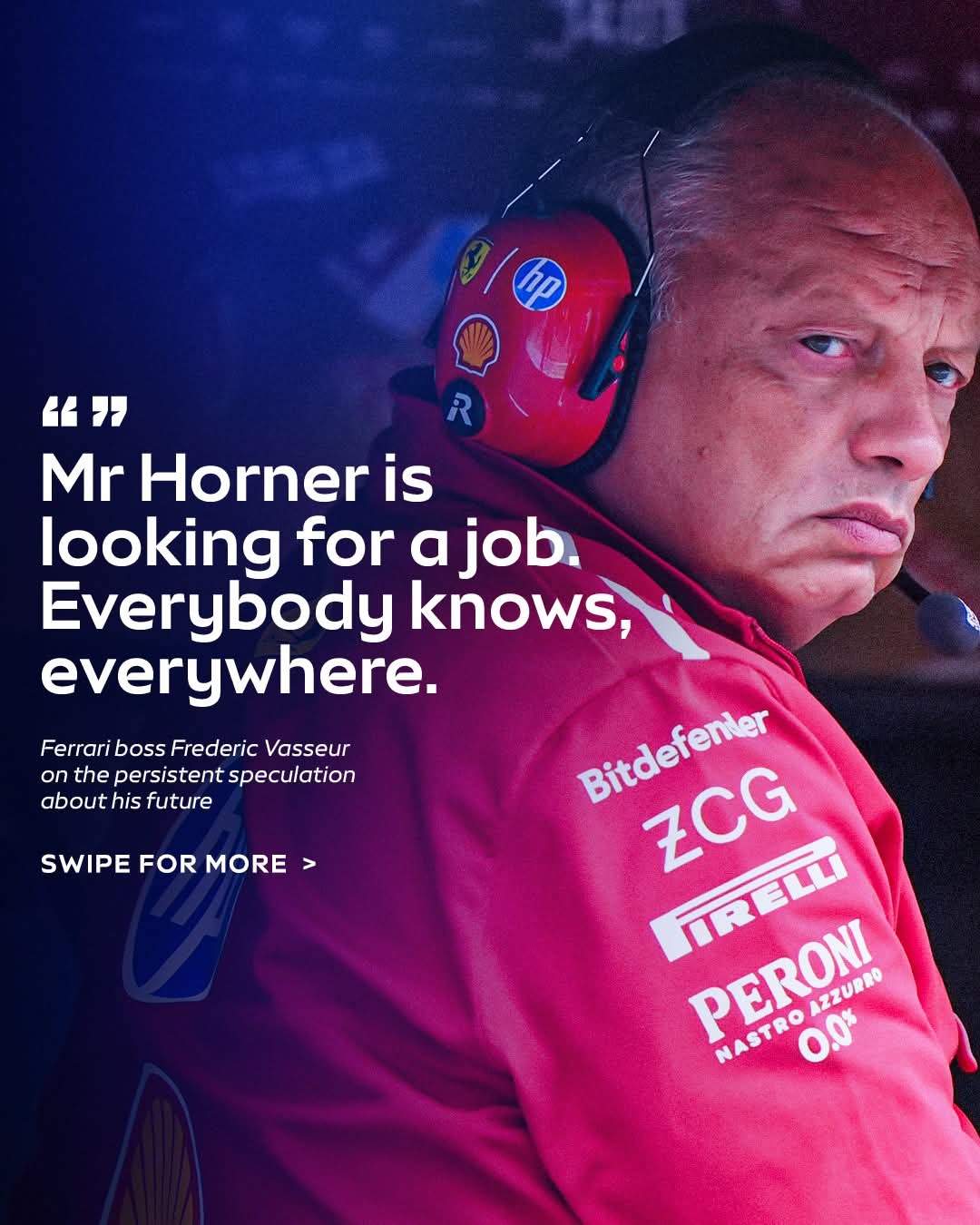
For Frederic Vasseur, who took charge at the beginning of the 2023 season, that pressure remains a constant part of the job.
VASSEUR’S FERRARI ERA HAS REACHED A CRITICAL STAGE
Vasseur became Ferrari’s fifth team principal in nine years when he replaced Mattia Binotto.
His arrival was viewed as an attempt to provide stability after several years of management changes.
Ferrari’s challenge, however, has always been bigger than simply changing the person in charge.
The team needs to consistently produce a car capable of fighting for victories and championships while maintaining operational stability across its technical and sporting departments.
That makes every difficult season particularly important.
If results improve, leadership stability becomes easier to maintain.
If results continue to disappoint, speculation about possible changes naturally becomes louder.
WHY CHRISTIAN HORNER’S NAME IS SO INTERESTING
Horner brings something unusual to the conversation: proven experience in building a championship-winning organisation.
He joined Red Bull’s Formula 1 operation when the team was still developing its identity and helped oversee its rise into a championship contender.
Under his leadership, Red Bull became a major force with drivers including Sebastian Vettel and Max Verstappen.
The team’s success was not created by one individual, of course.
Engineers, drivers, strategists, aerodynamicists and senior management all played important roles.
Nevertheless, Horner became one of the most recognisable team principals in modern Formula 1.
That experience is precisely why Villeneuve believes his record deserves consideration.
HORNER WOULD NOT BE A SIMPLE SOLUTION
However, replacing a team principal is never as straightforward as replacing one name with another.
Ferrari has a unique internal structure and culture.
A leader who succeeds at one organisation is not automatically guaranteed to produce the same results somewhere else.
Horner’s success at Red Bull was built alongside a particular technical philosophy, management structure and group of personnel.
Ferrari operates differently.
Any hypothetical move would therefore involve much more than simply putting Horner in the team principal’s office.
It would require adapting his leadership style to Ferrari’s existing organisation while potentially changing parts of the team’s wider structure.
VILLENEUVE’S “EJECTABLE SEAT” WARNING
Perhaps the most striking part of Villeneuve’s comments was his description of the Ferrari team principal’s position as an “ejectable seat.”
His point was straightforward: Ferrari’s history shows that leaders can come under enormous pressure when results fail to arrive quickly.
That pressure can make long-term planning difficult.
Formula 1 development programmes often require years rather than months to produce their full benefits.
Technical regulations change, personnel move between teams and car concepts can take time to mature.
Yet Ferrari’s reputation means patience can be difficult to maintain when the championship results do not meet expectations.
THE HORNER QUESTION IS BIGGER THAN ONE RUMOUR
There is a temptation whenever Horner’s name is linked with Ferrari to reduce the discussion to a simple question: Will he replace Vasseur?
The reality is considerably more complicated.
There is a difference between a driver, team principal or executive being discussed as a possible candidate and an actual agreement being reached.
Unless Ferrari or Horner confirms a future arrangement, speculation should remain exactly that.
What is not speculation is Horner’s record at Red Bull.
That record is the foundation for why his name carries weight whenever senior Formula 1 leadership positions are discussed.
FERRARI NEEDS MORE THAN A FAMOUS NAME
Another important point is that Ferrari’s competitive problems, when they arise, cannot automatically be solved by changing the team principal.
Formula 1 success depends on dozens of interconnected areas.
Aerodynamic development, chassis performance, power-unit efficiency, tyre management, strategy, pit stops, reliability and driver performance all contribute to championship results.
Leadership matters because it connects those departments and establishes priorities.
But a new team principal would still need the technical organisation around them to deliver.
That is why Ferrari’s long-term competitiveness cannot be judged solely by who sits at the top of the organisation.
THE BIGGER QUESTION FOR VASSEUR
For Vasseur, the challenge is therefore not simply dealing with Horner speculation.
His bigger task is demonstrating that Ferrari’s current project can deliver sustained competitive progress.
The longer Ferrari remains outside the position it expects to occupy, the more intense the questions surrounding its leadership become.
That is the environment Villeneuve was describing.
It is not necessarily a statement that Vasseur is about to lose his position.
Instead, it illustrates the reality of leading Ferrari: success creates security, while prolonged underperformance can quickly generate pressure.
WHAT HORNER’S RED BULL SUCCESS REALLY MEANS
Horner’s greatest asset in any hypothetical Ferrari discussion is his ability to operate within a championship-winning organisation.
Red Bull’s rise demonstrates that he has experience managing a team through periods of major growth, competitive pressure and championship success.
But Ferrari would present an entirely different challenge.
At Red Bull, Horner helped build a modern powerhouse.
At Ferrari, any leader would inherit one of the oldest and most scrutinised brands in Formula 1.
That difference could be just as important as Horner’s previous achievements.
FERRARI’S NEXT CHAPTER REMAINS UNCERTAIN
For now, the most accurate conclusion is that Ferrari’s leadership future remains a subject of speculation rather than a confirmed change.
Vasseur remains in charge, while Horner’s name continues to attract attention because of his extraordinary Red Bull record.
Villeneuve’s comments add another layer to the debate.
His message is essentially that Ferrari cannot ignore the experience and success Horner has accumulated, while anyone leading Ferrari must understand just how quickly pressure can increase when results fall short.
That creates an intriguing situation for the team.
Ferrari does not simply need a famous team principal.
It needs a leadership structure capable of turning enormous resources, talent and expectations into consistent championship-level performance.
Whether that ultimately involves Vasseur continuing his project, Horner entering the picture or another solution entirely remains an open question.
For now, one thing is clear: Ferrari’s leadership will remain under the microscope for as long as the team’s results fail to match the enormous expectations surrounding the Scuderia.