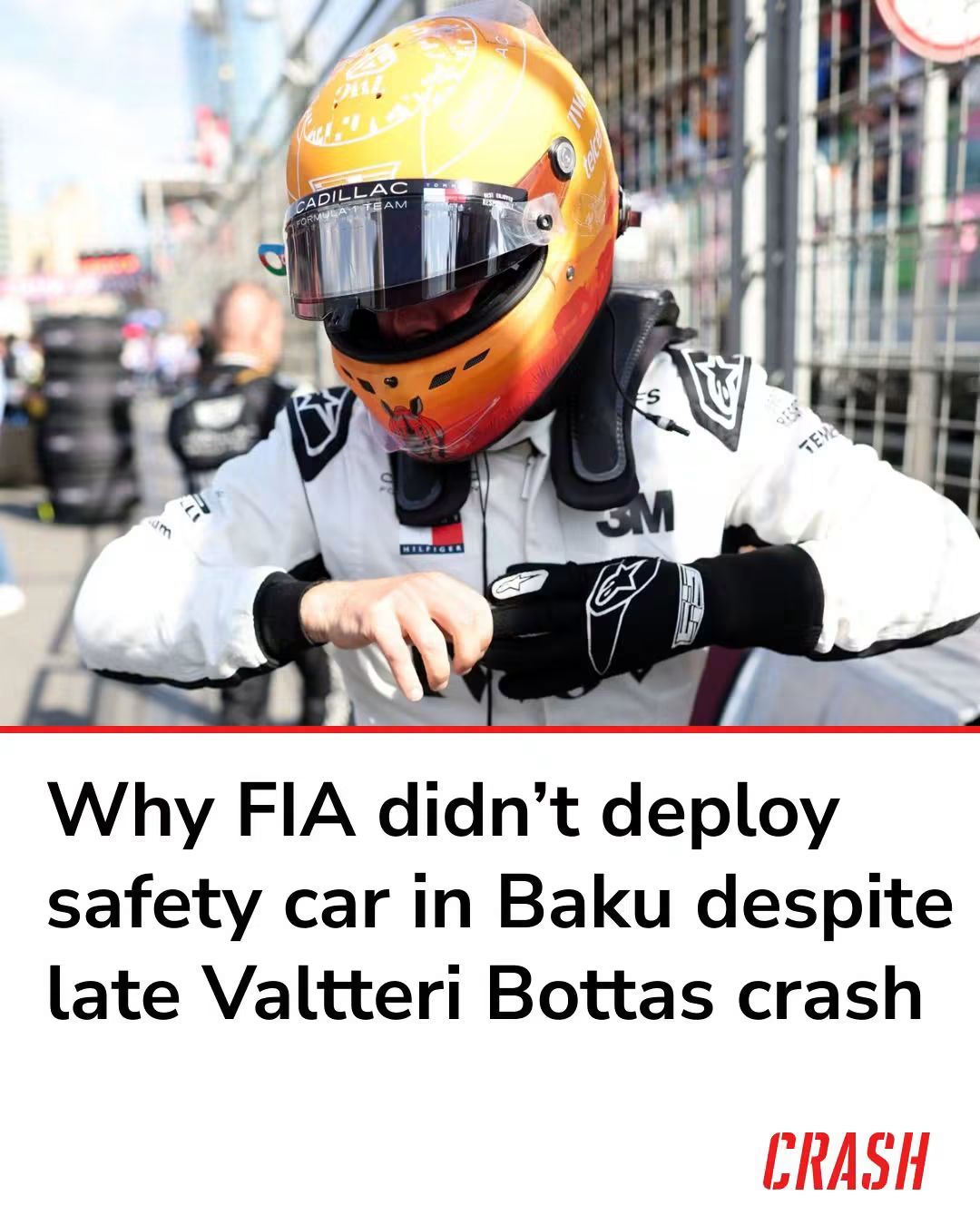
The streets of Baku rarely deliver a quiet afternoon, and the 2026 Azerbaijan Grand Prix proved no exception. As George Russell and Max Verstappen fought a thrilling final-lap duel for victory, Valtteri Bottas’s Cadillac slammed into the wall at Turn 15. Yellow flags appeared. The race continued under green-flag conditions with only local caution. No Safety Car. No Virtual Safety Car. The FIA later explained the decision through its stewards’ findings, and the reasoning reveals a lot about how modern Formula 1 balances risk, spectacle, and the realities of a street circuit.
WHAT ACTUALLY HAPPENED ON THE FINAL LAP
Bottas had already endured a difficult race. Running toward the back of the field, he reported a hybrid-system anomaly earlier on the same lap after running wide at Turn 1. The systems, he later told stewards, appeared to become confused by the extra distance driven. Approaching Turn 15 he suffered what he described as a “huge super-clip.” Only the front brakes seemed to respond properly. The rear end locked or failed to harvest energy as expected, and the Cadillac hit the barrier.
Bottas climbed out, replaced the steering wheel, and spent time inspecting the rear of the car. He believed a rear-brake issue may have contributed. Marshals and race control assessed the scene. The car was off the racing line at a relatively open section of the track. Double yellows (or single yellows depending on the exact sector) were shown. The leaders lifted, lost some power-unit boost in Russell’s case, and continued. Verstappen closed dramatically but finished 0.196 seconds behind. Bottas was classified 16th, two laps down after the accident.
THE FIA’S REASONING: LOCATION AND RISK ASSESSMENT
The stewards’ document makes the governing body’s position clear. After hearing from Bottas, the Cadillac team representative, and reviewing video evidence, they determined that the situation “did not present a significant level of danger.” The car’s position relative to the racing line and the prevailing track conditions meant a full Safety Car deployment was not required.
This is consistent with long-standing FIA practice. Safety Cars are not automatic every time a car stops. Race control weighs whether the vehicle or recovery activity creates an immediate hazard to others, whether the car can be moved quickly under local yellows, and whether marshals or equipment would be exposed. In this case the answer was no. Bottas’s decision to linger while inspecting the car was noted and gently criticized—he acknowledged he should have moved to a place of safety more promptly—but it did not escalate the overall risk enough to neutralize the entire field.
Compare this with incidents that do trigger a Safety Car: a car stopped in a high-speed blind area, debris covering the racing line, or the need for a crane. The 2014 Japanese Grand Prix tragedy involving Jules Bianchi still shapes protocol around recovery vehicles. When a crane is required, a full Safety Car almost always follows. Here, none was needed.
WHY THE DECISION MATTERS FOR DRIVERS, TEAMS, AND THE SPORT
For Russell the yellow flags created a momentary power-unit hiccup that nearly handed victory to Verstappen. A Safety Car would have completely rewritten the final-lap fight and possibly the result. For Bottas and Cadillac the incident underlined ongoing reliability struggles for the new American manufacturer. A technical issue that began earlier in the lap snowballed into a race-ending crash on the last tour of a demanding street circuit.
Broader implications touch the entire championship. Baku has a well-earned reputation for late drama. Nine consecutive Azerbaijan Grands Prix have featured at least one Safety Car, Virtual Safety Car, or red flag. Drivers and strategists plan around the high probability of interruptions. When race control elects not to deploy the Safety Car for a late, relatively contained incident, it preserves the sporting integrity of a close battle while still protecting competitors through yellow flags. It also reduces the chance of artificial bunching that can turn a processional race into a lottery.
Critics sometimes argue that consistency is lacking. Fans and rival teams occasionally question why one incident triggers neutralization and another does not. The FIA’s post-race explanation in this case provides transparency: location, residual danger, and the ability of local yellows to manage the risk were the deciding factors. That clarity helps teams calibrate their own risk assessments and radio messages in future similar situations.
LOOKING AHEAD: SAFETY PROTOCOLS IN AN ERA OF HIGH-SPEED STREET CIRCUITS
Formula 1’s safety record has improved dramatically over the past two decades, yet street circuits like Baku, Monaco, and Singapore continue to test the system. High walls, limited runoff, and the constant possibility of debris mean race directors must make split-second calls. The Bottas incident shows the current threshold: if the car is clear of the racing line and no recovery equipment is immediately required, yellow flags can suffice even late in a Grand Prix.
Expect continued scrutiny. Teams will analyze telemetry from Bottas’s hybrid and braking systems. The FIA will review whether driver education around promptly leaving a stricken car needs reinforcement. And race-control protocols will keep evolving as cars become more complex and circuits more demanding.
-
- In the end the decision allowed one of the closest finishes of the season to stand on its sporting merits. Russell held on. Verstappen came within a fifth of a second. Bottas walked away unharmed. The FIA judged the risk manageable under yellow flags alone—and, on the evidence available, that judgment held. In a sport where safety and spectacle constantly negotiate with each other, that balance is worth understanding.