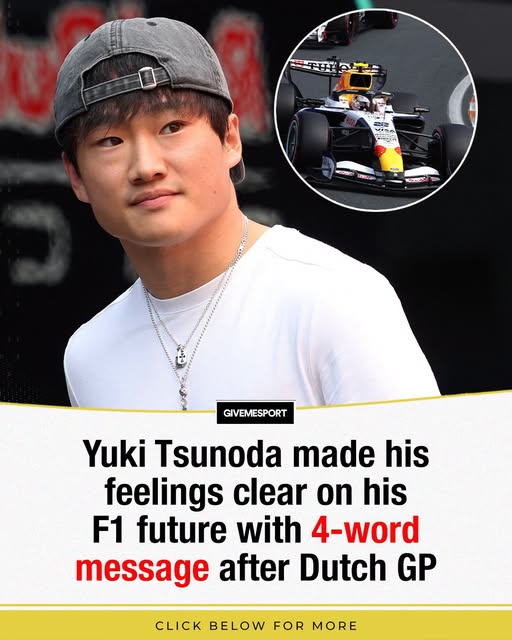
Yuki Tsunoda may have spent most of the 2026 season away from the Formula 1 grid, but his return at the Dutch Grand Prix has immediately reignited questions about his future.
The Japanese driver was called into action after Isack Hadjar was ruled out with a wrist injury, with Liam Lawson moving into Hadjar’s Red Bull seat and Tsunoda taking Lawson’s place at Racing Bulls. Despite having very limited preparation in the new-generation machinery, Tsunoda produced a performance that could have significant consequences for his 2027 prospects.
TSUNODA WASTED LITTLE TIME MAKING HIS CASE
Tsunoda qualified 12th and finished the sprint in 13th before matching his qualifying position in the Grand Prix. However, the final result did not tell the entire story.
He finished 11th, narrowly missing out on a points-paying position, while his teammate Arvid Lindblad dropped down the order. More importantly, Tsunoda looked increasingly comfortable as the race progressed.
His overtake on Pierre Gasly became one of the standout moments of his comeback. After months away from competitive F1 racing, Tsunoda showed the aggression and confidence that have been central to his reputation throughout his career.
That matters because teams evaluating drivers for 2027 will not simply look at the final classification. They will examine how quickly a driver adapted, how they handled the new regulations and how much performance they extracted from the machinery.
“THEY SHOULD CALL ME” — TSUNODA MAKES HIS POSITION CLEAR
After the race, Tsunoda was asked about his future and delivered a remarkably direct message:
“They should call me.”
It is only four words, but the message carries considerable weight.
Tsunoda knows his position. He is no longer guaranteed a place on the F1 grid, and his Dutch GP appearance came because circumstances suddenly opened a door. Rather than treating the weekend simply as an opportunity to fill in, however, he used it as an audition.
His argument is essentially straightforward: if teams are still deciding their 2027 line-ups, they should be looking at what he can offer.
THE EIGHT-MONTH ABSENCE MAKES HIS PERFORMANCE MORE INTERESTING
One of the most impressive aspects of Tsunoda’s weekend was the limited amount of actual track preparation he had completed.
The Japanese driver explained that he had only driven the new car four times in eight months, although Red Bull’s simulator programme helped him remain sharp.
That makes his ability to adapt particularly significant.
The 2026 regulations have introduced a substantially different generation of F1 machinery, meaning drivers who had already spent months learning the cars held an obvious preparation advantage. Tsunoda effectively had to compress that learning process into a very short period.
Yet he still finished just outside the points and demonstrated competitive racecraft.
TSUNODA’S BIGGEST CHALLENGE IS NOT SPEED — IT IS OPPORTUNITY
The Dutch GP may have strengthened Tsunoda’s case, but one strong weekend does not automatically guarantee a 2027 seat.
The biggest obstacle could be the number of available seats.
F1 teams have limited openings, and several young drivers are competing for those opportunities. Tsunoda therefore needs his Zandvoort performance to become more than a one-weekend highlight.
If Hadjar returns and Lawson resumes his normal role, Tsunoda could once again find himself watching from the sidelines. That would make his Dutch GP appearance particularly important because it reminded the paddock that there is still a proven F1 driver capable of stepping into a car and immediately producing a respectable performance.
THE DUTCH GP MAY HAVE CHANGED TSUNODA’S 2027 CONVERSATION
Before Zandvoort, Tsunoda’s future could easily have been viewed as a fading F1 story. After the race, that conversation has become considerably more interesting.
He demonstrated adaptability, overtaking ability and race composure despite having almost no recent race experience in the new-generation car.
Tsunoda himself appeared satisfied with what he achieved, saying he had given everything he could and believed his performance was positive.
Now the ball is effectively in the teams’ court.
“They should call me.”
For a driver fighting to remain in Formula 1, those four words were more than a soundbite. They were a public challenge to the teams deciding who deserves a seat on the 2027 grid.