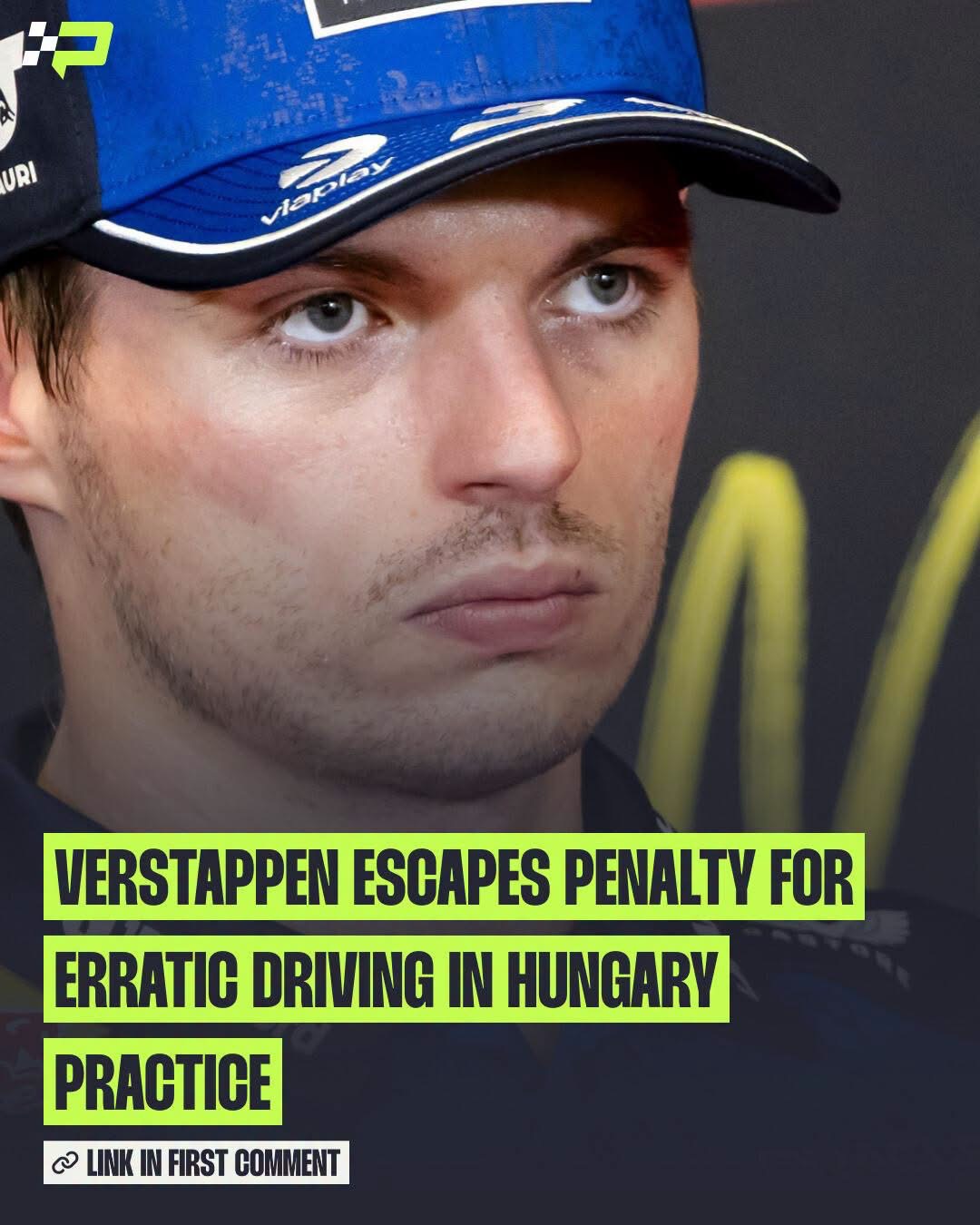
The FIA has officially decided to take no further action against Max Verstappen following an incident involving Carlos Sainz during the opening practice session of the Hungarian Grand Prix. The ruling ends a brief but closely watched investigation after the Red Bull driver was summoned to the stewards over what initially appeared to be retaliatory driving following an earlier obstruction by the Williams driver.
Although Verstappen escaped punishment, the episode once again highlighted the fine line Formula 1 drivers walk between expressing frustration on track and crossing into behavior that could warrant disciplinary action. With the championship entering a crucial stage before the summer break, every investigation involving a title contender inevitably attracts significant attention.
THE INCIDENT THAT PROMPTED THE FIA REVIEW
The drama unfolded during Friday’s FP1 session when Verstappen encountered a slow-moving Carlos Sainz approaching Turn 12. Forced to abandon his flying lap after moving off the racing line to avoid the Williams, Verstappen immediately showed his frustration.
Moments later, Verstappen slowed considerably on the exit of Turn 12 before the approach to Turn 13, appearing to gesture toward Sainz as the Spaniard drove past. The maneuver also occurred with Gabriel Bortoleto’s Audi nearby, prompting race control to investigate whether Verstappen’s actions constituted erratic driving or unnecessary obstruction.
Because of the potential safety implications, Verstappen was required to meet with FIA stewards after the practice session to explain his actions.
WHY THE STEWARDS CHOSE NOT TO PENALIZE VERSTAPPEN
Following a review of telemetry, onboard footage, team radio communications, and video evidence, FIA officials concluded that no sporting offense requiring a penalty had occurred.
A key factor in the decision was Carlos Sainz’s own testimony. The Williams driver reportedly informed the stewards that Verstappen’s actions did not affect his driving or compromise his session in any meaningful way. Officials also determined that no other driver had been impacted by the brief exchange.
As a result, the FIA opted against imposing any penalty, effectively closing the investigation after determining the incident amounted to a moment of frustration rather than dangerous conduct.
Sainz, however, reportedly received a warning regarding his role in the sequence after acknowledging communication issues with his team radio contributed to the earlier misunderstanding.
VERSTAPPEN’S FRUSTRATIONS REFLECT A DIFFICULT SEASON
While the Hungarian practice incident ultimately carried no sporting consequences, it reflects the broader frustrations surrounding Verstappen’s 2026 campaign.
The four-time world champion has yet to win a Grand Prix this season, managing only three podium finishes despite consistently extracting strong performances from a Red Bull package that has struggled to match Mercedes and Ferrari over race distance.
His best result remains second place in Austria, complemented by third-place finishes in Canada and Belgium. Those performances have kept him competitive, but they have not been enough to keep pace with the championship leaders.
Currently sitting seventh in the Drivers’ Championship, Verstappen faces an increasingly difficult task if he hopes to climb back into title contention before the season enters its final stages.
THE CHAMPIONSHIP AND CONTRACT STORY CONTINUES TO GROW
Beyond the results themselves, Verstappen’s future remains one of Formula 1’s biggest talking points.
Although his Red Bull contract runs through the end of 2028, widespread reports continue to suggest performance-related clauses could influence his long-term future if the team’s competitiveness does not improve. Speculation surrounding possible interest from rival teams has only intensified as Red Bull continues searching for answers.
While none of those discussions have been officially confirmed, Verstappen’s on-track frustrations naturally fuel further debate whenever incidents like Friday’s occur.
For Red Bull, the priority remains clear: provide Verstappen with a car capable of consistently challenging Mercedes and Ferrari before attention shifts entirely toward future driver market speculation.
WHY THE FIA’S DECISION MATTERS
The FIA’s handling of the investigation demonstrates that context remains critical when evaluating incidents during practice sessions.
Rather than reacting solely to appearances, officials relied on extensive evidence and direct testimony from the drivers involved before reaching their conclusion. That process reinforces Formula 1’s commitment to reviewing each case individually rather than automatically issuing penalties based on emotional exchanges.
As qualifying and the race weekend continue, Verstappen can now focus entirely on maximizing Red Bull’s performance without carrying the burden of disciplinary action. However, with championship points becoming increasingly valuable before the summer shutdown, every session—and every interaction on track—will continue to be scrutinized closely.
For now, the FIA has closed the case, but Verstappen’s battle to revive both Red Bull’s season and his championship hopes is far from over.