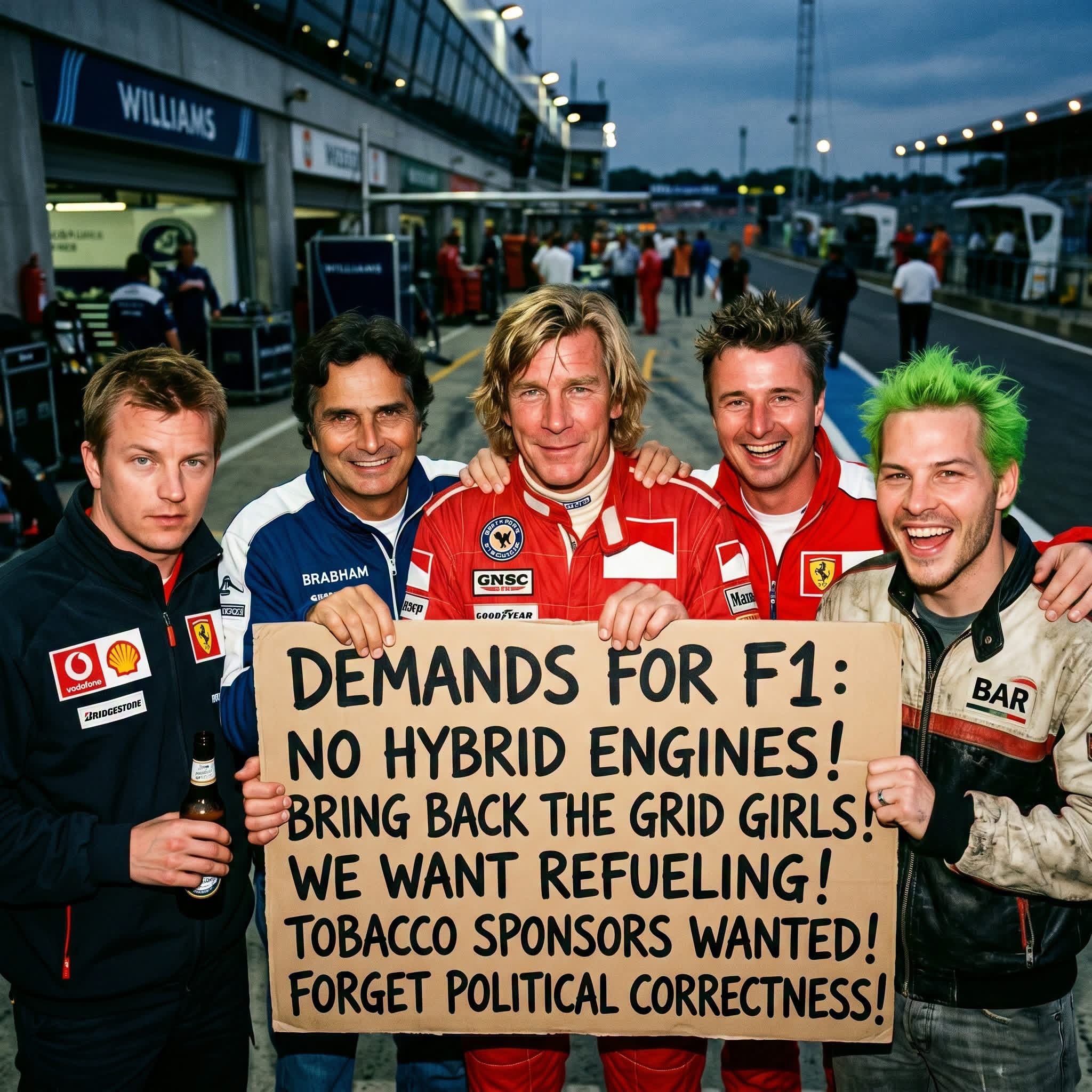
Formula 1 has always balanced innovation with nostalgia, but every few years the debate reignites over whether the sport has lost some of its raw, unpredictable character. An image circulating among fans captures that sentiment perfectly, showing several former Formula 1 personalities holding a sign demanding the return of some of the championship’s most controversial traditions. The board calls for the end of hybrid engines, the return of grid girls and in-race refueling, a comeback for tobacco sponsorship, and an end to what it describes as political correctness.
Whether viewed as a humorous throwback or a genuine criticism of modern Formula 1, the image reflects arguments that continue to divide fans across generations. While longtime followers often reminisce about the spectacle and danger of earlier decades, others argue today’s Formula 1 is stronger, safer, and more technologically advanced than ever before.
WHY THE HYBRID ENGINE DEBATE REFUSES TO DISAPPEAR
Few topics divide Formula 1 fans more than hybrid power units. Introduced in 2014, the turbo-hybrid era transformed the championship by prioritizing fuel efficiency, electrical energy recovery, and engineering excellence. Manufacturers such as Mercedes benefited enormously from the regulations, setting new standards for performance and efficiency.
However, critics argue that the hybrid era sacrificed one of Formula 1’s defining characteristics—the unforgettable roar of naturally aspirated V8 and V10 engines. Many fans believe the emotional connection between the cars and spectators diminished as engine noise became quieter and technical complexity increased.
Despite those criticisms, reversing course appears highly unlikely. Formula 1 has committed significant resources to sustainable technologies, and upcoming regulations continue pushing manufacturers toward cleaner fuels and more efficient power units. With automotive companies investing billions into electrification, Formula 1’s technological direction aligns closely with the broader automotive industry.
THE RETURN OF REFUELING: EXCITEMENT OR UNNECESSARY RISK?
Among the demands on the sign, bringing back refueling remains one of the most realistic discussion points.
Refueling was a strategic cornerstone of Formula 1 for years, creating dramatic pit-stop battles and allowing teams to pursue vastly different race strategies. Drivers could sprint on lighter fuel loads before diving into the pits, often changing the outcome of races through tactical brilliance rather than outright pace.
Yet Formula 1 eliminated refueling in 2010 primarily because of safety concerns and cost reduction. Several frightening pit-lane fires and fueling accidents highlighted the risks involved, while removing refueling simplified race operations and shifted greater emphasis onto tire management and overall race pace.
Although many fans miss the unpredictability it created, reintroducing refueling would require significant regulatory changes and renewed safety considerations that Formula 1 may be reluctant to embrace.
GRID GIRLS AND TOBACCO SPONSORS REMAIN HIGHLY SENSITIVE TOPICS
Perhaps the most controversial demands involve bringing back grid girls and tobacco sponsorship.
Grid girls were removed before the 2018 season as Formula 1 sought to modernize its image and present a more inclusive environment. Supporters of the previous tradition argued it was part of motorsport culture, while critics believed it no longer reflected the values the championship wanted to promote globally.
Similarly, tobacco sponsorship once defined Formula 1’s visual identity. Iconic liveries from Marlboro, Camel, Rothmans, Mild Seven, Benson & Hedges, and Lucky Strike became legendary among fans and collectors. However, tightening international advertising regulations gradually removed tobacco branding from motorsport, making a widespread return virtually impossible under current laws in many countries.
While nostalgic fans continue celebrating those classic liveries, the commercial landscape has fundamentally changed. Technology companies, financial firms, cryptocurrency brands, telecommunications businesses, and sustainability-focused partners now dominate Formula 1 sponsorship.
HAS FORMULA 1 BECOME TOO POLITICALLY CORRECT?
The final message on the sign reflects one of Formula 1’s most polarizing discussions.
Over the past decade, Formula 1 has increasingly addressed diversity, inclusion, environmental responsibility, and social awareness. Supporters argue these initiatives help the championship remain relevant to a global audience while encouraging positive change within motorsport.
Others believe the sport should focus exclusively on racing and avoid becoming involved in broader cultural or political conversations. That disagreement continues to generate passionate debate across social media, podcasts, and fan communities.
The challenge for Formula 1 is finding a balance between respecting its heritage and adapting to the expectations of modern audiences, sponsors, manufacturers, and host nations.
WHY FORMULA 1 IS UNLIKELY TO RETURN TO ITS PAST
While nostalgia remains one of Formula 1’s strongest emotional drivers, a wholesale return to earlier eras appears unrealistic.
Safety standards have evolved dramatically, manufacturers are investing heavily in sustainable technologies, governments maintain strict advertising regulations, and commercial partners expect Formula 1 to project a forward-looking image. These realities make many of the demands displayed on the sign difficult—if not impossible—to implement.
Instead, Formula 1 is more likely to preserve elements of its heritage through special liveries, historic demonstrations, fan experiences, and documentaries while continuing to innovate on the technical side.
WHAT THIS DEBATE MEANS FOR FORMULA 1’S FUTURE
Images like this resonate because they tap into a broader conversation about what Formula 1 should represent. For some, the sport’s golden era was defined by louder engines, greater unpredictability, iconic sponsorships, and a rebellious identity. For others, today’s Formula 1 offers closer competition, world-class engineering, improved safety, and a sustainable vision capable of attracting new fans and manufacturers.
The reality is that Formula 1’s future will likely continue blending tradition with innovation. Expect the championship to keep refining racing regulations to improve on-track action while maintaining its commitment to advanced technology and global growth. Nostalgia will always be part of Formula 1’s appeal, but the sport’s long-term success will depend on evolving rather than attempting to recreate a past that existed under very different circumstances.
Editor’s Note: The uploaded image appears to be a staged or edited scene featuring people holding a sign with various demands. It should not be treated as evidence that the individuals shown actually made or endorsed those statements.


Get back to basics!!! This is not a Prius or Tesla, its a RACE CAR!!! Put a proper gasoline/petrol engine with manual gearbox in the car and go racing!!