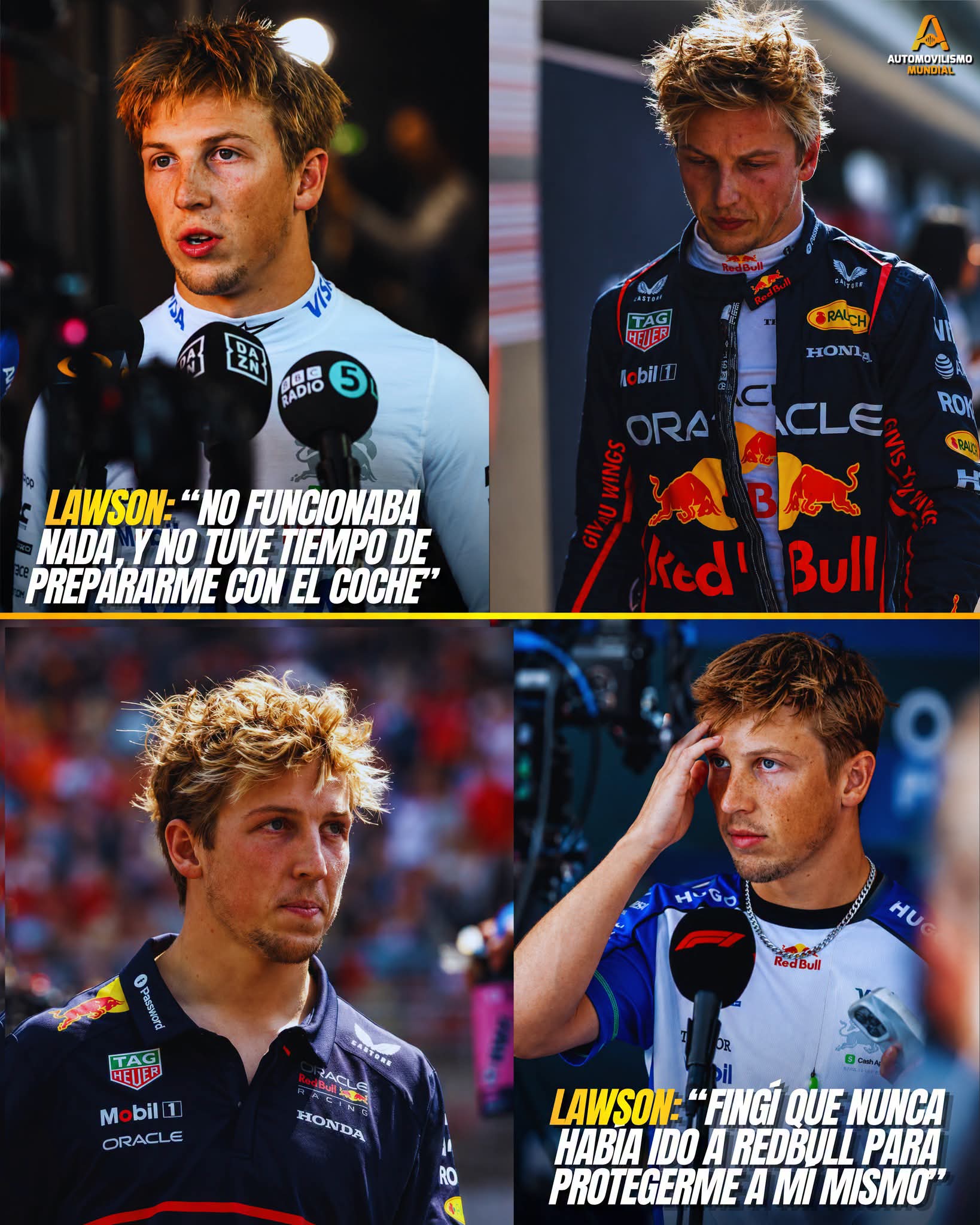
Liam Lawson has finally spoken publicly about one of the most controversial driver decisions of the 2026 Formula 1 season, and his version of events paints a dramatically different picture from the one that was presented by Red Bull at the time.
The New Zealander’s brief stint alongside Max Verstappen lasted just two race weekends before Red Bull made the brutal decision to send him back to Racing Bulls. While team management publicly suggested the move was made partly to protect Lawson amid mounting pressure, the driver himself has now firmly rejected that narrative.
His comments have reopened debate about Red Bull’s driver management approach and raised serious questions about whether young talents are being given a fair opportunity to succeed in one of Formula 1’s most demanding environments.
LAWSON REJECTS RED BULL’S PUBLIC EXPLANATION
For months, the dominant story surrounding Lawson’s demotion was that Red Bull acted out of concern for a driver struggling under immense pressure.
Lawson, however, insists that version of events is far from accurate.
According to the New Zealander, he was never battling the kind of mental collapse that many fans were led to believe. Instead, he argues that the team created a narrative that conveniently justified a decision that had already been made.
His frustration appears to stem from the fact that the discussion shifted away from performance and development and toward a story that portrayed him as unable to cope with Formula 1’s pressures.
For a driver fighting to establish himself at the highest level of motorsport, that perception can be extremely damaging.
THE CHINA GAMBLE THAT CHANGED EVERYTHING
One of the most revealing aspects of Lawson’s recent comments centers around the Chinese Grand Prix weekend.
According to him, Red Bull elected to make a radical setup change to the RB21 in an attempt to better understand the car’s behavior and unlock performance.
The move was reportedly far outside normal race-weekend procedures and represented a significant experiment by the team.
When the gamble failed to produce the desired results, Lawson claims the disappointing performance was later used as evidence against him.
From his perspective, the situation feels deeply unfair.
A driver agreeing to help the team gather data and test solutions is one thing. Having the consequences of that experiment become a key factor in losing a coveted Formula 1 seat is another entirely.
That distinction lies at the heart of Lawson’s criticism.
DID RED BULL ACT TOO QUICKLY?
Perhaps the strongest argument in Lawson’s favor is the limited amount of time he received.
Two races is an incredibly small sample size in modern Formula 1.
Adding further complexity was the fact that both opening events took place at circuits where Lawson lacked extensive experience compared to many of his rivals.
Formula 1 history is filled with examples of drivers who needed time before finding their rhythm.
Even world champions have endured difficult starts after changing teams or adapting to unfamiliar machinery.
Lawson believes he was denied that opportunity.
His view is that judgment arrived before adaptation could occur.
Whether fans agree or disagree, it is difficult to ignore how quickly the decision was made.
THE RED BULL SECOND SEAT PROBLEM CONTINUES
Lawson’s story is not unfolding in isolation.
Over the last decade, multiple talented drivers have struggled when promoted alongside Max Verstappen.
Pierre Gasly arrived with enormous potential but lasted only half a season. Alex Albon faced similar difficulties. Sergio Perez experienced occasional success but ultimately found himself unable to consistently match Verstappen’s level. Yuki Tsunoda also failed to secure a long-term solution to Red Bull’s second-seat dilemma.
Now Lawson’s name has joined that growing list.
The recurring pattern has fueled ongoing criticism that the team creates an environment where the margin for error is virtually nonexistent.
When every race weekend becomes a survival test, development can quickly become impossible.
Young drivers often need confidence to grow. Constant pressure can have the opposite effect.
WHY MAX VERSTAPPEN’S SHADOW LOOMS SO LARGE
Part of the challenge stems from Verstappen himself.
The Dutchman has become one of the most complete drivers Formula 1 has ever seen. His ability to extract performance from difficult cars often masks underlying issues that teammates struggle to manage.
When Verstappen adapts instantly while others require time, comparisons become brutal.
This creates a situation where teammates are not merely competing against rival drivers. They are competing against an extraordinary benchmark operating inside the same garage.
For Red Bull management, the temptation to compare every driver directly against Verstappen is understandable.
The problem is that almost nobody in Formula 1 history would consistently win that comparison.
LAWSON’S RESPONSE HAS BEEN IMPRESSIVE
What makes this story particularly interesting is what happened after the demotion.
Many drivers would have allowed frustration to consume them.
Instead, Lawson has rebuilt his reputation at Racing Bulls.
The New Zealander has emerged as the team’s leading scorer and has delivered some of the strongest performances of his Formula 1 career. His pace, confidence, and racecraft have all improved significantly since returning to the junior squad.
Ironically, the demotion that many viewed as a career setback may have become a turning point.
Lawson now looks more composed, more experienced, and more determined than ever.
WHAT THIS MEANS FOR RED BULL’S FUTURE
The controversy surrounding Lawson arrives at an uncomfortable time for Red Bull.
Questions continue to surround the team’s driver development system, while competitors such as Mercedes and Ferrari appear increasingly patient with their young talents.
If Red Bull wants to continue producing future stars, it may eventually need to reconsider how quickly it evaluates drivers placed in one of Formula 1’s toughest seats.
The team’s ruthless approach has delivered championships, but it has also created a trail of talented drivers whose confidence and momentum suffered after promotions that ended almost before they began.
Lawson’s comments ensure that debate will not disappear anytime soon.
A STORY THAT IS FAR FROM OVER
For Liam Lawson, this is about more than one lost seat.
It is about reputation, opportunity, and proving that his Formula 1 journey should never have been defined by two difficult weekends.
His recent performances suggest he is determined to let results speak louder than controversy.
Whether he eventually earns another shot at a top team remains uncertain.
But one thing is becoming increasingly clear: Lawson refuses to accept the narrative that his Red Bull dream ended because he wasn’t good enough.
And if his current trajectory continues, Formula 1 may soon discover that Red Bull’s decision was far more complicated than it first appeared.