The 2026 Belgian Grand Prix produced one of the most controversial afternoons of the Formula 1 season, with FIA stewards forced to investigate multiple high-profile incidents involving Ferrari. While Andrea Kimi Antonelli strengthened his grip on the Drivers’ Championship with another commanding victory, much of the post-race conversation centered on Ferrari’s penalties, Lewis Hamilton’s clash with George Russell, Charles Leclerc’s contact with Oscar Piastri, and an unsafe pit release that ultimately resulted in a hefty financial punishment for the Italian team.
Although Hamilton retained fourth place after the race, Ferrari left Spa with a significant fine and fresh questions surrounding its race-day execution, while the FIA’s inconsistent rulings became the dominant talking point across the paddock and among Formula 1 fans worldwide.
FERRARI’S BELGIAN GRAND PRIX WAS FILLED WITH DRAMA
Ferrari entered the Belgian Grand Prix hoping to challenge Mercedes for victory, but instead found itself at the center of nearly every major incident during the race.
Hamilton’s afternoon immediately became complicated after first-lap contact with former Mercedes teammate George Russell. The collision sent Russell spinning into the gravel and ended his race almost instantly, dealing a massive blow to his championship campaign.
Race stewards reviewed the incident and handed Hamilton a five-second time penalty, concluding that he was responsible for the collision despite acknowledging mitigating circumstances, including reduced grip and turbulent air.
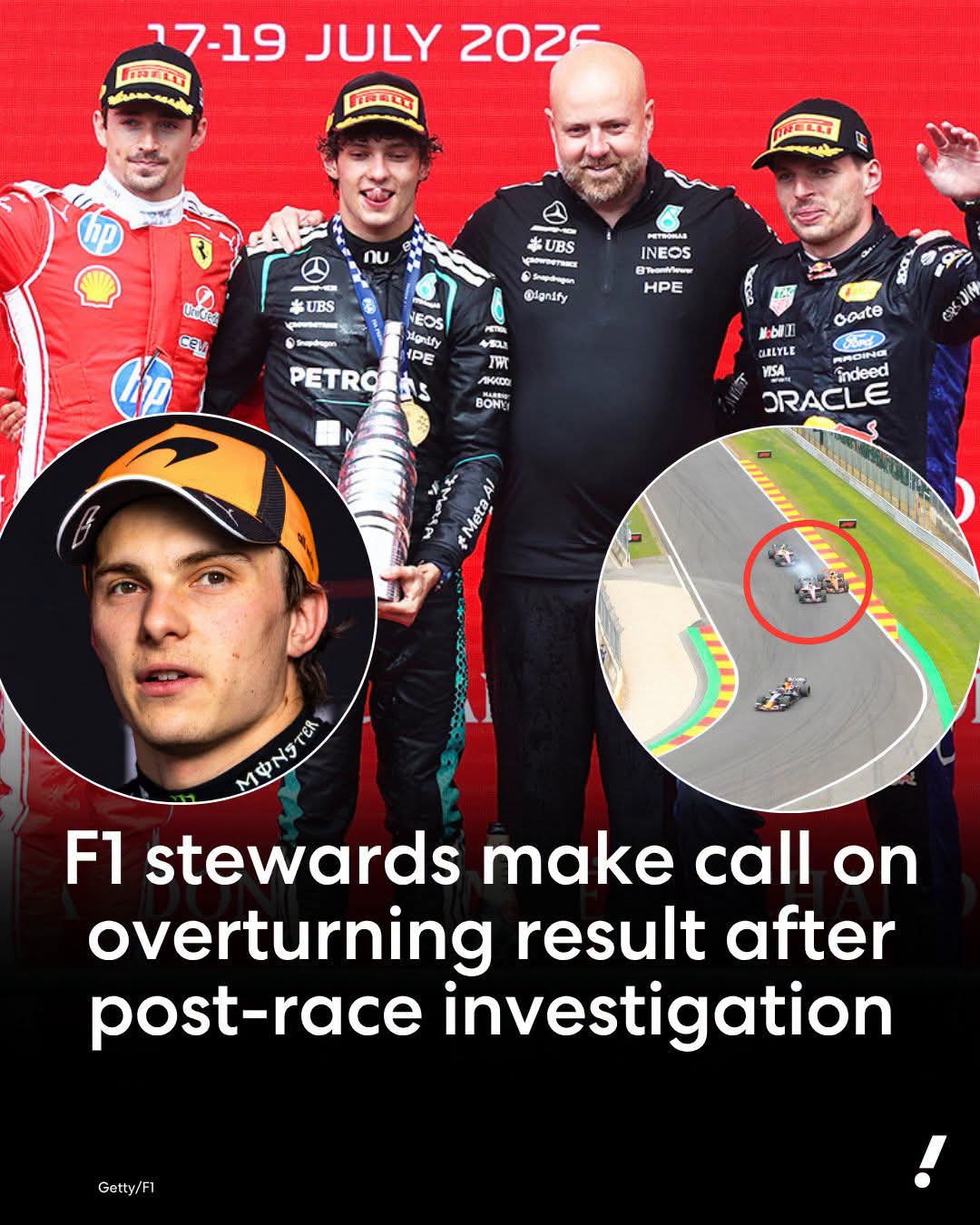
Later in the race, teammate Charles Leclerc became involved in another controversial incident after making contact with Oscar Piastri while defending his position. Unlike Hamilton, however, Leclerc escaped without any sporting penalty, allowing him to finish second behind Antonelli.
The contrasting decisions immediately divided fans, analysts, and former drivers.
UNSAFE PIT RELEASE RESULTS IN $50,000 FINE
Ferrari’s troubles didn’t end on track.
During a Virtual Safety Car period, Hamilton entered the pits to serve his penalty and switch tyres. At the same time, Ferrari attempted to adjust his damaged front wing.
As Hamilton received the green release signal and accelerated away, one of Ferrari’s mechanics was still completing the wing adjustment. The mechanic was knocked to the ground but fortunately escaped without injury.
Following an investigation, the FIA concluded that Ferrari’s release procedure was unsafe.
Rather than penalizing Hamilton, race officials fined Ferrari €30,000, with an additional €10,000 suspended for 12 months, creating a total financial penalty equivalent to roughly $50,000 AUD.
Ferrari admitted that the incident resulted from late communication regarding the front-wing adjustment, confusion within the garage, and the mechanic’s failure to react before the release signal.
LECLERC DECISION CREATES BIGGER DEBATE THAN HAMILTON PENALTY
While Hamilton’s penalty generated headlines, many within Formula 1 questioned why Leclerc escaped punishment altogether.
Piastri suffered front-wing damage after Leclerc squeezed him toward the edge of the circuit during an overtaking attempt. The McLaren driver immediately reported over team radio that he believed insufficient racing room had been left.
Although race control investigated the incident, the stewards ruled that no further action was necessary, determining that Leclerc had followed the normal racing line and that Piastri had not established enough overlap to claim the corner.
That explanation failed to convince much of the Formula 1 community.
Several prominent analysts argued that Leclerc’s move appeared more deserving of a penalty than Hamilton’s earlier contact with Russell, leading to widespread criticism of the FIA’s consistency.
SOCIAL MEDIA REACTS TO FIA’S CONTRASTING DECISIONS
Formula 1 fans were quick to express frustration after comparing the outcomes of the two Ferrari-related investigations.
Many argued that Hamilton’s opening-lap collision represented a classic first-lap racing incident where reduced grip, heavy traffic, and compressed field conditions naturally increase the likelihood of contact.
At the same time, critics believed Leclerc’s move against Piastri involved a more obvious lack of racing room yet received no sporting consequence.
The differing verdicts reignited an ongoing debate surrounding steward consistency, one of Formula 1’s most frequently discussed issues in recent seasons.
Whenever similar incidents produce different outcomes, questions inevitably arise about how penalties are judged and whether clearer standards are needed.
PIASTRI’S RACE WAS COMPROMISED DESPITE A STRONG RECOVERY
For Oscar Piastri, the Leclerc collision significantly altered the trajectory of his race.
Although he managed to continue, the damaged front wing affected the balance of his McLaren during the opening stint, making tyre management and overall pace considerably more difficult.
Piastri later admitted that the contact had major consequences for his race, even though the team eventually recovered enough performance to secure fifth place.
The result limited the damage, but McLaren will likely leave Belgium feeling frustrated after another race where operational execution and stewarding decisions combined to prevent a stronger finish.
ANTONELLI TAKES FULL ADVANTAGE IN THE TITLE FIGHT
Lost amid the controversy was another outstanding drive from Andrea Kimi Antonelli.
The Mercedes rookie converted pole position into his sixth victory of the season, extending his championship advantage while both of his closest rivals endured difficult afternoons.
Russell retired without scoring, while Hamilton’s penalty prevented him from mounting a serious challenge for victory.
As a result, Antonelli strengthened both his Drivers’ Championship lead and Mercedes’ position atop the Constructors’ standings.
With Hungary now approaching before Formula 1’s summer break, Antonelli enters the next round carrying both momentum and a growing psychological advantage over the rest of the field.
WHY THE BELGIAN GRAND PRIX COULD HAVE LONG-LASTING CONSEQUENCES
The Belgian Grand Prix may ultimately be remembered less for Antonelli’s victory than for the controversies surrounding Ferrari and the FIA.
Ferrari leaves Spa having demonstrated competitive race pace, yet operational mistakes and costly incidents prevented the team from fully capitalizing on its performance.
Meanwhile, the FIA now faces renewed scrutiny over steward consistency after two remarkably similar racing situations produced very different outcomes.
As the championship battle intensifies, every decision carries greater importance. A single five-second penalty, an unsafe release, or a disputed no-penalty call could ultimately influence both world titles.
With several races still remaining, Formula 1’s fight for championship glory may depend just as much on consistency in the stewards’ room as it does on performance on the racetrack.