Formula 1 has always been built on a fascinating question that nobody can answer with complete certainty: how much of success comes from the driver, and how much comes from the car?
For decades, fans have debated whether championships are won by exceptional talent behind the wheel or by engineering brilliance in the factory. Every generation has produced arguments comparing legends from different eras, with supporters often wondering what would happen if every driver had access to identical machinery.
Now, Carlos Sainz has proposed perhaps the most radical solution Formula 1 has ever heard.
The Spaniard recently suggested an idea so revolutionary that it would fundamentally transform the championship as we know it. While even Sainz admits it is unlikely to ever happen, the proposal has reignited one of the biggest debates in motorsport history.
THE CRAZY IDEA THAT HAS F1 TALKING
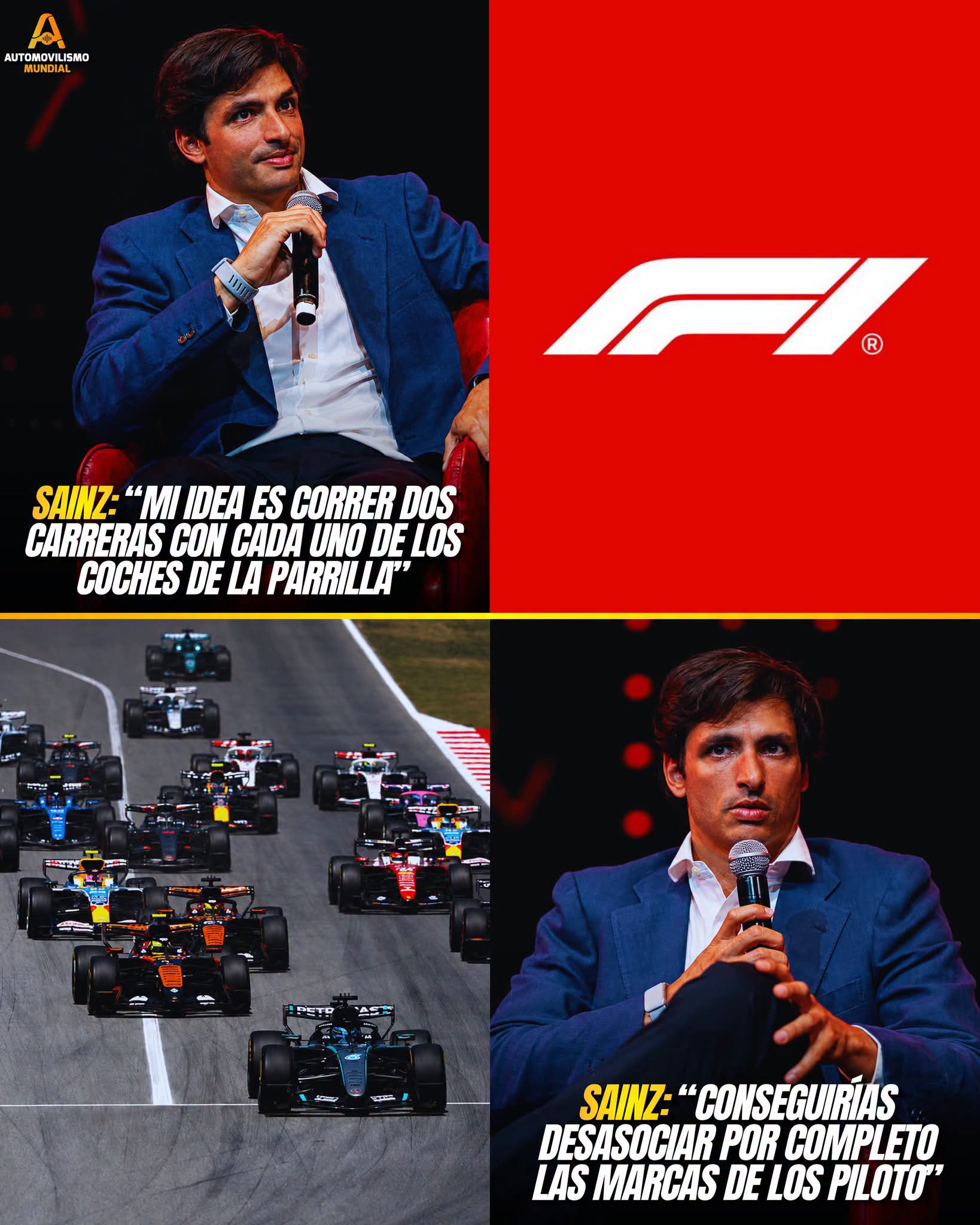
Speaking during an interview, Sainz floated what he described as a “crazy idea” for the future of Formula 1.
His proposal is simple in theory but extraordinary in practice.
Instead of drivers remaining with a single team throughout the season, every driver would race every car on the grid. A competitor would spend two races in a Williams, two in a Ferrari, two in a McLaren, two in a Mercedes, two in a Red Bull, and continue rotating through the entire field.
Under this system, drivers would effectively be contracted directly by Formula 1 rather than by individual teams.
The result would be a championship where every competitor receives identical opportunities across the season, removing the traditional advantage of being paired with the fastest car.
It’s a concept that sounds almost impossible, yet it raises some fascinating questions.
THE QUESTION FANS HAVE ASKED FOR GENERATIONS
Formula 1’s greatest debates often revolve around hypothetical scenarios.
Would Max Verstappen dominate if he spent an entire season in a midfield car? Could Lewis Hamilton have won championships in weaker machinery? How would Charles Leclerc perform in a dominant Red Bull? Would Lando Norris or George Russell thrive in Ferrari?
These discussions never end because there is no definitive answer.
Drivers are evaluated within the context of their machinery. While exceptional talents often outperform their teammates, the reality is that Formula 1 remains a sport where the car plays a massive role in determining results.
Sainz’s proposal attempts to eliminate that uncertainty completely.
If every driver competed in every car, the final standings would theoretically reveal who extracted the most performance across all machinery.
For many fans, that sounds like the ultimate test of driving ability.
WHY THIS IDEA IS IMPOSSIBLE TO IGNORE
At first glance, the concept appears absurd.
Formula 1 is built around manufacturers, constructors, sponsors, technical partnerships, and driver development programs. Teams invest hundreds of millions of dollars designing cars specifically around their philosophies and objectives.
Removing permanent driver-team relationships would overturn the entire business model of the sport.
Ferrari’s identity is built around its drivers. Mercedes develops long-term projects around its talent. Red Bull has spent years creating one of the most successful driver academies in motorsport history.
Under Sainz’s proposal, much of that structure would disappear.
Yet despite the obvious obstacles, the idea resonates because it addresses a genuine frustration shared by many fans.
People want to know who the fastest driver truly is.
WHAT THE CURRENT SYSTEM GETS RIGHT
While Sainz’s concept is intriguing, Formula 1’s existing format remains one of its greatest strengths.
The championship is unique because it combines human talent with engineering excellence.
Unlike spec-series racing categories where every competitor drives identical machinery, Formula 1 rewards innovation. Teams compete not only through their drivers but also through aerodynamic development, power unit performance, strategy, and technical creativity.
This combination creates storylines that make Formula 1 special.
The battle between teams is just as important as the battle between drivers.
Without that element, Formula 1 would become a very different sport.
IMAGINE THE CHAOS OF A ROTATING GRID
Although unrealistic, imagining such a championship is fascinating.
Max Verstappen could spend one weekend fighting for victory in a Red Bull before battling to escape Q1 in a struggling car the following race.
Lewis Hamilton might showcase his experience across multiple platforms, while younger stars like Kimi Antonelli could prove their adaptability against seasoned veterans.
The championship standings would constantly shift as drivers adjusted to dramatically different handling characteristics, team cultures, and technical approaches.
Adaptability would become the most valuable skill on the grid.
Rather than mastering one car, drivers would need to master ten.
It would be one of the toughest challenges motorsport has ever seen.
WHY SAINZ’S COMMENTS MATTER
Even if the proposal never progresses beyond a theoretical discussion, Sainz has highlighted an important issue.
Modern Formula 1 often places enormous emphasis on machinery.
When one team dominates, critics frequently argue that the car deserves more credit than the driver. Conversely, talented drivers trapped in uncompetitive machinery can struggle to demonstrate their full potential.
Sainz’s idea forces fans and decision-makers to reconsider how success is measured in Formula 1.
It raises legitimate questions about competitive balance, talent evaluation, and the role technology should play in determining champions.
Those conversations are valuable even if the proposal itself remains unrealistic.
THE FUTURE OF FORMULA 1 WILL LOOK VERY DIFFERENT
Formula 1 continues evolving at a rapid pace.
The sport has embraced sprint races, budget caps, new technical regulations, and growing global audiences. Concepts that once seemed impossible have become reality over time.
While a rotating-driver championship remains extraordinarily unlikely, elements of Sainz’s thinking could influence future discussions about competitive fairness and sporting formats.
The FIA and Formula 1 management are constantly searching for ways to improve racing and maintain fan interest.
Bold ideas often start as impossible dreams before becoming serious conversations.
A FANTASY THAT REVEALS A DEEPER TRUTH
Carlos Sainz may have described his proposal as a crazy idea, but it touches on one of Formula 1’s most enduring mysteries.
Fans will always wonder who the best driver truly is when separated from the machinery beneath them.
The reality is that Formula 1’s magic comes from never fully knowing the answer.
It is a sport where engineering brilliance meets extraordinary human talent, where drivers and cars are inseparable parts of the same equation.
Sainz’s vision would certainly create the fairest driver comparison in history.
But it might also remove the very element that has made Formula 1 the pinnacle of motorsport for more than seven decades: the constant battle between man, machine, and innovation.