The fallout from the 2026 Monaco Grand Prix refuses to fade away.
What initially appeared to be a routine post-race penalty has evolved into one of the most controversial stewarding disputes of the Formula 1 season, with Mercedes formally challenging the FIA over its decision to reinstate Pierre Gasly’s podium finish.
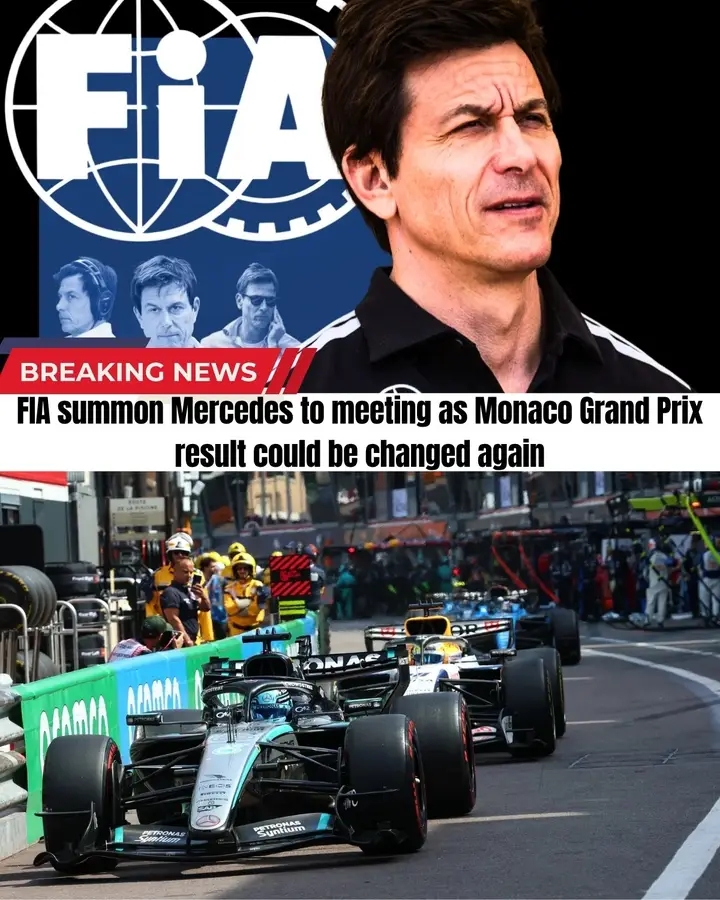
The case has now reached another critical stage after Formula 1’s governing body summoned Mercedes representatives to a hearing regarding the team’s request for a right of review. While Monaco was expected to be remembered for its on-track action around the famous streets of Monte Carlo, the race is increasingly being defined by questions surrounding officiating, procedural accuracy, and competitive fairness.
With multiple teams now involved and the possibility of further legal arguments ahead, the controversy has become much bigger than a single podium position.
HOW THE MONACO PITLANE CONTROVERSY BEGAN
The drama started shortly after the chequered flag in Monaco.
Alpine driver Pierre Gasly initially crossed the finish line in third place, securing what appeared to be a valuable podium finish for the French team. However, stewards later handed him a five-second time penalty for exceeding the pitlane speed limit.
Gasly was not alone. Several drivers were penalized after being found marginally above the 60 km/h limit, with some violations reportedly measuring just 0.1 km/h over the threshold.
As a result of the penalty, Gasly was demoted to fourth place, while Red Bull rookie Isack Hadjar inherited a surprise podium finish.
At the time, the FIA’s ruling appeared straightforward. The regulations regarding pitlane speed limits are normally among the clearest and least controversial rules in Formula 1.
That assumption would not last long.
THE DISCOVERY THAT CHANGED EVERYTHING
Following the race, Alpine launched a right of review concerning Gasly’s penalty.
During the investigation, officials discovered a significant issue with the pitlane measurement system used during the Monaco weekend.
According to the subsequent findings, the pitlane had been measured as approximately 77 meters longer than drivers were actually able to travel. This discrepancy had a direct impact on the calculations used to determine whether drivers exceeded the speed limit.
The revelation immediately raised serious questions.
If the measurement itself was inaccurate, could the penalties issued during the race truly be considered valid?
The FIA ultimately concluded that Gasly’s penalty should be overturned, restoring his third-place finish and removing Hadjar from the podium.
While Alpine celebrated the decision, the move created a fresh wave of frustration elsewhere in the paddock.
WHY MERCEDES BELIEVES GEORGE RUSSELL WAS DISADVANTAGED
No team has been more vocal than Mercedes.
George Russell’s race became significantly complicated by the pitlane penalty situation. Beyond the original sanction, Russell also received additional punishment related to how the penalty was served during the race.
Mercedes argues that the chain reaction created by the original speeding decision fundamentally altered Russell’s afternoon.
Had those penalties never existed, the team believes Russell could have been fighting for a podium finish himself.
Team principal Toto Wolff has publicly expressed frustration with the process and reportedly consulted legal advisors as Mercedes evaluated its options.
From the team’s perspective, the issue is not simply about Gasly’s reinstated podium. Instead, Mercedes believes the correction of one driver’s result should trigger a wider examination of all competitors who may have been affected by the same flawed measurement.
FIA SUMMONS MERCEDES TO IMPORTANT HEARING
The next chapter in the dispute will take place during a formal FIA hearing.
Mercedes has submitted its own petition for review, and the governing body has now called team representatives to appear before stewards.
The hearing will be conducted in two stages.
First, stewards must determine whether Mercedes’ petition is admissible under FIA regulations. The team must demonstrate that there is a significant and relevant new element that was unavailable when the original decision was made.
Only if that threshold is met will a second phase be conducted to examine the substance of the case and determine whether any additional action is warranted.
This procedural hurdle is important because right-of-review requests are notoriously difficult to win in Formula 1. Teams must present genuinely new evidence rather than simply disagreeing with an earlier decision.
WHY RED BULL AND MCLAREN ARE ALSO WATCHING CLOSELY
Mercedes is not the only team with a vested interest in the outcome.
Reports indicate that both Red Bull and McLaren have also raised concerns regarding the FIA’s handling of the situation.
The reason is simple.
Any decision that changes a race classification has consequences that extend far beyond a single driver. Championship points, prize money distributions, sponsorship exposure, and strategic outcomes can all be affected.
When race results are altered days after an event concludes, rival teams naturally want assurance that the process is transparent, consistent, and fair.
The growing number of stakeholders involved has transformed what began as a technical pitlane issue into a paddock-wide debate about governance and accountability.
THE BIGGER PROBLEM FOR THE FIA
Perhaps the most damaging aspect of the controversy is the reputational impact on the FIA itself.
Formula 1 relies heavily on confidence in officiating. Drivers, teams, sponsors, and fans must trust that rules are being applied consistently and accurately.
When measurement errors emerge after a race has ended, questions inevitably follow.
Could similar mistakes have occurred elsewhere?
What safeguards exist to prevent such issues from happening again?
And how quickly should governing bodies act when errors are discovered?
The FIA now faces the difficult challenge of resolving the current dispute while also reassuring the entire paddock that its systems remain reliable.
COULD THE MONACO RESULTS CHANGE AGAIN?
The possibility cannot be completely ruled out.
While many observers believe it is unlikely that Monaco’s final classification will undergo another major revision, Formula 1 has seen surprising legal and regulatory outcomes before.
If Mercedes successfully demonstrates that Russell suffered competitive harm as a direct consequence of an invalid penalty process, stewards may be forced to consider additional remedies.
However, revising race results after the fact remains an extraordinary measure and one the FIA will likely approach with extreme caution.
The governing body must balance fairness with the need for finality in sporting results.
WHAT THIS MEANS FOR THE 2026 CHAMPIONSHIP
Every point matters in modern Formula 1.
Whether the battle involves drivers fighting for the world championship, teams chasing Constructors’ Championship positions, or midfield squads competing for millions in prize money, even a handful of points can have enormous consequences.
That reality explains why Mercedes is continuing to pursue the matter despite the long odds.
The dispute also serves as a reminder that championships are not decided solely by what happens on track. Administrative rulings, steward decisions, and regulatory interpretations can sometimes play a decisive role in shaping a season.
As Formula 1 heads toward the Austrian Grand Prix, the Monaco controversy remains unresolved, and the sport may not yet have heard the final word on one of the most unusual officiating disputes in recent memory.
FINAL THOUGHTS
The Monaco Grand Prix was supposed to showcase Formula 1 at its most glamorous and prestigious. Instead, it has become a case study in how small technical errors can create enormous sporting consequences.
Mercedes’ challenge is about more than George Russell or Pierre Gasly. It is a test of how Formula 1 handles mistakes, reviews controversial decisions, and maintains trust in its rulebook.
The upcoming FIA hearing could ultimately change nothing. But regardless of the outcome, the controversy has already sparked an important conversation about accuracy, transparency, and accountability at the highest level of motorsport.
And with several teams now scrutinizing the process, the pressure on the FIA has never been greater.