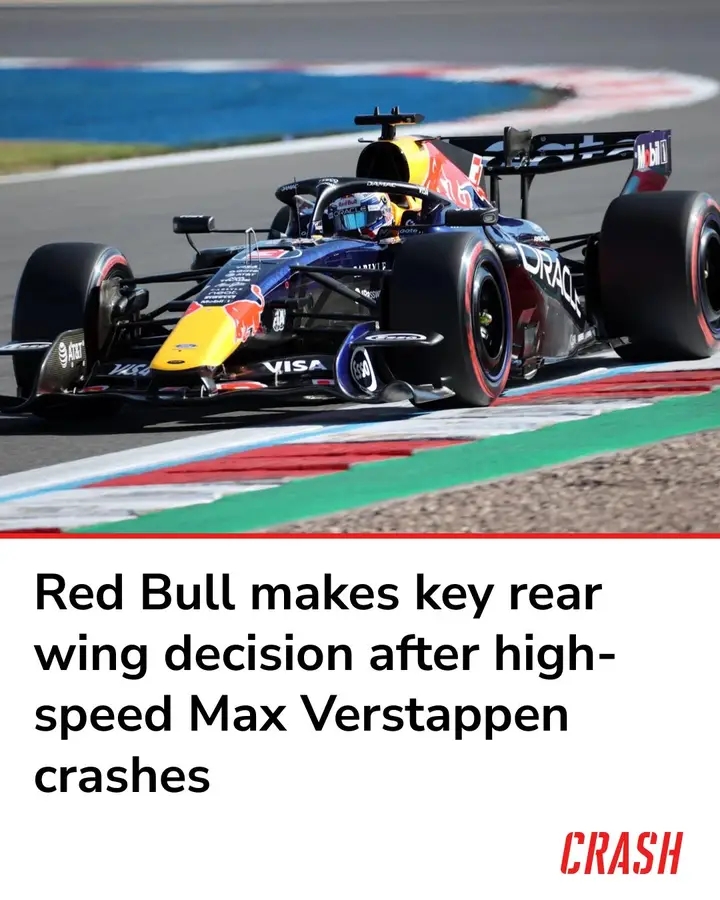
Red Bull Racing has moved quickly to address the rear wing problems that recently caused major concern after one of the failures contributed to Max Verstappen’s crash. The incident raised fresh questions about the team’s reliability at a time when every point is becoming increasingly valuable in the Formula 1 championship.
While Red Bull has remained one of the sport’s benchmark teams in recent years, even the strongest organizations are vulnerable when technical problems emerge. Rear wing failures are particularly alarming because they directly affect the car’s aerodynamic stability, especially through high-speed corners where drivers rely on maximum downforce and confidence. For a driver like Verstappen, who consistently pushes the limits, even a minor structural issue can have significant consequences.
WHY THE REAR WING FAILURE IS A MAJOR CONCERN
Formula 1 cars are designed with incredibly sophisticated aerodynamic packages, and the rear wing is one of the most critical components. It generates downforce that keeps the rear of the car planted on the track while balancing drag for straight-line speed.
When a rear wing begins to fail or flex beyond acceptable limits, the driver can instantly lose stability. At high speeds, that loss of grip can be impossible to recover from, making crashes almost inevitable.
The recent incident involving Verstappen demonstrated exactly how serious such a failure can become. Rather than being viewed as an isolated problem, it immediately triggered an internal review to ensure similar issues do not occur again during the remainder of the season.
RED BULL MOVES QUICKLY TO FIX THE PROBLEM
Reports indicate that Red Bull has already implemented measures to strengthen and inspect its rear wing assembly following the recent failures. The team’s engineering department has focused on identifying the root cause, whether it involved structural fatigue, excessive loading, manufacturing defects, or unexpected aerodynamic forces.
Formula 1 operates with extremely fine engineering tolerances, meaning even a small weakness can become critical after hundreds of kilometers of racing. By reacting quickly, Red Bull hopes to restore confidence before another costly incident damages its championship ambitions.
Fast technical responses have long been one of Red Bull’s greatest strengths. The Milton Keynes-based team has built its reputation on rapidly identifying problems and introducing effective solutions without sacrificing performance.
THE IMPACT ON MAX VERSTAPPEN
For Verstappen, reliability is just as important as outright pace.
The Dutch driver has repeatedly shown that he can maximize every opportunity, but mechanical failures remain one of the few factors completely outside his control. Losing points because of technical issues is especially frustrating when championship rivals continue to capitalize on every race weekend.
Driver confidence is another important factor. Formula 1 drivers attack fast corners with complete trust that the car beneath them will behave exactly as expected. After experiencing a rear wing failure, rebuilding that confidence becomes an important part of returning to peak performance.
Fortunately for Red Bull, Verstappen has demonstrated throughout his career that he can quickly move past setbacks and immediately focus on the next race.
WHAT THIS MEANS FOR RED BULL’S CHAMPIONSHIP HOPES
Modern Formula 1 championships are often decided by remarkably small margins. A single retirement caused by reliability can ultimately determine the outcome of an entire season.
That makes Red Bull’s response especially important. Preventing another failure is worth far more than recovering from one after it happens. Every finish, every podium, and every championship point becomes increasingly valuable as the season progresses.
If the updated rear wing solution proves successful, Red Bull can shift its attention back toward maximizing performance instead of worrying about reliability. However, another similar incident would inevitably raise further scrutiny from both the FIA and rival teams.
RIVALS WILL BE WATCHING CLOSELY
Every technical development in Formula 1 attracts attention from competing teams, and Red Bull’s latest changes will be no exception.
Teams such as McLaren, Ferrari, Mercedes, and Aston Martin constantly monitor one another’s upgrades, searching for competitive advantages while ensuring every component complies with FIA regulations.
If Red Bull’s revised rear wing delivers improved durability without sacrificing aerodynamic efficiency, it could become another example of the team’s ability to solve problems faster than its competitors.
ENGINEERING RESILIENCE OFTEN DECIDES CHAMPIONSHIPS
History has shown that championship-winning teams are not those that avoid every problem, but those that respond to setbacks more effectively than everyone else.
Red Bull has consistently demonstrated an ability to recover from difficult moments through rapid engineering improvements and strong operational execution. The latest rear wing modifications represent another test of that capability.
As Formula 1 enters one of the most demanding stages of the season, reliability could become just as decisive as outright speed. Verstappen remains one of the grid’s fastest drivers, but maintaining a dependable car will be essential if Red Bull hopes to stay firmly in the championship fight.
With the rear wing concerns now being addressed, attention shifts back to the racetrack. The coming races will reveal whether Red Bull has fully eliminated the issue or whether further refinements will be needed in what is shaping up to be an increasingly competitive Formula 1 season.