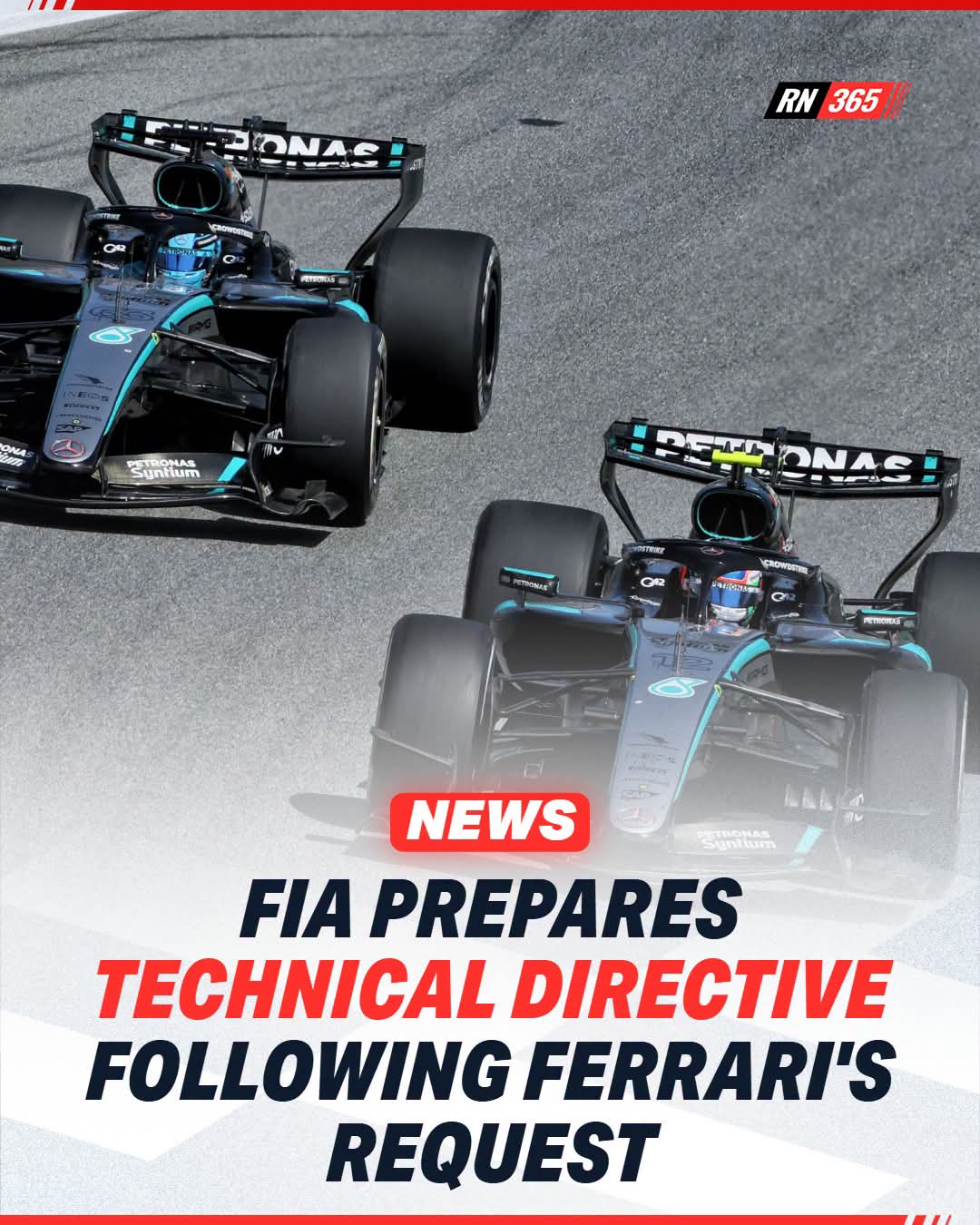
Formula 1’s latest technical controversy may be about to erupt just as the championship battle reaches a critical stage. Reports suggest the FIA is preparing a clarification regarding an innovative diffuser design introduced by Mercedes, following concerns raised by Ferrari over the legality of the concept.
The issue centers around a rear diffuser upgrade that Mercedes recently introduced as part of its ongoing effort to maintain its advantage at the front of the grid. While innovation has become one of the defining themes of Formula 1’s new 2026 regulations, not every breakthrough survives scrutiny from rivals—or the FIA.
Now, with Ferrari requesting clarification and the governing body reportedly preparing an official response, Mercedes could be facing an unexpected challenge that has the potential to influence both championships.
THE DIFFUSER AT THE CENTER OF THE STORM
The diffuser plays a crucial role in modern Formula 1 aerodynamics. Positioned at the rear underside of the car, it helps accelerate airflow beneath the floor, generating significant downforce while minimizing drag.
Mercedes’ latest design reportedly features additional diffuser extensions aimed at increasing aerodynamic efficiency and rear-end stability. The concept is believed to have contributed to the team’s strong performance throughout the early stages of the 2026 campaign.
With the introduction of Formula 1’s new regulations this season, engineers have been given greater freedom to explore creative solutions. That freedom has already produced several eye-catching innovations across the grid.
Ferrari and Red Bull, for example, have attracted attention with their rotating rear-wing concept nicknamed the “Macarena” wing. Mercedes’ diffuser now joins the growing list of innovations pushing the limits of the rulebook.
WHY FERRARI GOT INVOLVED
In Formula 1, rival teams constantly monitor each other’s developments.
When a team introduces a potentially game-changing innovation, competitors typically ask themselves two questions: Can we copy it? And is it legal?
Ferrari’s request for clarification suggests the Italian team wanted the FIA to provide a definitive interpretation of the regulations governing Mercedes’ diffuser design.
Such inquiries are common throughout Formula 1 history. Teams frequently seek guidance from the FIA to determine whether a rival’s concept falls within the intended framework of the rules.
Sometimes the result is straightforward approval. Other times, the FIA concludes that a design exploits a gray area that requires clarification.
That appears to be the situation unfolding now.
FIA PREPARES TECHNICAL CLARIFICATION
According to reports, the FIA is preparing documentation that could effectively redefine how diffuser extensions are interpreted under the 2026 regulations.
If implemented, the clarification may prevent teams from replicating Mercedes’ solution and could potentially require modifications to existing designs.
The Austrian Grand Prix has reportedly emerged as the target event for introducing the clarification.
However, the situation remains fluid.
Mercedes is understood to be lobbying for a delay until the British Grand Prix at Silverstone, arguing that logistical constraints make immediate compliance difficult.
The team’s equipment and race transport have already been dispatched to Austria, meaning redesigning and manufacturing alternative components on short notice would create significant operational challenges.
MERCEDES INSISTS THE DESIGN IS LEGAL
From Mercedes’ perspective, the controversy is straightforward.
The team believes its current floor and diffuser package complies fully with the existing regulations. Engineers developed the concept based on the FIA’s published rules and introduced it through normal development procedures.
That distinction matters.
The issue does not appear to involve allegations of cheating or deliberate rule-breaking. Instead, it centers on differing interpretations of technical wording within a brand-new rulebook.
This is an important difference because Formula 1’s most famous technical disputes often emerge not from obvious violations but from creative engineering solutions that stretch regulatory intent.
History is filled with examples, from double diffusers to flexible wings and innovative suspension concepts.
WHY THE TIMING MATTERS
The timing could hardly be more significant.
Mercedes currently finds itself in a fierce championship battle against Ferrari, with Red Bull also attempting to close the gap through aggressive development.
Any forced modification to a key aerodynamic component could affect performance, particularly at a stage of the season where margins are incredibly small.
Even a minor reduction in aerodynamic efficiency could influence:
Qualifying performance
Tire management
Race pace consistency
Overall championship momentum
The impact might not be dramatic overnight, but in a season where tenths of a second separate multiple teams, every aerodynamic gain matters.
AUSTRIA COULD BECOME A POLITICAL BATTLEGROUND
The Austrian Grand Prix was already expected to be one of the most important weekends of the season.
Mercedes is bringing updates focused on reliability and performance. Ferrari is introducing the latest phase of its engine development programme. Red Bull arrives under immense pressure to improve its competitiveness at its home circuit.
Now the diffuser controversy adds another layer of intrigue.
Discussions between FIA officials, technical directors, and team representatives could become almost as important as the action taking place on track.
Formula 1 championships are often won not only through speed but also through how effectively teams navigate technical and political challenges.
Austria could prove to be a prime example.
WHAT HAPPENS NEXT?
Several scenarios remain possible.
The FIA could decide that Mercedes’ current interpretation is acceptable, allowing the design to remain unchanged.
Alternatively, the governing body may introduce a clarification that takes effect immediately, forcing modifications before or during the Austrian weekend.
A third possibility is a compromise solution, granting Mercedes additional time to comply before Silverstone.
The latter option may be the most practical given the logistical realities involved in Formula 1’s tightly packed race calendar.
Regardless of the final outcome, the controversy highlights how aggressively teams are pursuing performance gains under the new regulations.
WHY THIS STORY COULD SHAPE THE CHAMPIONSHIP
Technical battles often become defining moments in Formula 1 seasons.
When one team discovers an innovative solution, rivals inevitably react. Sometimes those developments survive and become standard across the grid. Other times, they trigger regulatory intervention that reshapes the competitive landscape.
Mercedes’ diffuser may become one of the most important technical stories of the 2026 season.
If the design is restricted, Ferrari and Red Bull could gain valuable ground. If Mercedes successfully defends its interpretation, it may strengthen its position at the front and reinforce confidence in its engineering direction.
Either way, the battle extends far beyond a single aerodynamic component.
It represents another chapter in Formula 1’s endless war between innovation, regulation, and competitive advantage—and the outcome could influence who ultimately lifts the championship trophies at the end of the season.