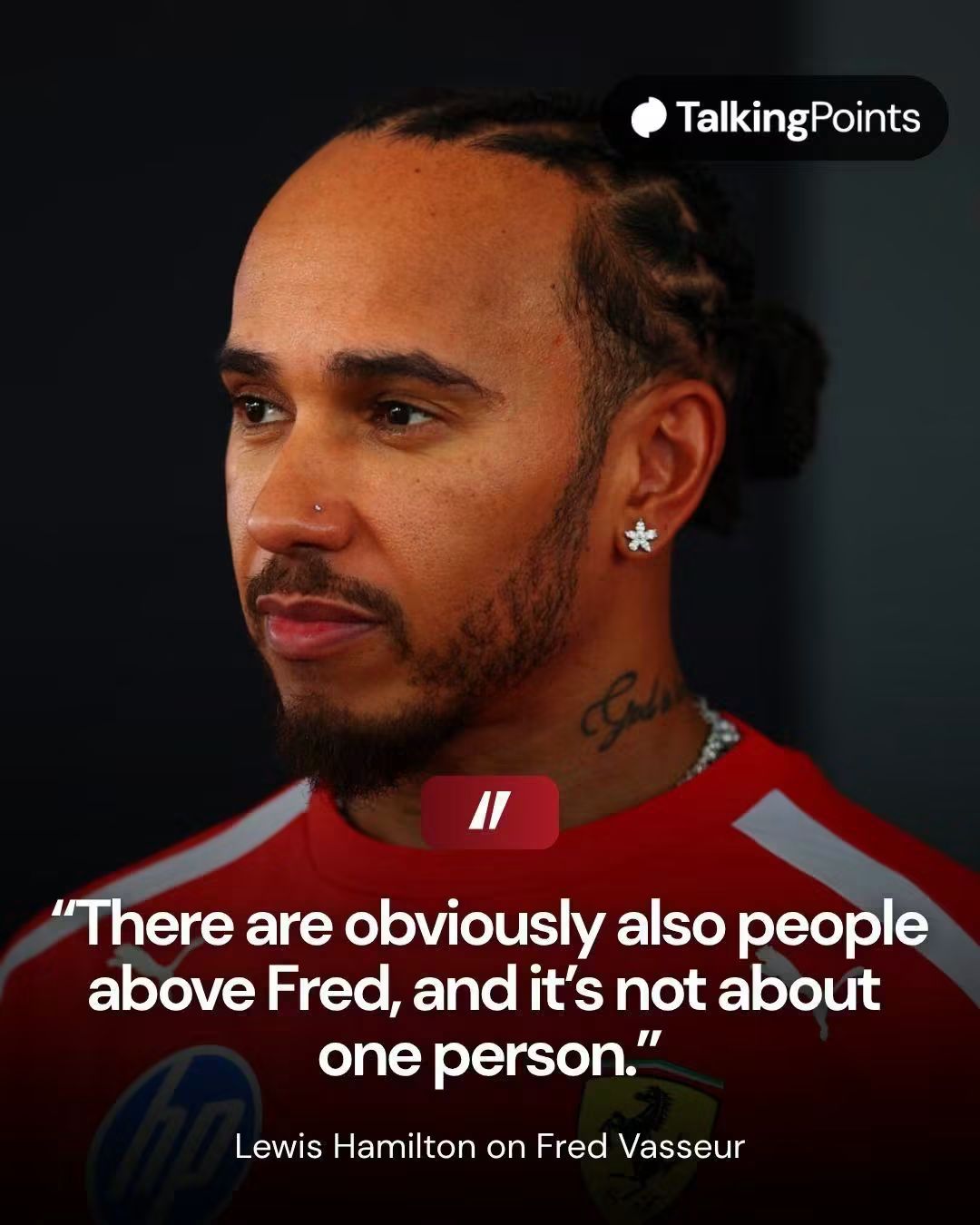
Lewis Hamilton has drawn a clear line in the sand. Amid swirling rumors, media pressure, and questions about Ferrari’s direction, the seven-time world champion has made it plain: team principal Fred Vasseur should not carry the blame alone for the Scuderia’s recent challenges. In comments that cut through the noise, Hamilton pointed higher up the corporate ladder and insisted that swapping out the Frenchman would do more harm than good.
The message is straightforward and significant. Ferrari sits second in the constructors’ championship after meaningful progress under Vasseur’s leadership. Yet the familiar cycle of scrutiny has returned. Hamilton’s intervention reframes the conversation from one man’s performance to the broader structure that surrounds him.
WHY HAMILTON IS STANDING FIRMLY BEHIND VASSEUR
Hamilton’s defence is not polite corporate speak. He described Vasseur as the right person to lead the team forward, noting the stability and improvements already delivered. Ferrari has swapped team principals with alarming regularity in recent years. Hamilton highlighted that the current setup feels more solid than previous iterations and credited Vasseur with helping drive the team to its present position.
He went further. Replacing Vasseur, he argued, would set the project back. The foundations for future competitiveness have been laid. Consistency matters more than another round of upheaval. Hamilton also stressed that their personal working relationship remains strong and that he fully supports the Frenchman staying in place.
This is not blind loyalty. Hamilton has been vocal when things fall short. He has pushed for internal changes and expects high standards. His current stance therefore carries extra weight. It signals that the driver who joined Ferrari seeking titles still believes the current leadership can deliver them.
THE PEOPLE ABOVE: STRUCTURE, STABILITY AND SHARED RESPONSIBILITY
Hamilton did not stop at defending Vasseur. He explicitly noted that Formula 1 teams are not one-man operations. There are people above the team principal who form part of the overall picture. Critics, he suggested, should point fingers elsewhere if they want to assign blame.
At Ferrari that hierarchy includes executive chairman John Elkann and CEO Benedetto Vigna. The racing team operates within a much larger corporate entity that also oversees road cars and other commercial interests. Decision-making, resource allocation, long-term technical direction, and cultural priorities are influenced at those higher levels.
Hamilton’s experience at Mercedes provides useful context. There, Toto Wolff combines team principal duties with significant ownership and operational control. That concentrated authority creates clear accountability and rapid decision-making. Ferrari’s model is different. The team principal reports into a broader corporate structure. Hamilton’s comments invite scrutiny of whether that structure is optimally aligned for the intensity of modern Formula 1.
Stability and everyone “rowing in the same direction” matter enormously in this sport. When messages, priorities, or resource decisions are not fully synchronized, even a talented group of engineers and drivers can struggle to extract maximum performance week after week.
THE REALITY OF FERRARI’S 2026 PERFORMANCE
Context is essential. Ferrari has fielded a competitive car this season and sits second in the constructors’ standings—a clear step forward from previous campaigns. Hamilton has spoken of the car’s underlying strength while acknowledging a persistent power unit deficit of roughly four tenths of a second. That gap is difficult to overcome on pure pace alone.
Driver management and race execution have also drawn attention at times, including earlier intra-team friction that required clear conversations. Vasseur has addressed those moments directly with both Hamilton and Charles Leclerc. Both drivers have publicly reaffirmed confidence in their team principal.
Outside noise has been intense. Speculation linking former Red Bull boss Christian Horner to the role circulated widely enough that Ferrari felt compelled to issue statements of support. Hamilton described much of the external narrative as an attempt to break the team’s spirit—an effort he insists is failing because the people inside continue working hard.
WHY THIS STORY MATTERS FOR FERRARI AND FORMULA 1
Ferrari is not just another team. It is the most iconic brand in the championship, carrying expectations that dwarf those of almost every rival. When results fall short of those expectations, pressure intensifies on every level. Constant leadership changes have historically disrupted continuity in Maranello. Hamilton’s call for consistency and broader structural reflection is therefore more than internal politics—it is a practical argument about how championship-winning organizations are built and sustained.
The impact extends beyond one team. Successful Formula 1 outfits require clear lines of authority, technical excellence, cultural cohesion, and the ability to protect their people from external storms. When a driver of Hamilton’s stature publicly questions whether the upper structure needs examination, it forces a wider industry conversation about governance models. Ownership, corporate oversight, and pure racing leadership do not always sit comfortably together.
For the athletes, the difference is tangible. Drivers need confidence that their feedback is heard, that strategic decisions are coherent, and that the long-term project is stable. For engineers and factory staff, frequent leadership churn creates uncertainty. For the championship itself, a strong Ferrari is good for the spectacle and the commercial health of the sport.
LOOKING AHEAD: PREDICTIONS AND THE PATH FORWARD
Ferrari’s immediate task is to close the power unit gap and convert car potential into consistent results. Technical progress on the 2027 package will be critical. Equally important is whether the organization acts on the broader points Hamilton raised. Structural reviews do not always produce dramatic public announcements, but they can refine decision-making speed, resource prioritization, and cultural alignment.
Vasseur is likely to remain in post in the short term. Hamilton’s public backing, combined with the team’s official statements of confidence, reduces the immediate pressure. Longer term, the test will be results and internal coherence. If the car continues to improve and the team avoids self-inflicted drama, the current leadership will gain further credibility. If frustrations persist without corresponding progress, the conversation about higher-level accountability will only grow louder.
Hamilton’s intervention is valuable precisely because it resists the simplest narrative. Blaming the team principal is easy and familiar. Examining the full organizational picture is harder and more constructive. In a sport where margins are measured in hundredths of a second and seasons are decided by cumulative excellence, that distinction matters.
Ferrari has the talent, the history, and the resources to compete at the front. Whether it fully unlocks them depends on more than one individual. Hamilton has made that point clearly. The question now is whether the people above are listening as carefully as the rest of the paddock.