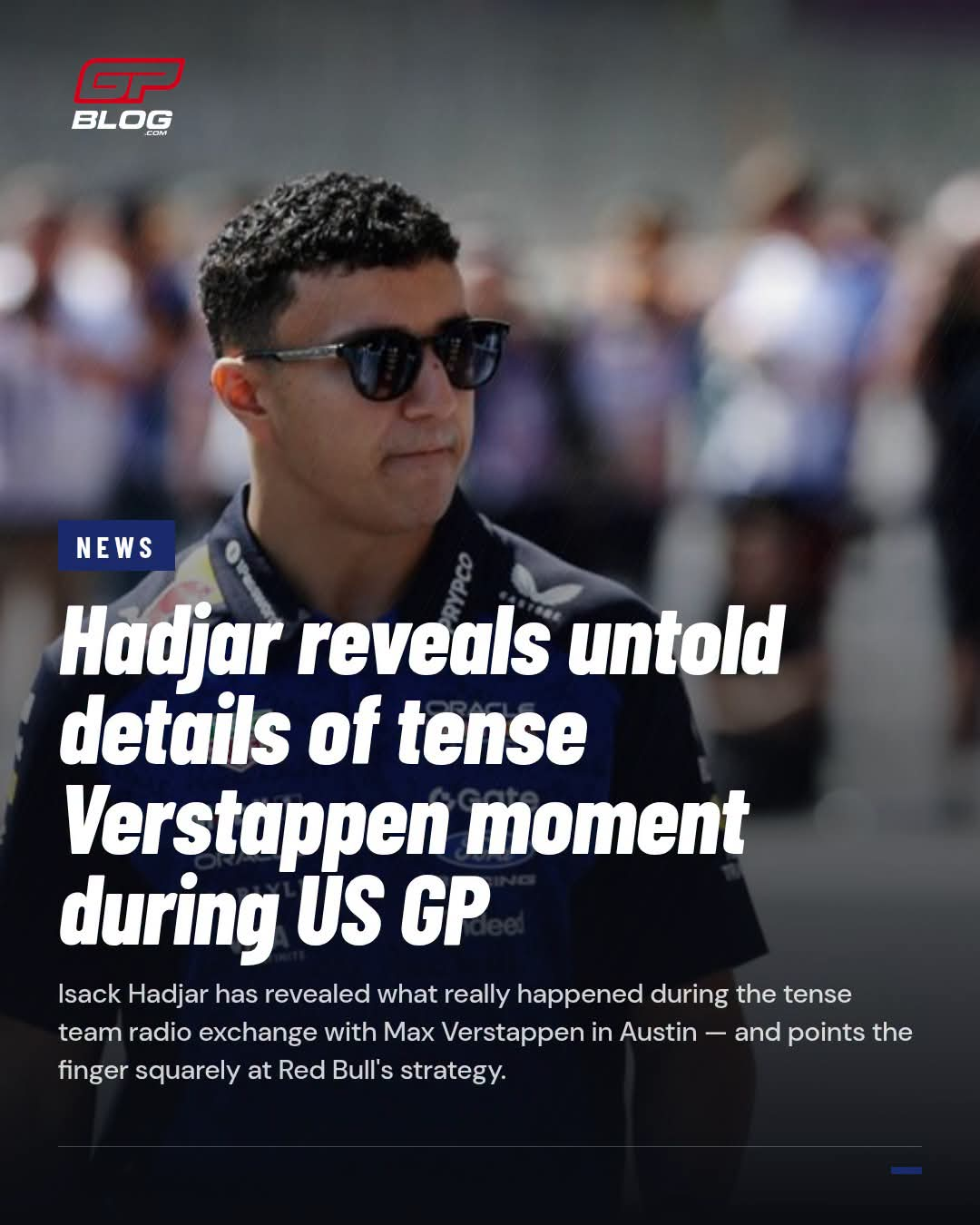
Isack Hadjar has revealed the strategic misunderstanding behind his tense team radio exchange with Max Verstappen during the 2026 United States Grand Prix, explaining how Red Bull’s failure to anticipate the race’s one-stop potential left both drivers losing valuable time in Austin.
The incident exposed a difficult moment for Red Bull, with Verstappen frustrated by the time he was losing behind his teammate while Hadjar tried to protect his own race strategy. Although the situation initially appeared to be a disagreement between the two drivers, Hadjar’s explanation suggests that the bigger problem was a strategic miscalculation that complicated the team’s race management.
RED BULL’S STRATEGY CREATED CONFUSION BETWEEN ITS DRIVERS
The disagreement unfolded during the second stint of the race at the Circuit of the Americas. Verstappen had already made his first pit stop and was running on fresher tyres as he pursued a two-stop strategy. Hadjar, meanwhile, was still using his original set of tyres and increasingly believed he could reach the finish with just one stop.
As Verstappen rapidly closed the gap, Red Bull instructed Hadjar to move aside and allow the reigning four-time world champion through. Hadjar initially resisted because he was concerned that surrendering the position would compromise his own race.
He eventually followed the instruction, but the delay was costly. Verstappen had to negotiate traffic and dirty air, while Hadjar also lost time by allowing his teammate past. What should have been a straightforward team decision instead became a frustrating episode for both drivers.
HADJAR EXPLAINS THE STRATEGIC MISJUDGMENT
Speaking after the race, Hadjar explained that the key mistake was failing to recognise early enough that a one-stop strategy could work so effectively.
The Frenchman indicated that by the time the team fully understood how manageable a single-stop race would be, Verstappen had already committed to a different strategy. That left Red Bull trying to manage two drivers whose race plans were no longer aligned.
Hadjar explained that Verstappen was approaching much faster, creating a confusing situation in which neither driver could make progress without affecting the other.
The issue was not simply about whether Hadjar should obey an instruction. It was about the timing of that instruction and whether Red Bull had correctly assessed the strategic picture before asking one driver to sacrifice valuable seconds for the other.
VERSTAPPEN’S RADIO REACTION SHOWED HIS FRUSTRATION
Verstappen made his frustration clear over team radio, sarcastically criticising the situation as he found himself stuck behind Hadjar in dirty air.
For a driver fighting near the front, losing time in traffic can have a significant impact on the outcome of a race. Even when a car is quicker, following another car closely can compromise aerodynamic performance and make it harder to maintain the pace needed to challenge rivals.
Verstappen had reason to be unhappy with the delay, particularly because his fresher tyres and different strategy meant he needed to make progress. However, Hadjar’s explanation highlights that the Frenchman was also trying to avoid damaging his own result.
The exchange therefore appeared to be less about personal hostility and more about two competing race objectives colliding at an inconvenient moment. Red Bull’s challenge was to recognise that conflict and make a decision that benefited the team without unnecessarily compromising either driver.
HADJAR FINISHES SIXTH AS VERSTAPPEN TAKES THIRD
Despite the confusion, Hadjar recovered to finish sixth, while Verstappen secured third place behind race winner Kimi Antonelli and Charles Leclerc.
The result demonstrated that both Red Bull drivers remained competitive, even though the team could potentially have managed the situation more efficiently. Verstappen’s podium was valuable, but the team will likely examine whether better strategic planning could have helped him challenge more closely for the win.
Hadjar’s sixth-place finish was also a respectable outcome, particularly given the pressure of managing tyre life while dealing with a faster teammate approaching from behind. His explanation provides important context for why he initially questioned the instruction rather than immediately moving aside.
RED BULL MUST AVOID REPEATING THE SAME MISTAKE
The incident offers Red Bull an important lesson as the 2026 championship battle intensifies. Race strategy is not only about selecting the correct number of pit stops; it also involves anticipating how tyre degradation, traffic and the pace of rival cars will affect decisions throughout the race.
If the team identifies a one-stop strategy too late, it can leave its drivers operating under conflicting assumptions. One driver may be protecting tyres for the finish while the other is pushing on a shorter stint, creating precisely the kind of situation that unfolded in Austin.
Clearer communication and earlier strategic assessments could help prevent similar disputes in future races. Red Bull must also ensure that team orders are supported by a clear understanding of the potential consequences for both drivers.
For Verstappen, the frustration was understandable because time lost behind a teammate can be decisive when fighting for victory. For Hadjar, the initial resistance reflected his attempt to protect a race that he believed could be completed with fewer stops.
Ultimately, the Austin incident appears to have exposed a problem with Red Bull’s decision-making rather than proving that either driver was solely responsible. With the Mexican Grand Prix approaching, the team will need to learn from the episode quickly if it wants to avoid turning strategic uncertainty into another costly on-track confrontation.


