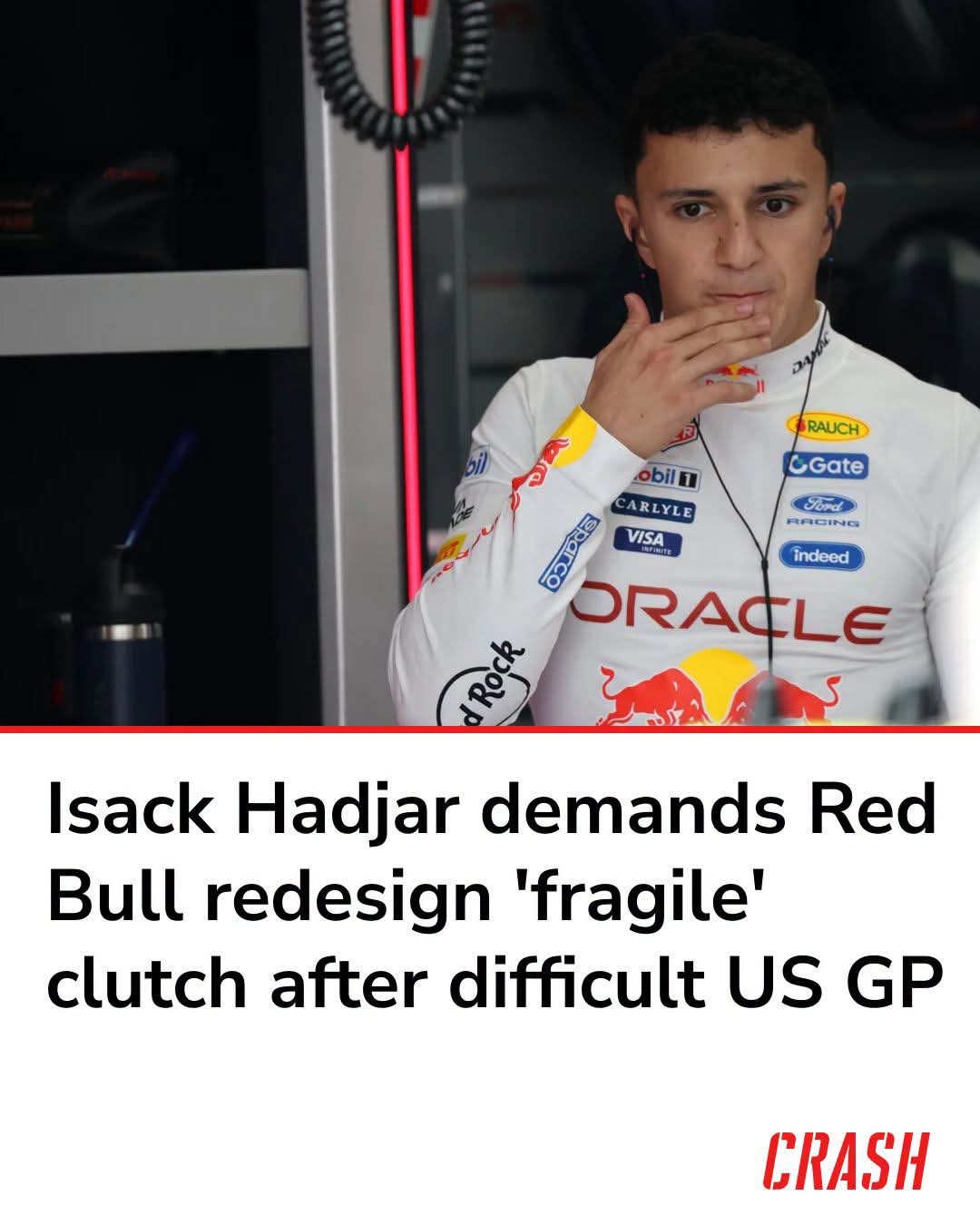
Isack Hadjar has delivered a strong message to Red Bull after a frustrating United States Grand Prix, insisting that the team must redesign its fragile clutch system following another disappointing race start. The Frenchman believes the recurring problem is beyond his control and has warned that the current system is struggling to cope with rising temperatures.
Hadjar arrived at the Circuit of the Americas with high expectations after qualifying third on the grid. Starting from such a strong position gave him a genuine opportunity to fight for another impressive result, but his hopes of challenging near the front quickly suffered a setback when the lights went out.
Instead of maintaining his position, the Red Bull driver lost ground to the Ferrari drivers and eventually finished sixth. His post-race comments revealed that the disappointing result was not simply about losing places at the start, but also about a series of technical and communication problems that compromised his race.
HADJAR INSISTS HIS RACE START WAS NOT THE PROBLEM
Hadjar believed he had executed the starting procedure correctly, despite dropping positions during the opening moments of the race.
After reviewing the start, the Frenchman maintained that he had done everything required from his side, pointing instead to what he described as excessive clutch delivery.
“I do everything perfectly in terms of procedure, and then I just have like clutch over delivery. And these things are just out of my control,” Hadjar explained.
His comments suggest that the problem is becoming increasingly frustrating because it limits his ability to convert strong qualifying performances into competitive race results.
A poor launch can have serious consequences in Formula 1, particularly when a driver starts near the front. Losing positions immediately forces a driver to recover through traffic, potentially compromising tyre life, race strategy and overall pace.
Hadjar was not the only Red Bull driver to experience difficulties off the line in Austin. Max Verstappen also lost position at the start, raising further questions about the team’s ability to deliver consistent launches.
For Red Bull, the concern is that recurring start problems could continue to undermine its race weekends unless the underlying cause is identified and addressed.
RED BULL’S CLUTCH SYSTEM FACES A MAJOR TEST
Hadjar’s strongest criticism was directed at the clutch itself, which he believes is too fragile to operate reliably under demanding race conditions.
When asked about possible solutions, the Red Bull driver suggested that a minor adjustment would not be enough.
“It needs a redesign because at the moment it’s too fragile and it’s not coping well with temperatures. It’s a real struggle,” he said.
The comments place pressure on Red Bull’s technical department to investigate whether the clutch’s behaviour under heat is contributing to inconsistent starts.
In Formula 1, clutch performance is particularly important during race starts, when drivers must carefully balance clutch release, engine response and available grip. Even a small inconsistency can cause a significant loss of acceleration against competitors launching cleanly.
If Hadjar’s concerns are supported by the team’s technical data, Red Bull may need to consider changes to the system’s design or operating characteristics. However, any redesign would require careful testing to ensure that improving reliability does not introduce new problems elsewhere.
The team’s challenge is especially important because both drivers need dependable starts to maximise their results. A car capable of qualifying near the front loses much of its advantage if it repeatedly struggles to accelerate away from the grid.
RADIO PROBLEMS AND THE WRONG ENGINE MAP COMPLICATED HIS RACE
The clutch was not Hadjar’s only concern in Austin. He also revealed problems with radio communication and the engine map used when leaving the pits.
Hadjar explained that he struggled to hear what was happening in the pit lane and subsequently left with what he described as the wrong map. He claimed the issue was costing him approximately a second per lap on the hard tyres.
“I have poor radio coverage; I can’t hear what’s happening in the pits. And I leave the pits with the wrong map,” he said.
These problems added another layer of frustration to a race that had already become difficult after the start.
Communication between a driver and the pit wall is essential in modern Formula 1. Teams constantly relay information about strategy, tyre management, car settings and changing track conditions. When that communication breaks down, a driver can lose valuable time responding to situations without the information needed to make the best decision.
The reported engine-map issue is equally significant. If the incorrect setting affected the car’s performance as Hadjar suggested, it could have made recovering positions even more difficult.
Red Bull will need to establish precisely what happened, whether the problems were connected and how similar mistakes can be prevented in future races.
A DISAPPOINTING TREND AFTER STRONG QUALIFYING PERFORMANCES
Hadjar’s sixth-place finish followed a difficult result in Singapore, where he finished tenth. The two races have left him outside the top five despite his ability to demonstrate competitive speed.
The contrast between qualifying and race performance is particularly frustrating for a driver trying to establish himself at the highest level of Formula 1.
Qualifying third in Austin demonstrated that Hadjar had the pace to compete near the front over a single lap. However, converting that speed into a strong Grand Prix result required a clean start, reliable equipment and effective execution from the team.
When one or more of those elements fails, even an excellent qualifying performance can quickly lose its value.
Hadjar’s frustration also highlights the pressure on Red Bull to provide its drivers with a package that performs consistently across an entire weekend. Speed remains essential, but reliability and operational precision often determine whether a driver finishes on the podium or outside the leading positions.
The Frenchman will want to see tangible progress in Mexico rather than another weekend in which technical difficulties prevent him from reaching his potential.
CAN RED BULL FIX THE PROBLEM BEFORE THE MEXICAN GRAND PRIX?
The Mexican Grand Prix, scheduled for October 30 to November 1, offers Red Bull an immediate opportunity to respond to Hadjar’s concerns.
However, the team may not have enough time to develop and fully validate a completely redesigned clutch before the next race. Any changes will depend on the complexity of the problem, the available engineering options and the team’s technical findings.
Red Bull could first investigate whether adjustments to the existing system, temperature management or starting procedures can reduce the risk of another poor launch while longer-term solutions are evaluated.
The team must also examine Hadjar’s reported radio and engine-map problems. Fixing the clutch alone would not address every issue that affected his race in Austin.
For Hadjar, the objective will be to turn his qualifying speed into a top-five finish and demonstrate that the recent setbacks are not becoming a pattern. For Red Bull, the priority is ensuring that preventable technical problems do not continue costing its drivers valuable points.
HADJAR’S WARNING PUTS RED BULL UNDER PRESSURE
Hadjar’s demand for a clutch redesign sends a clear message that he believes the current situation requires more than a temporary fix. His concerns involve reliability, temperature management and the wider execution of the race weekend.
The timing is significant, with the championship entering another important phase and Mercedes continuing to set the pace in both title battles. Red Bull cannot afford to surrender opportunities through recurring operational problems when its drivers are capable of producing competitive performances.
Hadjar’s sixth place in Austin was respectable considering the difficulties he described, but it was also a reminder of how quickly a promising weekend can unravel in Formula 1.
Whether Red Bull makes immediate changes or pursues a longer-term redesign, the Mexican Grand Prix will provide an early indication of how effectively the team has responded.
Hadjar has made his position clear: he believes he is doing his part behind the wheel, and now he wants Red Bull to deliver a clutch system capable of giving him a fair chance when the lights go out.