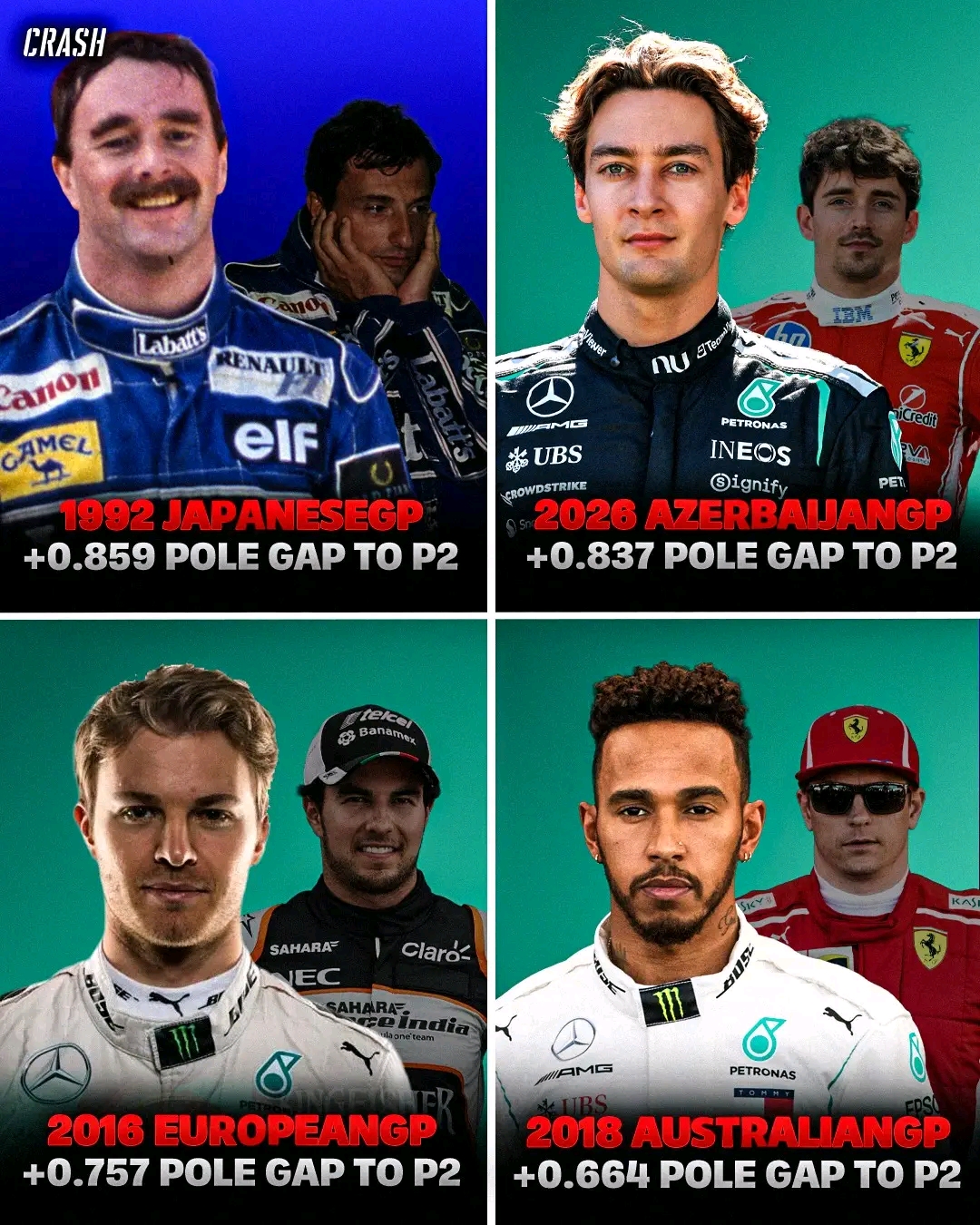
George Russell delivered one of the most dominant qualifying performances of the modern Formula 1 era on the streets of Baku. The Mercedes driver stopped the clock at 1:42.526 to claim pole for the Azerbaijan Grand Prix, leaving Charles Leclerc’s Ferrari a massive 0.837 seconds behind in second place. Oscar Piastri’s McLaren sat just one thousandth further back in third. That gap from P1 to P2 stands as the largest on a dry track since the days of Nigel Mansell’s Williams dominance in 1992.
In an age of hyper-competitive machinery and fractions-of-a-second margins, an eight-tenths advantage feels almost alien. Russell himself admitted he was shocked when the number appeared on his steering wheel. The lap, he said, was the biggest pole margin of his entire career—junior categories included.
WHY THIS GAP MATTERS IN TODAY’S FORMULA 1
Modern F1 cars are engineered for parity. Ground-effect aerodynamics, tightly regulated power units, and a single-lap knockout qualifying format usually compress the field. Seeing a gap this size in dry conditions is rare. The last time anything comparable appeared was Max Verstappen’s wet-weather 1.244-second pole in Canada 2023. On a dry circuit, Russell’s effort ranks among the most emphatic of the last decade.
Baku’s unique layout—long straights, tight walls, and evolving grip—amplified the difference. Russell extracted every last ounce from the Mercedes, benefiting from a perfectly timed slipstream and an intuitive feel for the car that has grown stronger as the season has progressed. Leclerc produced a strong lap of his own, yet still found himself more than eight tenths adrift. That tells you everything about how completely Russell was in the zone.
THE HUMAN AND TEAM IMPACT
For Russell, the result is more than a grid position. It is validation. After periods earlier in the year when straight-line speed mysteries and consistency issues left him frustrated relative to teammate Kimi Antonelli, this was a statement of pure pace. He has looked increasingly comfortable with the current generation of cars, describing the relationship as more intuitive week by week. A lap of this quality under pressure reinforces that progress.
The flip side belongs to Antonelli. The championship leader crashed in Q1 after hitting the wall at Turn 1, damaging the suspension and ending his session early. He will start 16th. An 81-point lead suddenly looks more vulnerable when your closest rival is starting from the front and you are buried in the midfield on a street circuit where overtaking is possible but costly.
Mercedes as a team leaves Baku with mixed emotions. One car sits on pole with a clear performance advantage. The other sits near the back after a rare error from its leading title contender. The constructors’ points and the internal dynamics will both feel the effects of this session.
Ferrari and McLaren will study the data carefully. Leclerc and Piastri were the only drivers within striking distance, yet even they were left more than eight tenths behind. The rest of the field was further adrift. Red Bull’s Isack Hadjar impressed in fourth, but the usual front-running order was scrambled. Lewis Hamilton could manage only sixth after running without a tow, while Max Verstappen ended eighth after traffic and yellow flags compromised his final run.
HISTORICAL CONTEXT AND WHAT IT SAYS ABOUT THE SPORT
Nigel Mansell’s 1992 Williams FW14B produced some of the largest qualifying gaps in modern history, most famously the near-two-second advantage over teammate Riccardo Patrese at Silverstone. Those were different times—active suspension, less regulated engines, and a field with greater performance disparity. Russell’s 0.837-second margin in 2026 therefore carries special weight. It shows that even under the current tightly controlled regulations, a driver and car combination can still produce a performance that looks like it belongs to another era.
Street circuits have always rewarded precision and confidence more than pure horsepower. Russell’s ability to string together sector after sector of purple times, while others struggled to match even one strong run, highlights the difference between a good lap and a special one. The slipstream he received on the long straight added a couple of tenths, but the majority of the advantage was pure pace.
PREDICTIONS FOR RACE DAY AND THE WIDER SEASON
Starting from pole on the Baku street circuit gives Russell a major strategic advantage. Clean air, the first choice of line into Turn 1, and the ability to control the early pace all favour him. Safety cars are common in Azerbaijan, so the race will not be straightforward, yet Russell’s qualifying form suggests the Mercedes has the tools to convert this into a strong result.
Antonelli’s recovery drive from 16th will be one of the stories of the weekend. On a track where positions can be gained, the Italian will need an aggressive yet measured approach. Any points he salvages will limit the damage; a big points haul for Russell would close the championship gap significantly.
Looking further ahead, this performance raises questions about the balance of power for the remaining races. If Mercedes can bottle the confidence Russell showed in Baku, the second half of the season becomes far more competitive. Ferrari and McLaren remain in the fight, but a gap of this magnitude on a circuit that usually produces close racing will force every team to re-examine their setups and energy management strategies.
Russell’s eight-tenths masterclass was more than a qualifying result. It was a reminder that Formula 1 can still produce moments of genuine dominance, even in an era designed to prevent them. For one afternoon in Baku, George Russell made the rest of the grid look ordinary. The race will decide whether that dominance translates into points, but the statement has already been made.