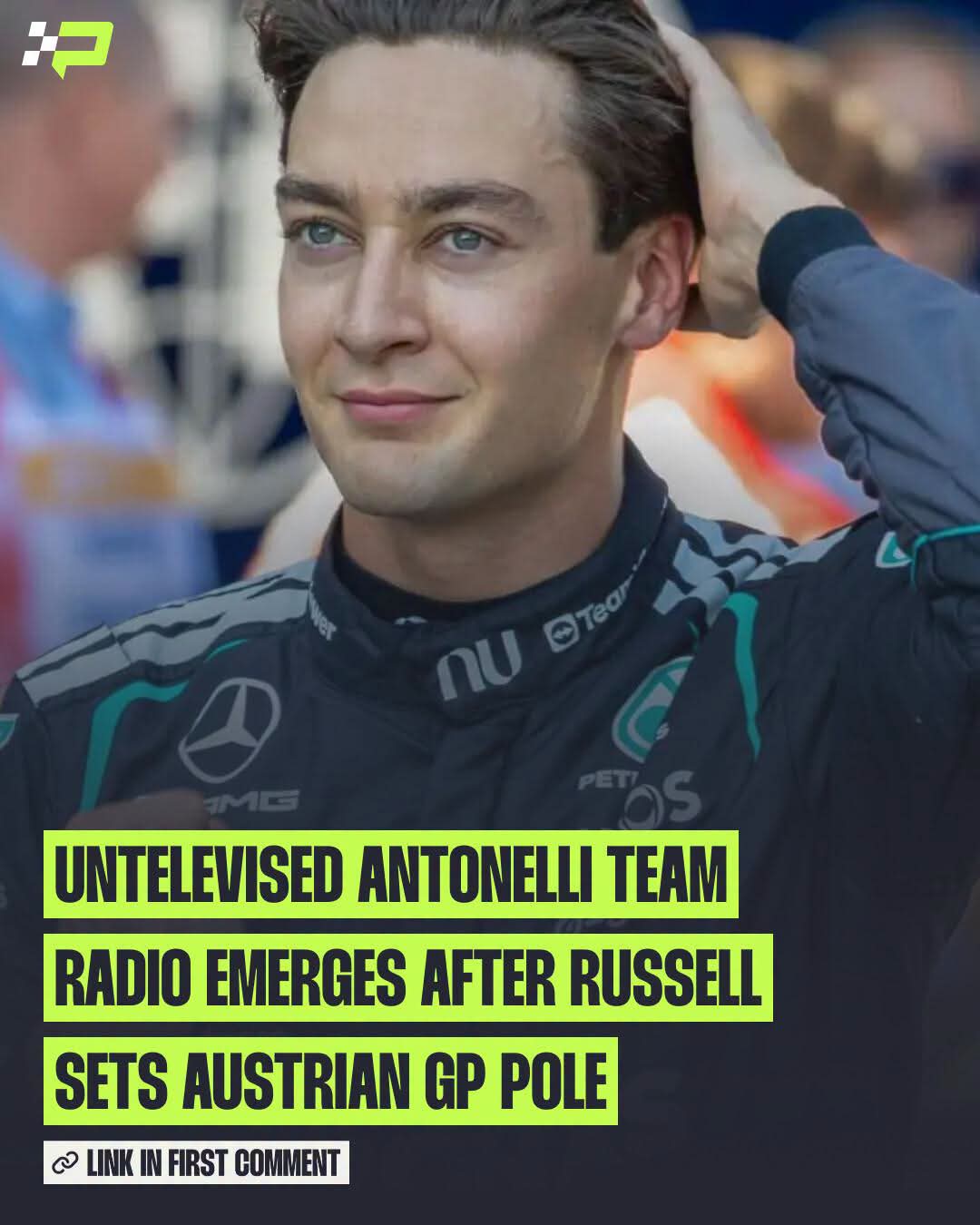
George Russell will lead the field away for the 2026 Austrian Grand Prix, but his stunning pole position has become one of the most talked-about qualifying performances of the season. While the Mercedes driver delivered a blistering lap after Max Verstappen’s late crash, newly surfaced Mercedes team radio has revealed just how confused the team was during the dramatic closing moments of Q3.
Although the FIA ultimately cleared Russell of any wrongdoing, the incident has divided fans, drivers, and pundits over whether Formula 1’s yellow flag procedures need to be reviewed—especially when incidents occur in high-speed corners.
MAX VERSTAPPEN’S CRASH CHANGED EVERYTHING
Qualifying had been building toward an intense battle between Mercedes, Ferrari, and Red Bull before Verstappen lost control of his Red Bull at Turn 9 during his final flying lap. His crash immediately triggered yellow flags, creating uncertainty for every driver still attempting to complete their laps.
Russell, who was still pushing, managed to improve enough to snatch pole position with a sensational 1:06.113 lap. His teammate Andrea Kimi Antonelli, however, abandoned his attempt after believing double yellow flags had been deployed.
That single decision dramatically altered Mercedes’ qualifying outcome. Instead of challenging Russell for pole or securing a front-row start, Antonelli was forced to settle for fourth on the grid.
NEW TEAM RADIO REVEALS THE CONFUSION INSIDE MERCEDES
Freshly released Mercedes radio transmissions provide a clearer picture of what unfolded.
After Russell’s lap put him on provisional pole, Antonelli immediately questioned how his teammate had been able to improve under yellow flag conditions.
His race engineer initially responded that Russell had lifted through the yellow zone. Antonelli, however, believed the situation involved double yellow flags rather than a single yellow.
That misunderstanding proved costly.
Earlier radio messages also captured Antonelli’s frustration as soon as the yellow flags appeared. Convinced his lap had been ruined, he repeatedly insisted that it had been the lap capable of putting him at the front.
Russell, meanwhile, immediately informed his own engineer that he had significantly lifted entering Turn 9 and believed he had complied fully with the regulations.
WHY THE FIA ALLOWED THE LAP TO STAND
The controversy centered on one crucial detail: the type of yellow flag displayed when Russell reached the accident scene.
According to FIA regulations, drivers encountering a single yellow flag must noticeably reduce speed and be prepared to change direction. Under a double yellow, drivers must slow significantly and effectively abandon any competitive attempt through that sector.
Race officials reviewed Russell’s telemetry and determined he had lifted sufficiently before entering the affected corner, satisfying the requirements for a single yellow flag.
Because double yellows had not yet been activated when Russell passed the incident, the stewards concluded that no sporting regulations had been breached, allowing his pole position to remain valid.
ANTONELLI CALLS FOR A REVIEW
Despite accepting responsibility for aborting his lap, Antonelli believes the broader procedure deserves closer examination.
The championship leader argued that Verstappen’s crash occurred in one of the fastest corners on the circuit, making an immediate double yellow a safer response. From his perspective, every driver still on a flying lap should have been forced to abandon their attempts.
His comments are unlikely to disappear quickly. Safety has always been Formula 1’s highest priority, and situations where different drivers interpret flag signals differently expose potential weaknesses in race control procedures.
If the FIA chooses to review its protocols after Austria, Antonelli’s observations may become an important talking point.
RUSSELL SHOWS EXPERIENCE UNDER PRESSURE
Regardless of the controversy, Russell demonstrated remarkable composure.
Rather than panicking after seeing the yellow lights, he immediately adjusted his driving, lifted where required, and then maximized the remaining corners to complete an exceptional lap.
That level of awareness is one of the reasons Mercedes continues to place enormous trust in the British driver. In a qualifying session where tiny mistakes separated multiple contenders, Russell combined outright speed with quick decision-making.
Mercedes team principal Toto Wolff also defended his driver, insisting the data clearly showed Russell made a substantial lift before Turn 9 and complied with the regulations.
WHAT IT MEANS FOR THE CHAMPIONSHIP
Russell’s pole position could have major implications for both championships.
Starting from the front gives him an excellent opportunity to reduce the gap to Antonelli in the Drivers’ Championship, where every point has become increasingly valuable. A victory would significantly strengthen Russell’s title hopes heading into the next phase of the season.
Ferrari, meanwhile, will see opportunity rather than disappointment. Charles Leclerc and Lewis Hamilton start directly behind Russell, giving the Italian team two realistic chances to challenge Mercedes into Turn 1 through strategy or race pace.
Verstappen’s recovery drive also promises to add another fascinating layer after his qualifying crash left him starting further back than expected.
AUSTRIA COULD SHAPE FUTURE FIA DECISIONS
While the FIA’s verdict officially closes Russell’s investigation, the wider debate is unlikely to end anytime soon.
The combination of Verstappen’s crash, Russell’s pole lap, Antonelli’s abandoned run, and conflicting interpretations of the yellow flags has reignited discussion over how race control communicates dangerous situations during qualifying.
If Formula 1 wishes to eliminate similar controversies in the future, Austria may become an important reference point for revisiting yellow flag procedures—particularly at circuits featuring high-speed corners where drivers have only fractions of a second to react.
For now, however, the result stands. George Russell remains on pole position, Mercedes celebrates another crucial qualifying success, and Sunday’s Austrian Grand Prix promises to begin with one of the season’s most closely watched starts.