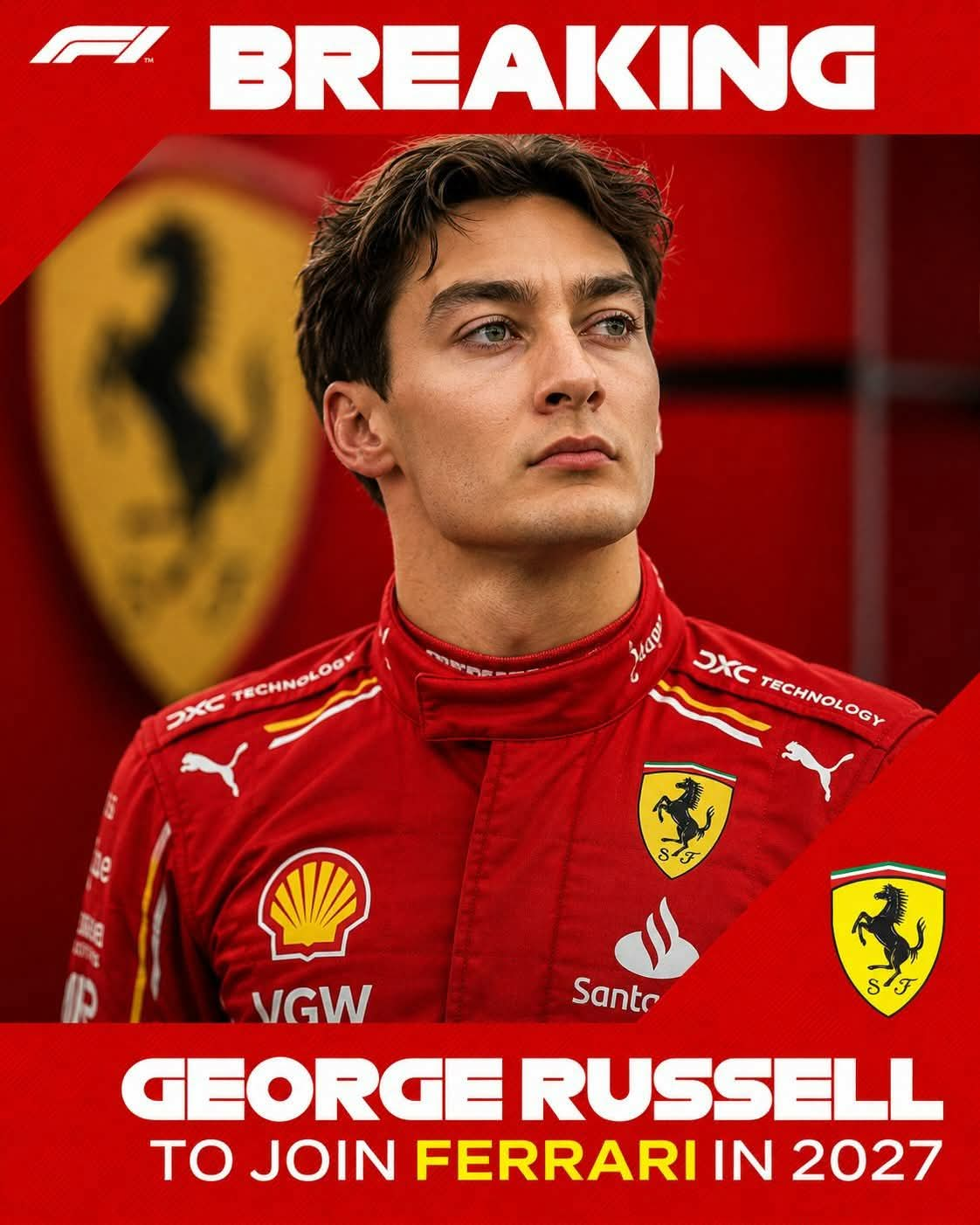
Formula 1 could be heading toward another major driver-market shake-up, with speculation linking George Russell to a sensational move to Ferrari for the 2027 season. Although no official agreement has been confirmed, the possibility of the Mercedes star switching to the Scuderia raises serious questions about the future of both teams and the direction of the championship.
Russell has established himself as one of the most capable drivers on the Formula 1 grid, combining qualifying speed, racecraft, and technical feedback with an increasingly prominent leadership role. Since joining Mercedes as a full-time driver in 2022, the British racer has worked to prove that he can compete at the highest level and lead a team through periods of change. A move to Ferrari would represent a significant new chapter in that journey, potentially placing him at the centre of one of motorsport’s most ambitious projects.
### WHY FERRARI COULD BE AN ATTRACTIVE DESTINATION FOR GEORGE RUSSELL
Ferrari remains one of the most prestigious destinations in Formula 1. For a driver with championship ambitions, joining the Italian team offers the opportunity to build a legacy with a manufacturer whose history is deeply connected to the sport.
However, reputation alone is not enough to guarantee success. Ferrari would need to demonstrate that its technical development, race strategy, and internal management can consistently deliver a car capable of fighting for victories and championships.
For Russell, the attraction would be straightforward if Ferrari could offer a stronger long-term competitive outlook than Mercedes. The decision would ultimately depend on the team’s performance, its future plans, the contractual situation, and the level of confidence Russell has in its leadership.
Nevertheless, it is important to distinguish speculation from fact. There is no confirmed agreement establishing Russell as a Ferrari driver for 2027, and the possibility should not be mistaken for an active, completed transfer.
### MERCEDES COULD FACE A MAJOR CHALLENGE IF RUSSELL LEAVES
Losing Russell would present Mercedes with a significant strategic challenge. Established drivers provide more than points and podiums; they also contribute technical feedback, continuity, and leadership during crucial development periods.
Russell’s experience with the team could be particularly valuable as Mercedes continues adapting to Formula 1’s changing technical landscape. Replacing him would require the team to identify a driver capable of delivering immediate results while fitting into its long-term championship ambitions.
Mercedes would have several potential approaches if such a departure ever became reality. It could promote a younger prospect, pursue an experienced rival, or restructure its driver lineup around its existing talent.
Any replacement decision would carry considerable consequences. A poorly timed change could disrupt development, while a successful appointment could give Mercedes an opportunity to establish a fresh competitive direction.
### HOW A RUSSELL-FERRARI MOVE COULD CHANGE THE DRIVER MARKET
A potential Russell transfer would attract attention far beyond Mercedes and Ferrari. Formula 1’s driver market operates through a network of interconnected contracts, negotiations, and long-term plans.
When one leading driver changes teams, rival organisations often reassess their own options. Vacant seats can create opportunities for younger racers, while established drivers may reconsider their positions depending on the competitiveness of the available machinery.
The timing would be particularly important ahead of the 2027 season. Teams must balance immediate performance with the need to build stable projects for the future, making driver decisions a crucial part of their competitive planning.
If Russell were genuinely available, his experience and reputation would likely make him an attractive option for several teams. However, the scale of any resulting reshuffle would depend on confirmed contracts and the decisions made by the organisations involved.
### FERRARI WOULD NEED MORE THAN A STAR DRIVER
Signing a driver of Russell’s calibre would generate considerable excitement among Ferrari supporters, but it would not automatically solve the team’s championship challenges.
Formula 1 success depends on the combined performance of the car, power unit, engineering department, race operations, and drivers. Even exceptional talent can struggle to challenge for titles when the machinery or operational execution falls short.
Ferrari would therefore need to ensure that any potential recruitment strategy aligned with a credible technical and sporting plan.
There would also be questions about team chemistry and the management of expectations. Bringing in a high-profile driver can strengthen a team, but success requires clear responsibilities, effective communication, and a shared understanding of the championship objectives.
For Russell, the opportunity would need to offer more than the prestige of wearing Ferrari red. It would have to provide a realistic pathway toward competing consistently at the front.
### COULD THE 2027 SEASON BE THE PERFECT TIME FOR A MOVE?
The 2027 campaign is an important reference point because Formula 1 is entering a new technical era in 2026, with substantial changes to chassis and power-unit regulations.
Teams will be assessing how effectively their designs perform under the new rules and whether their development programmes can sustain progress. Those evaluations could influence future driver decisions, particularly for racers seeking the strongest possible championship opportunity.
A driver who joins a team during a period of technical development could help shape its direction over several seasons. However, changing teams also carries risks, including adapting to unfamiliar engineering processes, working relationships, and car characteristics.
Russell would need to weigh those factors carefully if a move ever became a genuine possibility.
For Ferrari, recruiting an established driver could be part of a wider strategy to combine experience with technical progress. For Mercedes, retaining its strongest available lineup could be equally important to maintaining stability.
### VERDICT: RUMOURS ARE NOT CONFIRMATION
The idea of George Russell joining Ferrari in 2027 is an intriguing Formula 1 storyline, but it remains speculation without an official announcement or reliable confirmation of an agreement.
A move could reshape the competitive plans of both Ferrari and Mercedes, potentially influencing the wider driver market. Yet any serious assessment must consider the contractual situation, each team’s competitiveness, and the ambitions of the people involved.
The biggest question is not simply whether Russell could drive for Ferrari, but whether either team would benefit enough from such a change to make it worthwhile.
Until credible evidence emerges, Mercedes supporters have no confirmed reason to assume Russell is leaving, and Ferrari fans should treat the possibility as an unconfirmed rumour rather than an imminent signing.
In Formula 1, the most dramatic transfer stories often begin with speculation. Whether this one develops into a genuine driver-market battle remains to be seen.