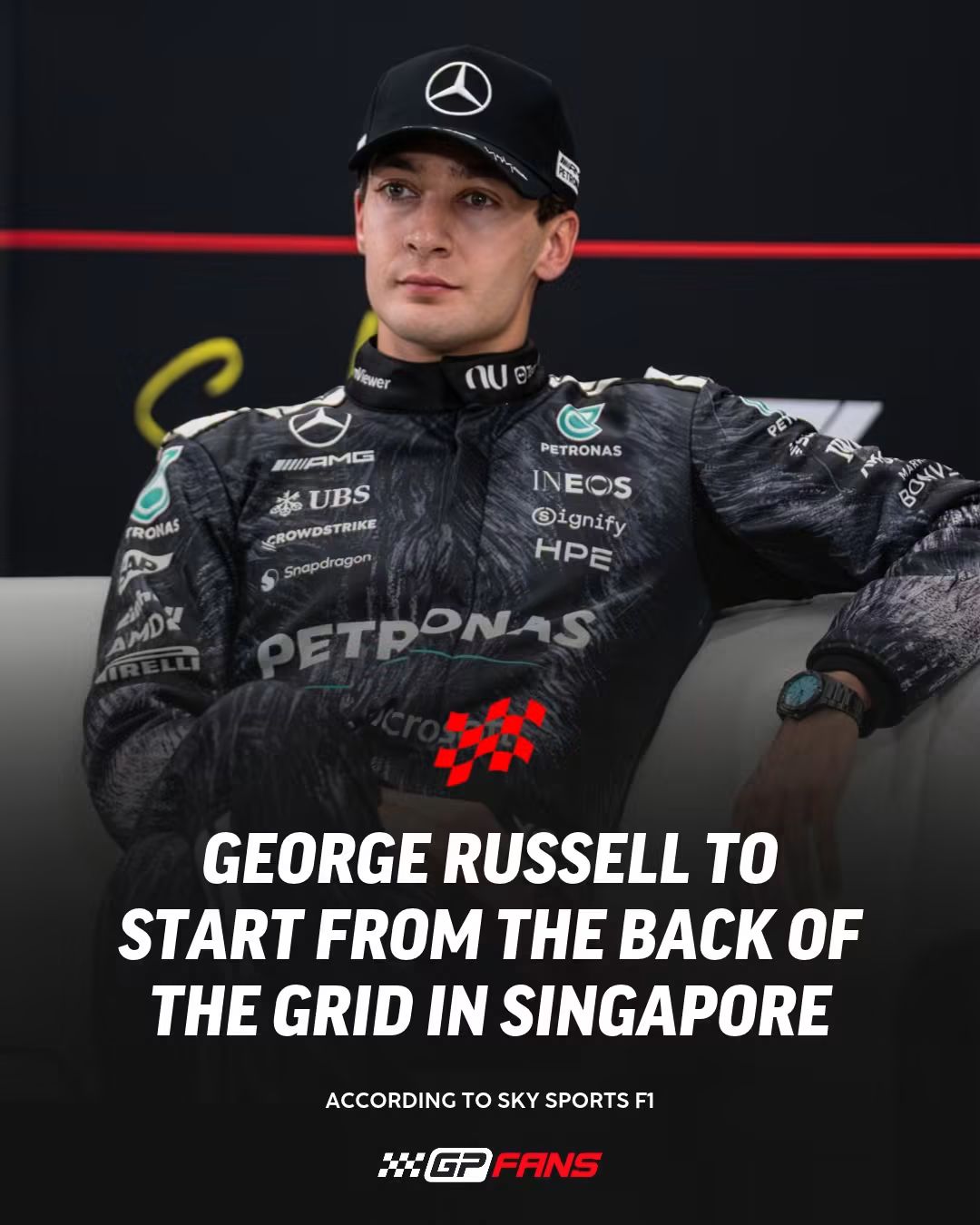
George Russell’s 2026 Formula 1 title challenge has taken another heavy blow. Mercedes has confirmed the British driver will take a new power unit at this weekend’s Singapore Grand Prix, triggering a substantial grid penalty that will almost certainly see him start Sunday’s race from the rear of the field.
The decision follows Russell’s late-race retirement at the Bahrain Grand Prix in Malaysia last weekend. Running in third place with just a handful of laps remaining, the Mercedes suffered a power unit failure that forced him to pull over. Teammate Kimi Antonelli finished second, stretching his championship lead to 84 points with seven rounds still to go. What looked like a manageable points swing suddenly became a major setback—and the consequences are still unfolding.
WHY THE POWER UNIT CHANGE WAS UNAVOIDABLE
Mercedes had carefully managed Russell’s engine allocation throughout the season. Drivers are limited to four internal combustion engines, turbochargers, MGU-H and MGU-K units, plus two energy stores and control electronics. Exceeding those limits triggers grid penalties. Russell had already reached the limit on key components. The failure in Malaysia left him without enough low-mileage parts to continue safely, forcing the team to introduce a fresh power unit in Singapore.
The original plan had been different. Mercedes intended to delay any penalty until the United States Grand Prix in Austin, where they hoped to introduce an upgraded power unit under the FIA’s Additional Development and Upgrade Opportunities (ADUO) system. That upgrade was meant to give Russell a performance step while absorbing only one grid drop. The Malaysia failure has scrambled those plans. There is now discussion about whether the upgraded unit can be accelerated for Singapore, potentially avoiding a second penalty later in the season. If not, Russell could face the double hit of penalties in consecutive races—an outcome team figures have described as particularly unfortunate.
THE SINGAPORE PROBLEM: A STREET CIRCUIT NIGHTMARE FOR COMEBACKS
Marina Bay is one of the hardest tracks on the calendar for recovering from a low starting position. The narrow, high-downforce street circuit offers limited overtaking opportunities. Safety cars are common, but they do not guarantee progress when you start near the back. Starting from the rear of the grid turns an already difficult weekend into a damage-limitation exercise.
This is a sprint weekend, so the power unit penalty will not affect Saturday’s sprint race. That offers a small window for Russell to score points and rebuild some momentum before the main event. Still, the championship arithmetic is harsh. Trailing by 84 points with seven races left, Russell needs a string of strong results and some misfortune for Antonelli. Starting from the back in Singapore makes that recovery far steeper.
IMPACT ON MERCEDES AND THE WIDER TITLE FIGHT
For Mercedes, the situation is awkward. The team has been competitive enough to put both cars in the mix for race wins and podium finishes, yet reliability and strategic engine management have become recurring themes. Antonelli continues to look composed and consistent in only his first full season, while Russell has been forced into a more reactive posture. The power unit issue also raises questions about the long-term durability of the current Mercedes specification as the season enters its final stretch.
The broader championship picture shifts as a result. Antonelli now holds a commanding lead that looks increasingly difficult to overturn. Other contenders further back in the standings may find opportunities if Mercedes is forced to manage two different engine strategies across the remaining races. Reliability has already played a decisive role this year; this latest episode underlines how critical power unit management remains under the current regulations.
WHAT COMES NEXT FOR RUSSELL
Russell will hope the new power unit is reliable and that Mercedes can extract the maximum from the car around the Marina Bay walls. A strong sprint result could provide a psychological boost, and any safety-car intervention in the grand prix might open a path into the points. Looking further ahead, the team will need to decide whether to introduce the ADUO-upgraded unit later and accept another penalty, or run the current specification for the rest of the season and risk a performance deficit.
The episode also serves as a reminder of how finely balanced modern Formula 1 has become. A single mechanical failure can erase points, force strategic compromises, and reshape a title fight in a matter of days. For Russell, the next few weeks will test both his racecraft from the back of the grid and Mercedes’ ability to limit the damage from an untimely power unit change.
Singapore has never been kind to drivers starting near the rear. This weekend, George Russell will discover just how unforgiving it can be.