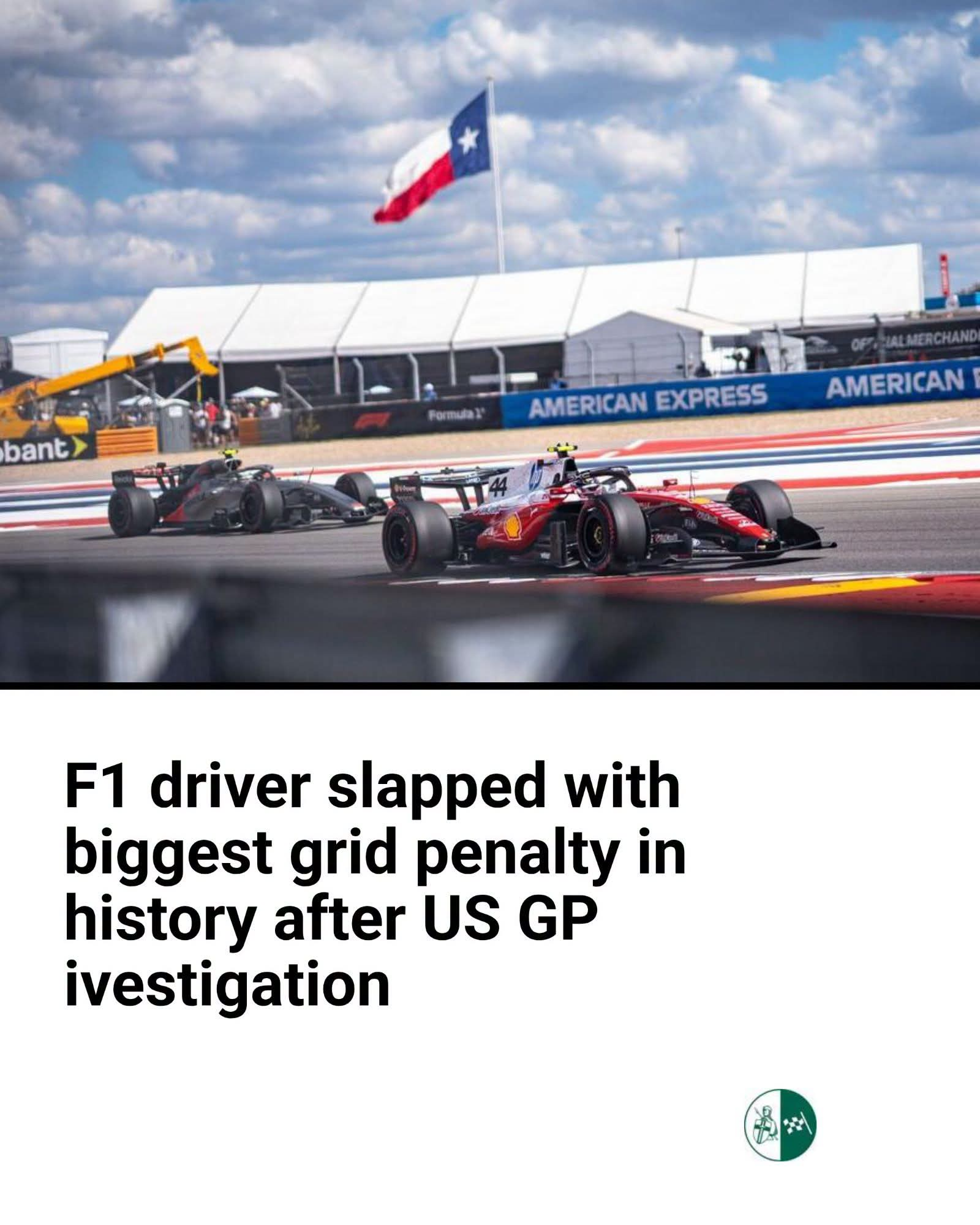
Gabriel Bortoleto has reportedly set a new Formula 1 record after accumulating a staggering 80-place grid penalty ahead of the 2026 United States Grand Prix. The Audi driver’s punishment follows a series of power unit component changes that pushed him beyond the permitted seasonal allocation, turning what had been a promising qualifying session into a major challenge for Sunday’s race at the Circuit of the Americas. The reported penalty surpasses the infamous 70-place punishment handed to former McLaren driver Jenson Button in 2015, highlighting just how complicated Formula 1’s engine penalty system can become.
WHY GABRIEL BORTOLETO RECEIVED AN 80-PLACE GRID PENALTY
Bortoleto entered the Austin race weekend already facing a 20-place grid penalty after Audi installed a fourth Control Electronics unit and a fourth Energy Store in his R26. Under the regulations cited in the stewards’ decision, drivers are restricted to three of each component during the season before additional units trigger grid penalties.
The situation escalated when Audi introduced further power unit components ahead of the race. The changes included another Energy Store and Control Electronics unit, as well as a new internal combustion engine, turbocharger, exhaust set, MGU-K and Power Unit Ancillary Component.
The additional Energy Store and Control Electronics unit each carried a five-place penalty, while the other specified components attracted 10-place penalties apiece. According to the FIA stewards’ ruling reported by the Daily Express and PlanetF1, the latest changes accounted for a further 60 grid places, taking Bortoleto’s reported accumulated penalty to 80.
However, the Brazilian will not literally drop 80 positions on the starting grid. Formula 1 has far fewer than 80 cars competing in a Grand Prix, and the regulations require drivers whose accumulated penalties exceed the specified threshold to start from the back of the field.
JENSON BUTTON’S INFAMOUS RECORD HAS BEEN SURPASSED
Before Bortoleto’s extraordinary penalty, Jenson Button was associated with one of Formula 1’s most notorious grid-penalty episodes. The former world champion received a 70-place penalty at the 2015 Mexican Grand Prix while driving for McLaren, during a difficult period for the team’s Honda power unit.
McLaren struggled with reliability and performance that season, with repeated component changes resulting in enormous grid penalties for its drivers. Button’s punishment became a symbol of the frustration surrounding the team’s engine problems and the limitations imposed by Formula 1’s power unit regulations.
Bortoleto’s reported 80-place total illustrates how the same underlying system can produce eye-catching figures when multiple components are changed at once. The comparison is striking, although the circumstances differ: the number represents accumulated penalties rather than the number of physical grid positions a driver can lose.
BORTOLETO QUALIFIED 13TH BEFORE THE SETBACK
Despite the penalty drama, Bortoleto had reasons to feel positive about his performance in Austin. The Brazilian qualified 13th, finishing just behind Audi teammate Nico Hulkenberg, and described his qualifying lap as one of his best efforts of the season.
Speaking to Globo, Bortoleto explained that he believed he had lost approximately three-tenths of a second at the final corner. He suggested that a cleaner final sector could have significantly improved his position during the opening qualifying phase.
He also explained that part of his qualifying work involved helping Hulkenberg by providing a tow. Bortoleto said he had limited opportunities to set competitive laps in the subsequent phase and was left with worn tyres when he attempted to improve his time.
His comments suggest that he felt comfortable with the car and believed Audi had the pace to achieve more. That makes the penalty particularly frustrating, as his qualifying result offered a foundation for a more competitive race before the additional component changes altered his starting position.
WHY AUDI MAY HAVE ACCEPTED THE PENALTIES
Although a penalty of this magnitude appears disastrous, teams sometimes accept grid penalties when introducing fresh power unit components is considered more beneficial than continuing with older hardware.
Reliability is a major consideration in Formula 1. A team facing concerns about the condition of its existing components may decide that fitting new parts is the safer option for completing a race or protecting its performance over the remaining rounds.
Fresh components do not automatically guarantee greater speed, however. The decision involves balancing reliability, performance, component availability and the cost of sacrificing track position. Audi’s exact reasoning for the full sequence of changes would need to be confirmed by the team.
For Bortoleto, the immediate consequence is clear: he must approach the Grand Prix as a recovery drive rather than a conventional race from his qualifying position.
CAN BORTOLETO RECOVER AND SCORE POINTS?
Starting at the back of the grid makes scoring points significantly more difficult, but it does not make a strong result impossible. The Circuit of the Americas offers overtaking opportunities, and changing weather, safety cars or strategic decisions can influence the order throughout a Grand Prix.
Bortoleto will need a clean start, consistent pace and effective tyre management to work his way through the field. Avoiding unnecessary battles and capitalising on mistakes from rivals could also prove important.
The challenge is that overtaking multiple cars consumes time and can place additional demands on tyres. Even if Audi has a competitive race pace, Bortoleto may struggle to recover enough positions to reach the top 10.
Nevertheless, the weekend can still provide useful experience for the young Brazilian. Managing a difficult starting position requires patience, strategic awareness and the ability to make calculated decisions under pressure.
A RECORD-BREAKING PENALTY THAT EXPOSES F1’S ENGINE RULES
Bortoleto’s reported 80-place penalty has once again drawn attention to the complexity of Formula 1’s power unit regulations. The system is designed to limit the number of components each driver can use throughout a season, encouraging teams to manage reliability and discourage unlimited component changes.
But when reliability concerns or strategic decisions force teams to introduce several additional parts, the resulting penalties can become almost meaningless as a literal measure of grid positions. Once a driver is already destined to start from the back, additional penalties cannot push that driver any further down the actual grid.
The episode therefore raises a broader question about whether the current penalty system communicates its intended purpose effectively to fans. While component limits remain important, accumulated penalties reaching 80 places can appear excessive when the practical consequence is still a back-of-the-grid start.
For Bortoleto and Audi, the priority will now be making the most of the race itself. The Brazilian may have lost the opportunity to start from 13th, but his performance on Sunday will ultimately depend on how well he and the team respond to the setback.
One thing is certain: Bortoleto’s reported 80-place penalty has become one of the most extraordinary grid-penalty stories of the 2026 Formula 1 season, eclipsing Button’s infamous 70-place total and putting Audi’s race strategy under intense scrutiny.