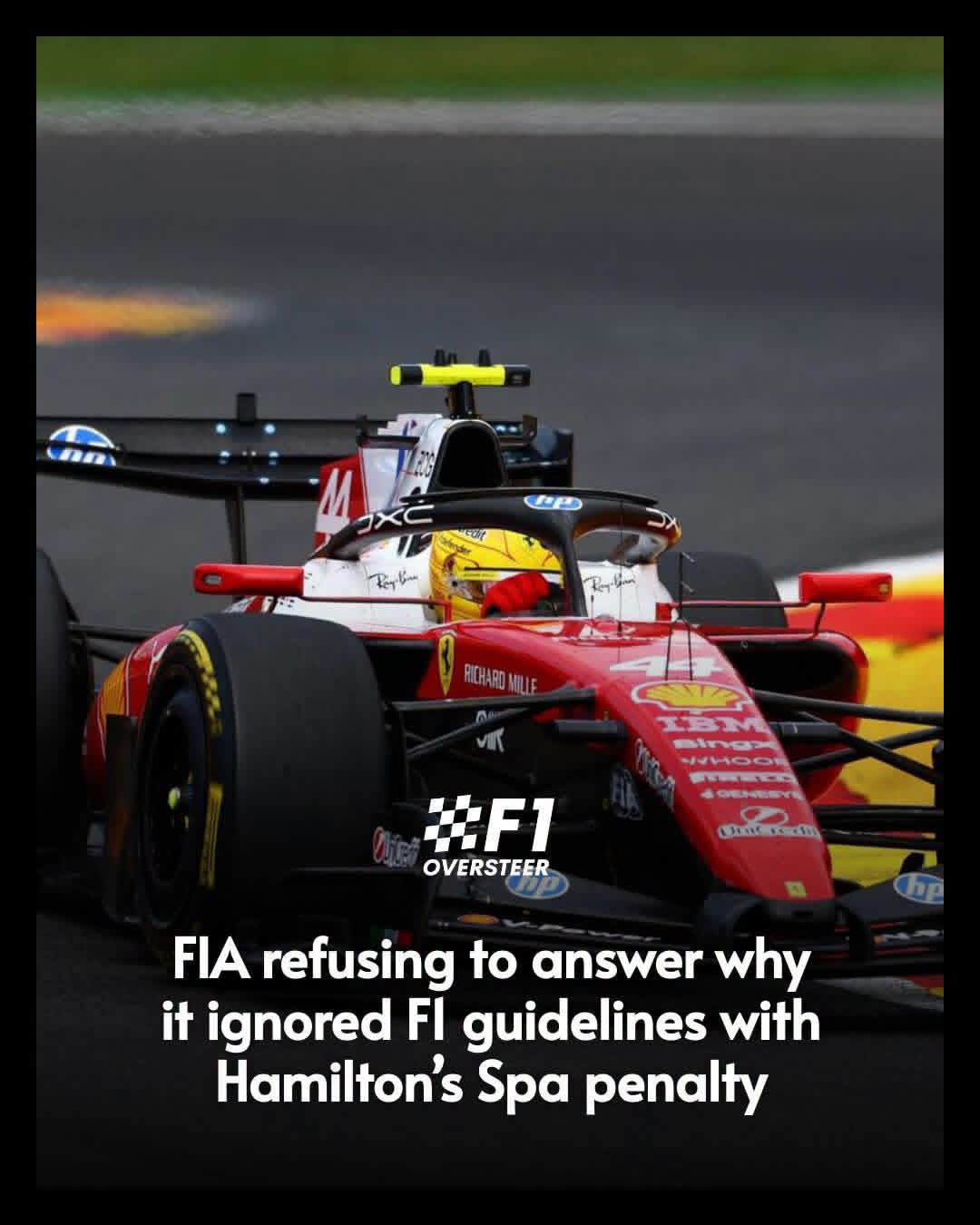
The FIA is facing growing scrutiny after reportedly refusing to explain why its stewards departed from Formula 1’s published penalty guidelines during the controversial Belgian Grand Prix. The decision not to penalize Lewis Hamilton for an unsafe release—despite his Ferrari striking one of its own mechanics in the pit lane—has reignited debate over consistency in race officiating and the transparency of stewarding decisions.
Instead of handing Hamilton an additional time penalty, race officials fined Ferrari €30,000, with €10,000 suspended for 12 months. While the mechanic escaped serious injury, many observers believe the punishment raised more questions than answers, particularly because the FIA’s own sporting guidelines appear to recommend sporting penalties for unsafe releases during races.
THE INCIDENT THAT SPARKED A NEW CONTROVERSY
Hamilton’s Belgian Grand Prix was already complicated before the pit lane drama unfolded.
The seven-time world champion received a five-second penalty after colliding with former Mercedes teammate George Russell on the opening lap at Les Combes, an incident that ended Russell’s race. Ferrari later chose to pit both Hamilton and Charles Leclerc during a Virtual Safety Car period, hoping to minimize the time lost.
Because Hamilton first had to serve his five-second penalty before Ferrari could begin servicing his car, the team’s planned front-wing adjustment was delayed. That delay disrupted the entire pit stop sequence.
As Hamilton received the green light to leave his pit box, a mechanic was still attempting to complete the wing adjustment. Hamilton drove away and made contact with the crew member before immediately stopping once he realized what had happened.
Fortunately, the mechanic avoided serious injury.
WHY THE FIA’S DECISION HAS BECOME SO CONTROVERSIAL
The debate extends beyond the incident itself.
According to Formula 1’s published stewarding guidelines, unsafe releases during races are generally expected to result in sporting penalties such as a five-second penalty, a 10-second penalty, or even a drive-through penalty, depending on severity. Financial penalties are typically associated with similar infractions during practice or qualifying sessions.
Instead, Ferrari received only a financial sanction.
Reports indicate the FIA has declined to clarify why its stewards chose not to apply the race penalty options outlined in those guidelines.
That lack of explanation has frustrated fans, analysts, and journalists alike because consistency is one of the foundations of fair competition in Formula 1. Teams spend enormous resources understanding the regulations, expecting those rules to be applied uniformly throughout the season.
HAMILTON WAS NOT DIRECTLY RESPONSIBLE—BUT SHOULD THE CAR HAVE BEEN PENALIZED?
One of the biggest complications is determining responsibility.
Hamilton did exactly what every Formula 1 driver is trained to do: respond to the green light authorizing him to leave the pit box. Drivers are instructed to trust their teams during pit stops because looking away from the release signal could create even greater danger.
The unsafe release appears to have resulted from Ferrari’s delayed communication and poor coordination during an unusually complex stop rather than any mistake made by Hamilton himself.
However, Formula 1 has long treated drivers and teams as a single competitive entity. Historically, drivers have received time penalties for unsafe releases regardless of whether they personally caused the error.
That precedent is what makes Belgium so unusual.
THE DECISION MAY HAVE CHANGED THE FINAL RESULTS
Had the FIA imposed an additional five-second penalty, Hamilton would almost certainly have lost fourth place to McLaren’s Oscar Piastri, who finished less than two seconds behind him.
A 10-second penalty would have dropped Hamilton even further down the order, potentially behind Isack Hadjar and Lando Norris.
Instead, Hamilton retained valuable championship points despite Ferrari being found responsible for an unsafe release.
While few argue Hamilton deserved personal blame, many believe Formula 1’s established system would normally have attached the sporting consequence to the car rather than solely issuing a financial punishment to the team.
CONSISTENCY REMAINS FORMULA 1’S BIGGEST CHALLENGE
This controversy arrives during a season already filled with heated stewarding debates.
Hamilton’s opening-lap collision with George Russell resulted in a five-second penalty despite several drivers—including Russell himself—describing it as a racing incident. Meanwhile, Charles Leclerc escaped punishment following contact with Oscar Piastri later in the race, further fueling discussions about inconsistent decision-making.
The Belgian Grand Prix has become another example of how differing interpretations of similar incidents can leave teams, drivers, and fans uncertain about what the rules actually require.
For Formula 1, perception matters almost as much as the decisions themselves.
WHY FIA TRANSPARENCY IS NOW UNDER THE SPOTLIGHT
Modern Formula 1 generates millions of viewers worldwide, with championship battles often decided by only a handful of points.
That makes transparency essential.
The FIA does publish steward reports after each race, but when those reports appear to conflict with published sporting guidelines, fans naturally expect further clarification. Refusing to explain those discrepancies risks undermining confidence in the governing body’s decision-making process.
Teams also rely on consistency when developing race strategies and training pit crews. If similar incidents receive entirely different punishments from one weekend to the next, predicting regulatory outcomes becomes increasingly difficult.
COULD THIS LEAD TO FUTURE CHANGES?
The Belgian Grand Prix controversy may encourage Formula 1 to revisit how unsafe releases are handled.
One possible outcome is a clearer distinction between driver responsibility and team responsibility, particularly in situations where the driver simply follows instructions from the pit wall. Another possibility is the FIA issuing additional guidance clarifying when financial penalties can replace sporting sanctions.
Without greater clarity, similar incidents are likely to generate the same controversy throughout the remainder of the season.
For now, Hamilton keeps his fourth-place finish, Ferrari absorbs the financial penalty, and the FIA finds itself facing renewed calls to explain how and why its own published guidelines were seemingly interpreted differently at one of the most scrutinized races of the 2026 Formula 1 season.