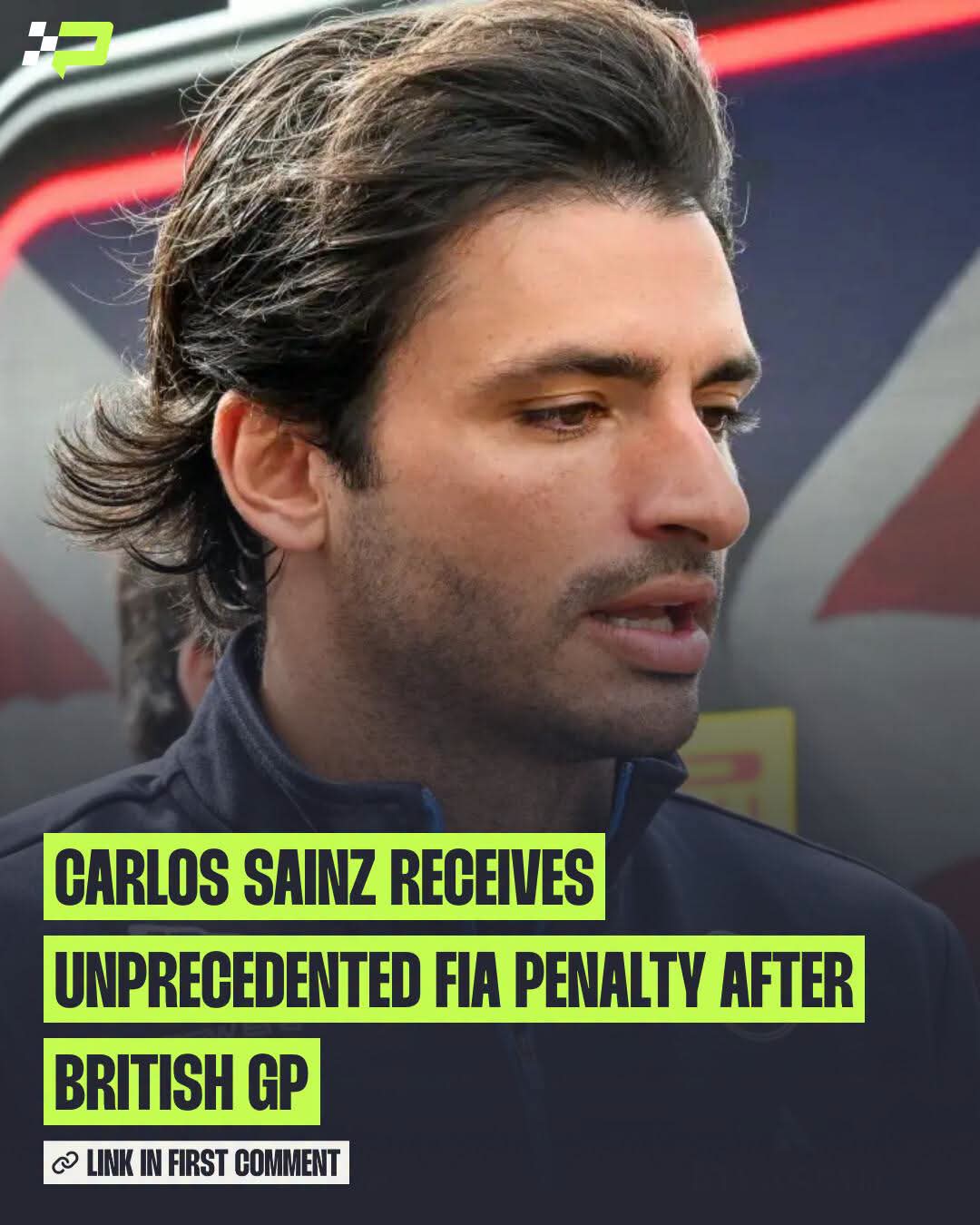
The 2026 British Grand Prix continues to generate headlines long after the checkered flag, with the FIA issuing one of the most unusual penalties Formula 1 has seen in modern times. Williams driver Carlos Sainz became the center of attention after race officials handed him a one-lap penalty following confusion during the Safety Car period at Silverstone.
Although the punishment ultimately had little effect on the championship standings because Sainz finished outside the points, the decision has sparked widespread discussion about race control, communication between teams and drivers, and whether Formula 1’s regulations need to become clearer in complex race situations.
SAFETY CAR CONFUSION CREATED A CHAIN REACTION
The closing laps of the British Grand Prix were already surrounded by controversy after Max Verstappen’s crash triggered a late Safety Car deployment.
Race control initially displayed a “Safety Car In This Lap” message, leading teams, drivers, broadcasters, and fans to believe the race would restart for one final lap of competitive action. Instead, the Safety Car remained on track until the finish, denying fans the dramatic ending many expected.
The FIA later confirmed that the restart message had appeared because of a software error, but the confusion extended beyond the battle for victory. It also played a significant role in Carlos Sainz’s penalty.
WHY CARLOS SAINZ WAS PENALIZED
According to the FIA’s explanation, Sainz found himself in an unusual position because of Silverstone’s unique pit lane and track configuration.
Although his Williams had briefly become unlapped during the Safety Car sequence, officials determined he did not officially qualify as one of the cars permitted to overtake the Safety Car when Race Control instructed lapped cars to pass.
Williams mistakenly believed Sainz was eligible to regain his lap and instructed him accordingly. As a result, Sainz overtook the Safety Car without authorization and effectively gained a lap he was not entitled to receive.
The FIA concluded that the team had misunderstood both Sainz’s classification and the official Race Control message, which specifically listed the cars allowed to overtake.
AN EXTRAORDINARY PENALTY IN MODERN FORMULA 1
Rather than issuing the more familiar five-second or ten-second time penalty, race stewards opted for something rarely seen in Formula 1: a one-lap penalty.
The decision immediately attracted attention because penalties of this nature are virtually unheard of in the modern era.
The FIA stated that the International Sporting Code gives stewards the authority to impose such a sanction when deemed appropriate. Officials believed removing the incorrectly gained lap represented the fairest way to restore the correct race order.
Sainz was initially classified 12th before being dropped to 17th in the final classification.
WHY THE PENALTY HAD LIMITED IMPACT
Fortunately for Williams, the punishment did not alter the championship picture significantly.
Sainz had already finished outside the top ten, meaning he was not in line to score points regardless of the final adjustment.
However, the incident still represents an embarrassing operational mistake for a team that has worked hard to improve its competitiveness throughout the 2026 campaign.
Every procedural error becomes increasingly costly in Formula 1, where fractions of a second—and sometimes even misunderstandings—can influence championship battles.
WHAT THIS SAYS ABOUT FIA PROCEDURES
The British Grand Prix highlighted more than one weakness in Formula 1’s race management.
First came the accidental “Safety Car In This Lap” notification, which confused nearly everyone following the race. Then came Sainz’s penalty, which stemmed from interpreting an already complicated sequence of Safety Car regulations.
While the FIA provided detailed reasoning afterward, many observers believe these situations should never become this confusing in the first place.
Formula 1 prides itself on technological excellence, yet software mistakes and communication breakdowns continue to create avoidable controversy.
Improving Race Control systems may now become a priority before similar incidents affect future championship-deciding races.
WILLIAMS WILL WANT TO LEARN FROM THE MISTAKE
Williams has shown encouraging progress during the 2026 season, with Sainz bringing valuable experience to the historic British team.
However, this incident serves as a reminder that success in Formula 1 depends just as much on flawless operational execution as it does on outright speed.
Every instruction from the pit wall must be accurate, particularly during Safety Car periods where regulations become increasingly complex.
Expect Williams to conduct a thorough internal review to ensure similar communication errors are avoided during the remainder of the season.
WHAT THIS MEANS FOR THE REST OF THE CHAMPIONSHIP
Although Sainz’s penalty did not directly influence the points standings, the British Grand Prix exposed several issues that could have far greater consequences later in the year.
With multiple teams still fighting for podiums, race victories, and championship positions, any confusion involving Safety Car procedures could become decisive in upcoming races.
The FIA will likely face renewed pressure to simplify communication protocols and eliminate the possibility of software-generated errors creating unnecessary controversy.
As Formula 1 heads toward the next phase of the season, teams will undoubtedly pay even closer attention to Race Control instructions during caution periods.
FINAL THOUGHTS
Carlos Sainz’s unusual one-lap penalty will be remembered as one of the most extraordinary stewarding decisions in recent Formula 1 history.
While the punishment had little practical effect on the final results, it has reopened discussions about the clarity of FIA regulations, team communication, and the reliability of Formula 1’s race management systems.
For Williams, the incident represents a frustrating lesson in precision. For the FIA, it serves as another reminder that consistency and transparency remain essential as the sport continues evolving.
With championship battles tightening across the grid, everyone involved will hope Silverstone’s chaotic finale becomes the exception rather than the beginning of a troubling trend.