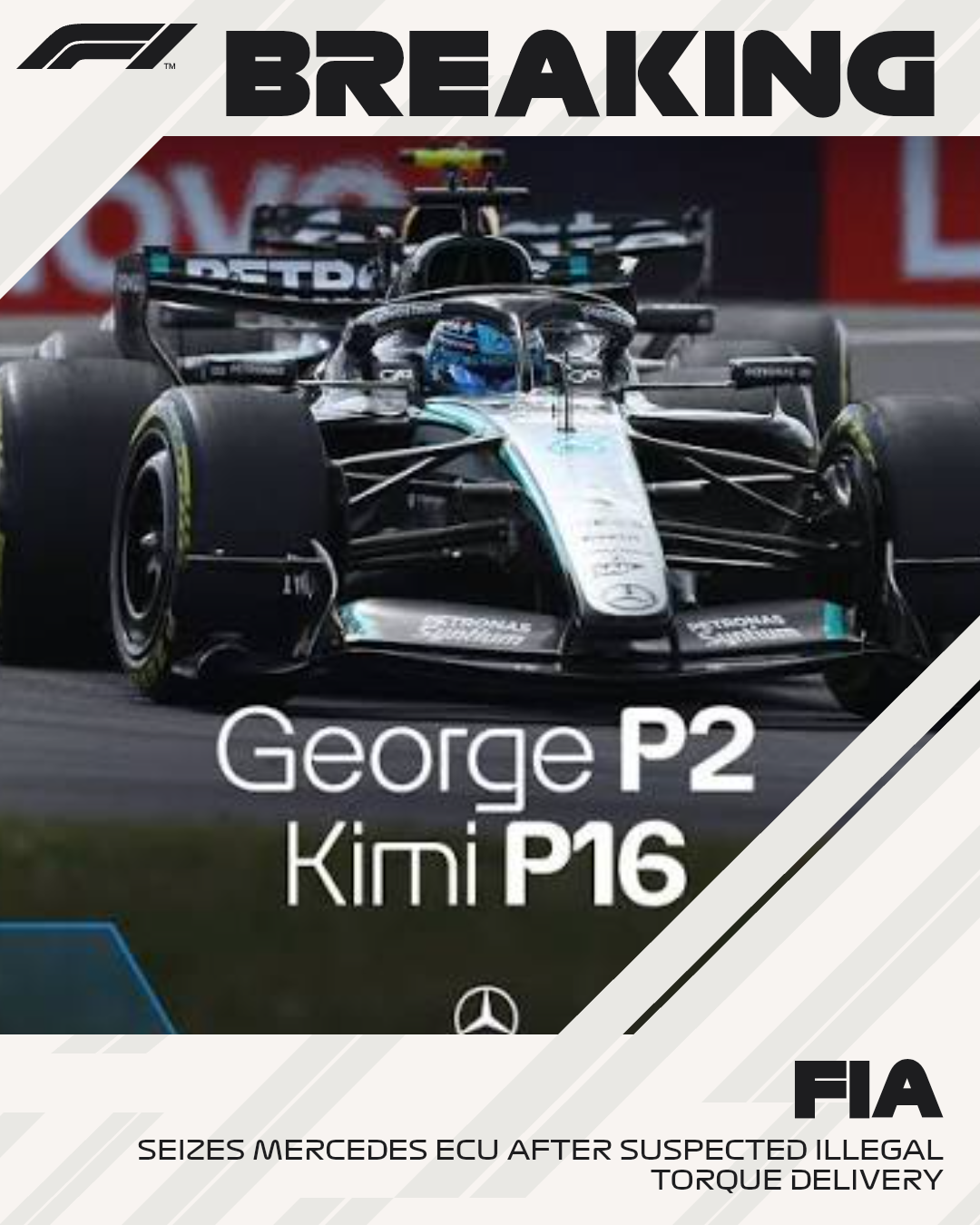
Formula 1 has been rocked by fresh controversy after reports emerged that the FIA has seized a Mercedes Electronic Control Unit (ECU) following suspicions surrounding the team’s torque delivery system. If confirmed, the investigation could become one of the most significant technical probes of the 2026 season, potentially carrying serious implications for Mercedes’ championship campaign and Formula 1’s strict technical regulations.
FIA LAUNCHES TECHNICAL INVESTIGATION INTO MERCEDES
According to the claim, FIA technical officials confiscated a Mercedes ECU for detailed analysis after identifying what they believe could be irregular torque delivery characteristics during recent race weekends. The ECU serves as the central electronic brain of every Formula 1 car, controlling vital systems including power unit management, energy deployment, throttle response, and torque output.
At this stage, there has been no official confirmation from the FIA or Mercedes, and no rule breach has been established. Investigations of this nature are standard procedure whenever governing officials identify telemetry or performance data that warrants closer examination.
WHY TORQUE DELIVERY IS SO IMPORTANT IN MODERN FORMULA 1
Under Formula 1’s highly sophisticated hybrid regulations, managing engine torque has become one of the biggest performance differentiators between manufacturers. Teams constantly work to optimize how power is delivered to the rear wheels, especially when exiting corners where traction determines acceleration onto long straights.
Even the slightest advantage in torque application can translate into tenths of a second over an entire lap. That makes torque mapping one of the most closely monitored aspects of Formula 1’s technical regulations.
The FIA carefully regulates how teams manage these systems to ensure competitors remain within legal operating limits. Any suggestion that software or electronic systems are manipulating torque beyond what regulations permit immediately attracts scrutiny.
WHAT THE ECU ANALYSIS COULD REVEAL
If FIA engineers are indeed examining Mercedes’ ECU, the investigation will likely focus on software calibration, power deployment patterns, sensor data, and electronic mapping strategies.
Modern Formula 1 investigations rely heavily on digital evidence rather than visual inspection alone. Engineers can compare telemetry, throttle traces, wheel speed, hybrid deployment, and torque curves against regulatory parameters to determine whether a system operates legally.
Importantly, seizing an ECU does not imply guilt. Technical inspections are designed to verify compliance, and many investigations conclude with teams being cleared after detailed analysis.
POTENTIAL IMPACT ON THE CHAMPIONSHIP
Should the investigation ultimately uncover any technical infringement, the consequences could be substantial. Depending on the severity of any violation, penalties could range from warnings and technical directives to race disqualifications or championship implications.
Mercedes currently remains deeply involved in both championship battles, making any technical investigation especially significant. Even uncertainty surrounding the team’s power unit could create additional pressure as rivals attempt to capitalize on any disruption.
Conversely, if Mercedes is cleared, the outcome would reinforce confidence in its engineering program while putting speculation surrounding its performance to rest.
FORMULA 1’S STRICT TECHNICAL ENFORCEMENT CONTINUES
The 2026 regulations have introduced one of the most technologically complex eras in Formula 1 history. With increased hybrid dependency and advanced software controlling virtually every aspect of performance, FIA technical inspections have become more detailed than ever before.
Every leading team understands that success now depends not only on building fast cars but also on remaining fully compliant with increasingly sophisticated electronic regulations.
This latest report serves as another reminder that Formula 1’s fiercest battles are often fought behind computer screens and inside engineering departments long before drivers reach the racetrack.
WAITING FOR OFFICIAL ANSWERS
For now, the Formula 1 community will be watching closely for any official statement from the FIA or Mercedes regarding the reported ECU seizure.
Until verified information is released, the situation remains an unconfirmed report rather than an established rule violation. However, if the investigation develops further, it could become one of the defining technical stories of the 2026 Formula 1 season, with implications stretching far beyond a single race weekend.