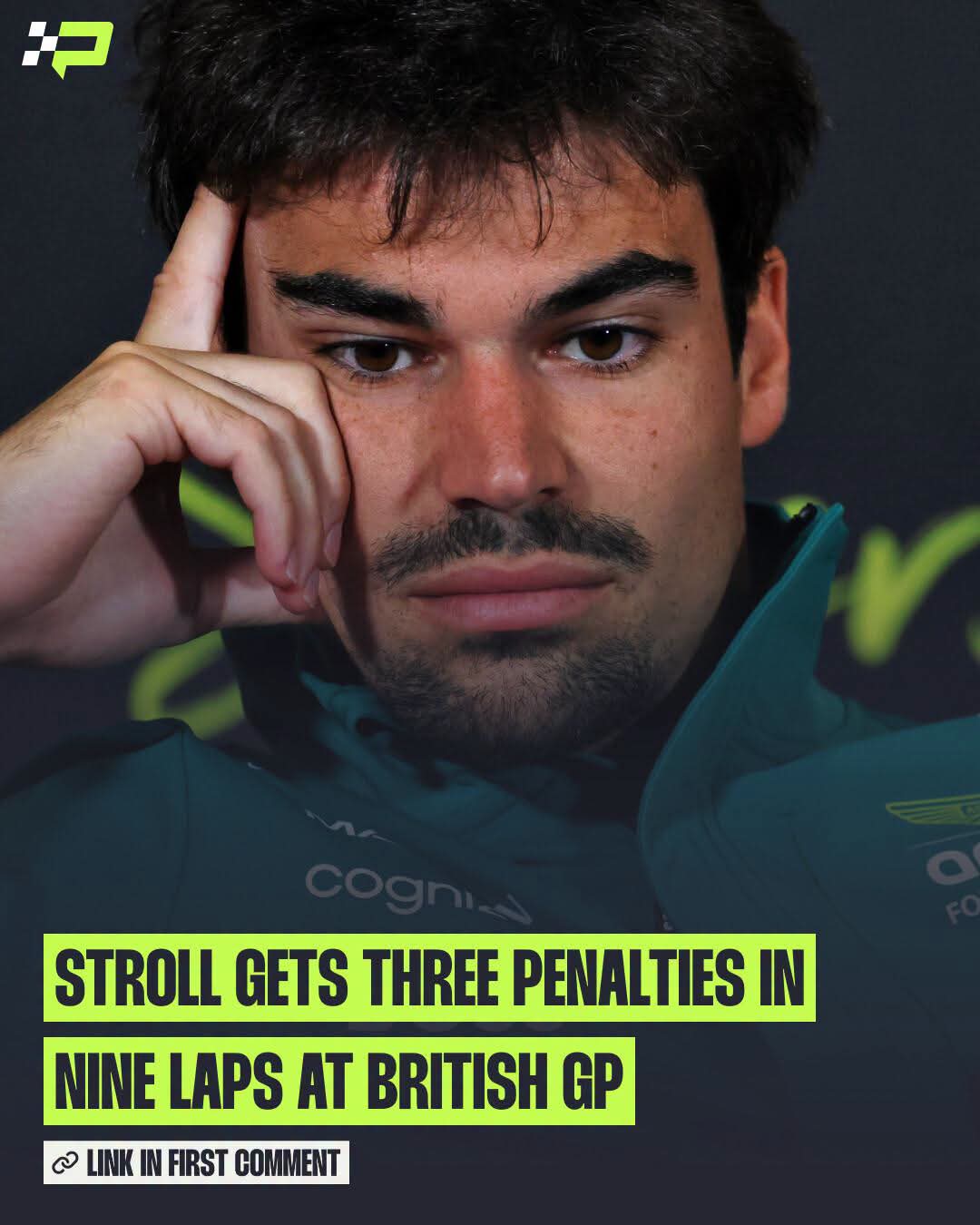
Lance Stroll’s difficult weekend at the 2026 British Grand Prix went from bad to worse after the FIA confirmed that the Aston Martin driver received three separate five-second time penalties for repeated track limits violations. While the penalties ultimately had little impact on the final points standings, they highlighted Aston Martin’s ongoing competitiveness issues and raised fresh questions about the team’s direction as the Formula 1 season enters a crucial phase.
Silverstone proved to be another frustrating outing for the Silverstone-based team, with both Stroll and Fernando Alonso struggling to escape the back of the field despite racing at Aston Martin’s home circuit.
REPEATED TRACK LIMITS ERRORS COST STROLL DEARLY
Formula 1’s track limits regulations have become increasingly strict over recent seasons, with race control relying on advanced monitoring systems to detect even the smallest violations. Drivers are permitted three track limits infringements during a race before automatic penalties begin to apply.
Unfortunately for Stroll, he exceeded that allowance.
The Canadian collected his fourth infringement on Lap 33 at Club Corner, triggering his first five-second penalty. Just two laps later, another excursion at Copse Corner resulted in a second penalty. His afternoon deteriorated further on Lap 42 when he exceeded track limits once again at Stowe Corner, leading to a third five-second sanction.
By the end of the race, Stroll had accumulated six track limits violations, making him one of the most penalized drivers of the British Grand Prix.
WHY TRACK LIMITS CONTINUE TO DIVIDE FORMULA 1
Track limits remain one of the most controversial topics in modern Formula 1.
The FIA argues that enforcing limits equally ensures fairness by preventing drivers from gaining an advantage through wider racing lines. Critics, however, believe that repeated penalties interrupt the natural flow of racing and often punish drivers who are already battling difficult car handling conditions.
Silverstone is particularly demanding because many of its high-speed corners tempt drivers to push beyond the white lines in search of additional lap time. Corners such as Copse, Stowe, and Club have regularly generated penalties throughout recent seasons.
Stroll’s race serves as another reminder that consistency behind the wheel is now just as important as outright speed.
ASTON MARTIN’S BIGGER PROBLEM GOES FAR BEYOND PENALTIES
While the penalties grabbed headlines, Aston Martin’s lack of performance remains the team’s biggest concern.
For the fourth consecutive Grand Prix weekend, both Aston Martin drivers found themselves qualifying near the back of the grid. Instead of fighting for points, the team spent most of Sunday’s race battling simply to stay competitive against midfield rivals.
Fernando Alonso also endured another difficult afternoon, finishing only one position ahead of Stroll despite avoiding the costly penalties.
For a team that entered the season hoping to challenge the leading manufacturers, the current reality has become increasingly disappointing.
HOME RACE DISAPPOINTMENT ADDS PRESSURE
The British Grand Prix always carries added significance for Aston Martin.
With the team’s headquarters located only a short distance from Silverstone, expectations are naturally higher whenever Formula 1 visits Britain. Engineers, factory staff, sponsors, and thousands of employees look forward to seeing the team perform strongly on home soil.
Instead, Aston Martin left the weekend without points and with another reminder that its development programme has yet to produce the improvements needed to close the gap to Ferrari, Mercedes, and the other front-running teams.
As rivals continue introducing effective upgrades, Aston Martin appears to be losing ground rather than gaining it.
FIA’S BUSY WEEKEND REFLECTS SILVERSTONE CHAOS
Stroll’s penalties formed part of an unusually busy weekend for Formula 1 stewards.
Lewis Hamilton escaped with only a reprimand following a yellow flag investigation, while Carlos Sainz received an unprecedented one-lap penalty after overtaking the Safety Car under exceptional circumstances. Race officials also spent considerable time explaining the controversial Safety Car procedures that prevented the British Grand Prix from finishing under green flag conditions.
The volume of steward decisions demonstrates how closely Formula 1 races are now monitored, with virtually every incident reviewed using telemetry, onboard cameras, GPS positioning, and race control data.
WHAT ASTON MARTIN MUST FIX BEFORE THE NEXT RACE
For Aston Martin, the focus now shifts toward solving performance issues rather than dwelling on penalties.
Reducing driver errors is certainly important, but improving the car’s pace remains the priority. Drivers forced to push beyond the limits often do so because they are searching for performance their machinery cannot consistently deliver.
Upcoming races will provide further opportunities for Aston Martin to introduce upgrades, but time is becoming increasingly limited. Every weekend spent outside the points makes recovering ground in both championships significantly more difficult.
The Belgian Grand Prix at Spa-Francorchamps will offer another important benchmark for measuring whether recent development work is beginning to pay off.
FINAL THOUGHTS
Lance Stroll’s triple penalty at Silverstone may appear severe, but it reflects Formula 1’s increasingly strict approach to enforcing track limits. More importantly, however, the penalties expose a deeper issue facing Aston Martin.
The team is no longer losing races because of isolated mistakes—it is struggling to consistently compete with the midfield, forcing its drivers into situations where they must push beyond the car’s natural limits.
Unless Aston Martin can unlock meaningful performance improvements in the coming rounds, weekends like the British Grand Prix could become an all-too-familiar pattern. With rival teams continuing to evolve and the championship entering its decisive stages, the pressure is mounting for Aston Martin to deliver answers before its season slips even further away.