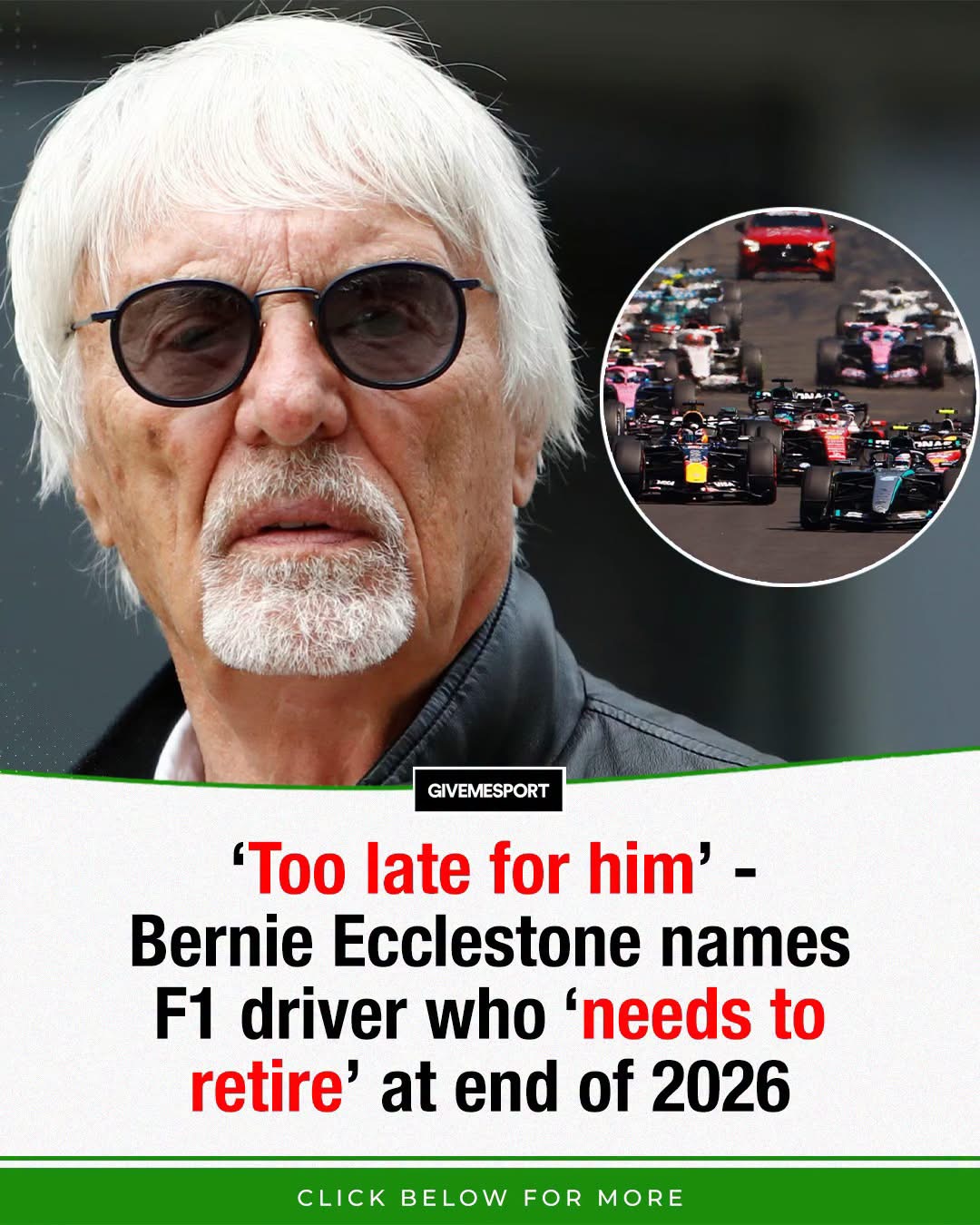
Lewis Hamilton has been handed another uncomfortable verdict about his Formula 1 future, with former F1 boss Bernie Ecclestone suggesting that the seven-time world champion should consider retiring at the end of the 2026 season.
The 96-year-old has delivered a particularly harsh assessment of Hamilton’s recent performances, criticising his frequent complaints over team radio and questioning whether the British driver can still make the impact he wants at Ferrari.
Hamilton joined Ferrari in 2025 with enormous expectations after ending his long-standing partnership with Mercedes. However, his move to Maranello has not produced the immediate success many anticipated, and the criticism surrounding his performances has continued.
Ecclestone’s comments add another layer of pressure to an already challenging period for the 41-year-old, whose long-term future beyond his current Ferrari contract remains uncertain.
ECCLESTONE DELIVERS HARSH VERDICT ON HAMILTON
Speaking to Sky Sports Germany, Ecclestone questioned Hamilton’s attitude during race weekends and suggested that the British driver was becoming increasingly frustrated behind the wheel.
The former Formula 1 commercial chief did not hold back when discussing the seven-time champion.
“When he gets into the car to start a race, he’s already whining and complaining about something before the first corner – no matter what it is. He’s getting to the age where he has to think about retiring,” Ecclestone said.
The comments are particularly striking considering Hamilton’s achievements in the sport.
With seven world championships, 105 Grand Prix victories and a record-breaking career spanning nearly two decades, Hamilton has already established himself among Formula 1’s greatest drivers.
However, Ecclestone clearly believes that the British star’s current performances and approach to racing raise questions about how much longer he should continue competing.
His remarks are an opinion rather than an indication of any confirmed retirement decision from Hamilton.
FERRARI’S DRIVER STRUCTURE ALSO COMES UNDER FIRE
Ecclestone did not limit his criticism to Hamilton’s performances. He also questioned whether the driver’s approach fits the way Ferrari operates.
The former F1 boss compared Hamilton’s position with that of Charles Leclerc, arguing that the Monegasque driver has a stronger connection with the organisation.
“Leclerc is a Ferrari man. Hamilton, on the other hand, came and tried to change the way Ferrari works. It’s too late for him to do that as an individual,” Ecclestone explained.
He also argued that Ferrari would benefit from having a clearly established number one driver supported by a capable teammate who understands his role.
That assessment touches on one of the biggest challenges facing the Scuderia.
Ferrari have two highly experienced and ambitious drivers, both of whom naturally want to compete at the front. Managing their expectations while maintaining a competitive atmosphere is not always straightforward.
However, establishing a number one driver is not automatically the solution. Ferrari must also consider performance, consistency and the championship situation before making any decision that could affect its driver hierarchy.
HAMILTON’S FERRARI MOVE HAS NOT GONE TO PLAN
Hamilton’s arrival at Ferrari in 2025 was one of the biggest stories in modern Formula 1.
After spending more than a decade with Mercedes and winning six of his seven world championships with the team, he made the dramatic decision to join the Italian outfit in pursuit of another championship opportunity.
The move generated enormous excitement, with supporters expecting the combination of Hamilton’s experience and Ferrari’s resources to produce immediate results.
Instead, his first season proved extremely difficult.
He failed to secure a Grand Prix podium throughout the 2025 campaign, marking the first time in his Formula 1 career that he had completed a full season without reaching the podium.
The 2026 campaign has brought some improvement, with Hamilton recording seven podium finishes across the first 20 races, according to the figures in the report.
Nevertheless, those results have not completely silenced questions about his adaptation to Ferrari or whether the team has provided him with a car capable of matching his ambitions.
LECLERC’S POSITION CREATES ANOTHER COMPLICATED QUESTION
Hamilton’s relationship with Leclerc is another important part of the Ferrari story.
The two drivers are both proven talents, but they have different experiences, driving styles and relationships with the team.
Leclerc has spent much of his Formula 1 career representing Ferrari and understands its internal environment. Hamilton, meanwhile, arrived with the experience of leading a championship-winning operation at Mercedes.
That difference could create challenges when disagreements emerge over strategy, car development or the direction of the team.
Ecclestone’s suggestion that Ferrari needs a clear number one reflects a traditional approach to team management.
However, Ferrari must be careful. Prioritising one driver too early could create unnecessary tension and potentially weaken its overall competitiveness.
The most effective solution may be to establish clear communication and decision-making processes rather than automatically treating one driver as the permanent number one.
WILL HAMILTON REALLY RETIRE AT THE END OF 2026?
Despite Ecclestone’s comments, there is currently no indication that Hamilton is preparing to retire at the end of this season.
The report states that his Ferrari contract runs until at least the end of 2027, meaning he is expected to remain with the team next year.
His future beyond that agreement is less certain, but the decision will ultimately depend on his own ambitions, Ferrari’s competitiveness and whether he still believes he can fight for major honours.
Hamilton has repeatedly demonstrated that he is motivated by competition and the desire to win. A difficult period at Ferrari does not automatically mean that his appetite for Formula 1 has disappeared.
At 41, age is naturally becoming part of the discussion, but experience remains a valuable asset in a championship where technical understanding, race management and consistency can make a significant difference.
The bigger question is whether Ferrari can give him the machinery and environment required to compete at the level he expects.
ECCLESTONE’S COMMENTS ADD PRESSURE TO FERRARI’S FUTURE
Ecclestone’s intervention has reignited an important debate about Hamilton’s place in modern Formula 1.
There is no denying that his Ferrari move has fallen short of the extraordinary expectations surrounding it. Equally, his achievements and recent podium results demonstrate that he remains capable of competing at a high level.
Ferrari now face a crucial period in deciding how to maximise the potential of both Hamilton and Leclerc.
For Hamilton, the remaining races of 2026 offer another opportunity to demonstrate that he still has something significant to contribute.
For Ecclestone, however, the verdict is already clear: he believes the British champion should start considering retirement.
Whether Hamilton listens to that advice is another matter entirely. His contract, competitive ambitions and personal determination suggest that the final decision will be his alone.