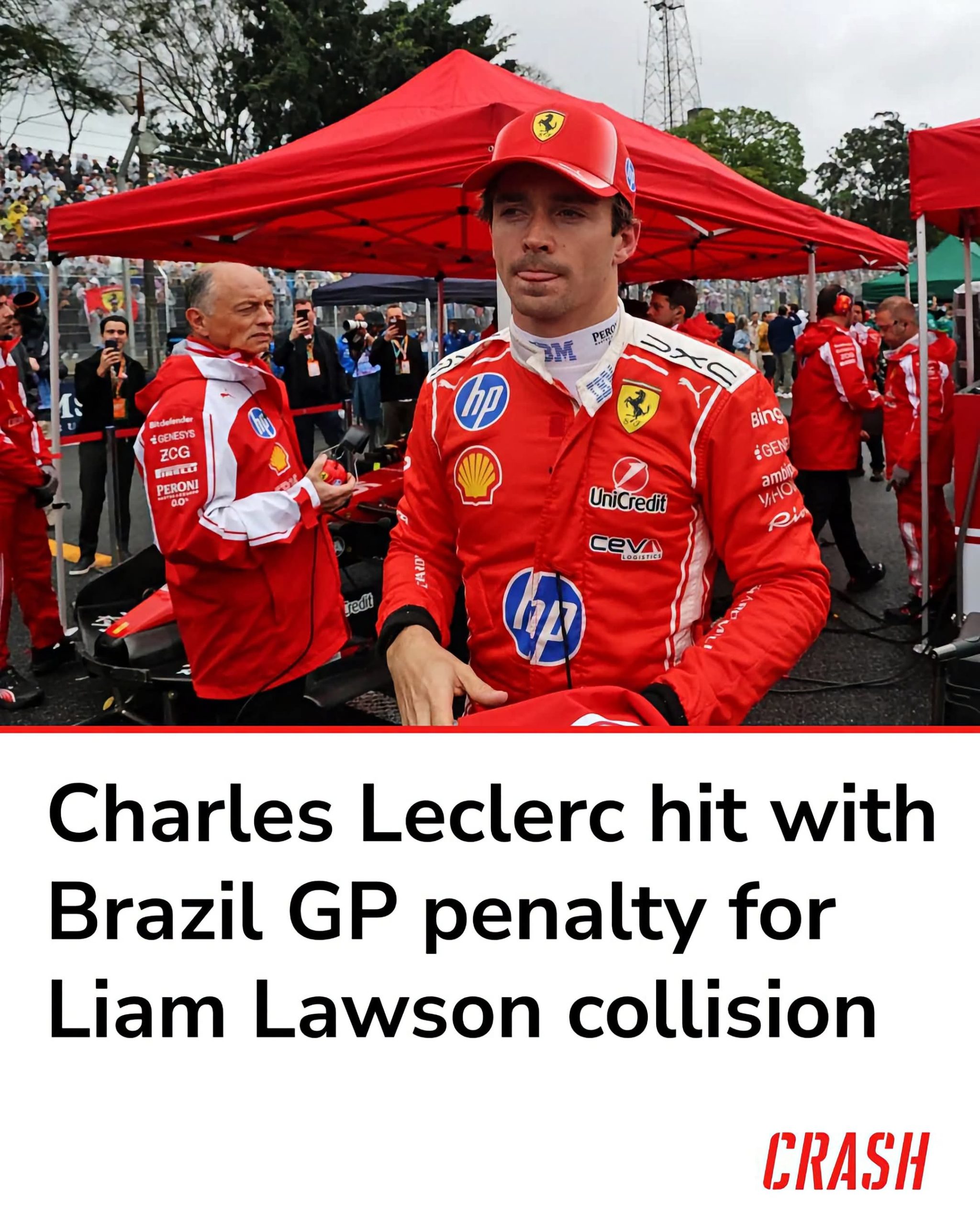
Charles Leclerc has been handed a five-second time penalty following a late-race collision with Liam Lawson at the 2026 São Paulo Grand Prix, costing the Ferrari driver a valuable position in the final classification at Interlagos. What initially appeared to be an aggressive but ordinary battle for position has now become another controversial moment in an increasingly tense Formula 1 season, with the stewards ruling that Leclerc gained a sporting advantage from the contact.
The incident happened during the closing stages of the rain-affected 71-lap race as Leclerc and Lawson fought for seventh place. The Ferrari driver was attempting to move ahead of the Racing Bulls competitor at Juncao when the two cars made contact. Although Lawson initially managed to maintain his position, the incident affected the remainder of their battle and gave Leclerc an opportunity to complete the overtake several corners later.
Leclerc eventually crossed the finish line in seventh place, just 1.816 seconds ahead of Lawson. However, the stewards’ investigation changed the outcome. His five-second penalty dropped him to eighth, while Lawson was promoted to seventh. Leclerc therefore finished directly ahead of his Ferrari teammate Lewis Hamilton, who secured ninth place after a difficult afternoon.
WHY THE FIA PENALISED CHARLES LECLERC
The stewards’ explanation made it clear that the decision was not based simply on the existence of contact between the two cars. Instead, their investigation focused on whether the collision had influenced the outcome of the battle.
According to the stewards, Lawson had the right to the corner under the Driving Standard Guidelines, meaning Leclerc was responsible for taking the necessary steps to avoid a collision. Although the contact was considered minor, the officials concluded that it disrupted Lawson and allowed the Ferrari driver to close the gap before completing his overtake.
Lawson also reported that the collision damaged the rear-left rim of his car. More importantly, the stewards believed the contact had an obvious sporting consequence because Leclerc was able to get alongside and eventually pass him after the incident.
Leclerc had argued that the contact was minor and produced no obvious sporting advantage. However, the officials disagreed after reviewing the footage and the sequence of events. Their conclusion was that the Ferrari driver had benefited from the incident, making a penalty necessary.
The five-second sanction was also a measured decision. The stewards acknowledged the difficult wet conditions and the relatively minor nature of the contact when deciding against imposing the more severe 10-second penalty.
LECLERC DISAGREES WITH THE STEWARDS’ INTERPRETATION
Leclerc appeared surprised that the incident had attracted an investigation, explaining after the race that he considered the exchange part of normal competitive racing.
The Ferrari driver described the battle as being on the limit but maintained that such moments are part of Formula 1. He also indicated that he only became aware of the investigation after the race, suggesting that he had not initially considered the contact serious enough to attract punishment.
His reaction highlights one of the biggest challenges facing modern Formula 1 drivers. The difference between aggressive racing and an infringement can be extremely small, particularly when competitors are fighting for positions in the closing laps.
Drivers are expected to defend their positions firmly while avoiding contact that could compromise another competitor. However, wet-weather conditions make that balance even more difficult. Reduced grip, unpredictable braking distances and limited opportunities to recover from mistakes can turn a seemingly minor move into a stewards’ investigation.
From Leclerc’s perspective, he was attempting to gain a position during a competitive battle. From the stewards’ perspective, the manner in which he attempted the move created an advantage that would not have been available without the collision.
LIAM LAWSON BENEFITS FROM AN IMPORTANT LATE-RACE DECISION
For Lawson, the ruling represented an important reward after a demanding race at Interlagos. The Racing Bulls driver had defended his position against one of Ferrari’s most experienced competitors and ultimately recovered seventh place through the stewards’ decision.
Finishing ahead of Leclerc is a significant result for Lawson, particularly considering the difference in resources and experience between Ferrari and Racing Bulls. Although the two teams operate within the same Red Bull ownership structure, they compete separately in the constructors’ championship, making every finishing position valuable.
Lawson’s performance also adds another encouraging result to his efforts to establish himself in Formula 1. With uncertainty surrounding several driver positions ahead of the 2027 season, strong performances against established names can help strengthen a driver’s reputation.
However, the result should not be viewed as evidence that Lawson had an entirely comfortable afternoon. He was under pressure from Leclerc and had to defend aggressively before the collision changed the nature of their battle. His ability to remain competitive until the finish was nevertheless important.
ANOTHER COMPLICATED WEEKEND FOR FERRARI
Leclerc’s penalty added another frustrating chapter to Ferrari’s Brazilian Grand Prix weekend. The Scuderia arrived at Interlagos hoping to collect valuable points, but its drivers faced several challenges across the event.
Hamilton started from the back of the grid following an engine-related penalty and fought his way into the points. However, tyre difficulties and a costly communication problem involving changing weather conditions prevented him from achieving a stronger result.
Leclerc also faced a difficult starting position and had to work his way through the field. His late battle with Lawson offered an opportunity to secure seventh place, but the penalty ultimately reduced Ferrari’s points return.
For a team competing against Mercedes, McLaren and Red Bull, these small losses can become increasingly important. Ferrari cannot afford to allow individual incidents, strategic mistakes or unnecessary penalties to undermine its efforts to remain competitive.
The bigger concern is consistency. A team may produce a competitive car and give its drivers opportunities to fight for strong results, but those advantages become less meaningful if race execution repeatedly creates avoidable setbacks.
MERCEDES CELEBRATES WHILE FERRARI FACES MORE QUESTIONS
The contrasting fortunes of Ferrari and Mercedes made the Brazilian Grand Prix even more significant. Mercedes secured the 2026 Constructors’ Championship at Interlagos, adding another major achievement to Toto Wolff’s successful leadership period.
While Mercedes celebrated another championship, Ferrari was left examining a weekend in which its drivers struggled to convert their opportunities into stronger results.
Leclerc’s penalty was not responsible for Ferrari’s wider difficulties, but it reinforced the importance of making every opportunity count. At the highest level of Formula 1, losing one position can affect championship points, team momentum and the final assessment of a driver’s weekend.
Ferrari will also need to ensure that its drivers remain comfortable taking calculated risks without allowing those decisions to create unnecessary consequences. Leclerc’s attacking approach is one of his strengths, but the Brazilian incident demonstrates how quickly an ambitious move can become costly.
WHAT THE PENALTY MEANS FOR LECLERC AND LAWSON
The immediate consequence is straightforward: Lawson moves into seventh place, Leclerc drops to eighth, and Hamilton remains ninth in the final classification.
Beyond the points, however, the incident raises another question about how aggressively drivers can race under the current interpretation of the rules. Formula 1 fans regularly demand closer battles and more decisive overtaking attempts, but penalties for contact can create frustration when drivers believe they are simply competing at the limit.
The stewards’ decision provides a reminder that an overtake is not judged only by whether a driver successfully completes it. The circumstances leading to the move matter just as much, particularly when contact changes the defending driver’s ability to maintain their position.
Leclerc may feel that the punishment was harsh given the wet conditions and relatively minor contact, but the FIA’s reasoning was based on the sporting advantage it believed he gained.
BRAZILIAN GP FALLOUT ADDS TO THE PRESSURE AHEAD OF THE NEXT RACE
The São Paulo Grand Prix delivered another dramatic weekend, with Lando Norris taking victory, Max Verstappen recovering from the back of the grid to finish second, and Isack Hadjar completing the podium.
Mercedes also secured the Constructors’ Championship, giving the team another reason to celebrate. Meanwhile, the post-race penalties ensured that the final classification did not remain exactly as it stood when the drivers crossed the finish line.
For Leclerc, the immediate priority will be putting the incident behind him and returning to the next race with a stronger result. His speed and ability to fight through the field remain important assets for Ferrari, but the team needs cleaner execution if it hopes to challenge consistently at the front.
Lawson, meanwhile, can take confidence from finishing ahead of the Ferrari driver after a demanding battle. His seventh-place finish provides another positive result at a time when every performance could matter for his future.
The biggest lesson from Interlagos is that Formula 1 races are not always decided by the chequered flag. Sometimes, a few seconds in the stewards’ room can change the result, reshape the points and turn an ordinary late-race battle into one of the weekend’s biggest talking points.