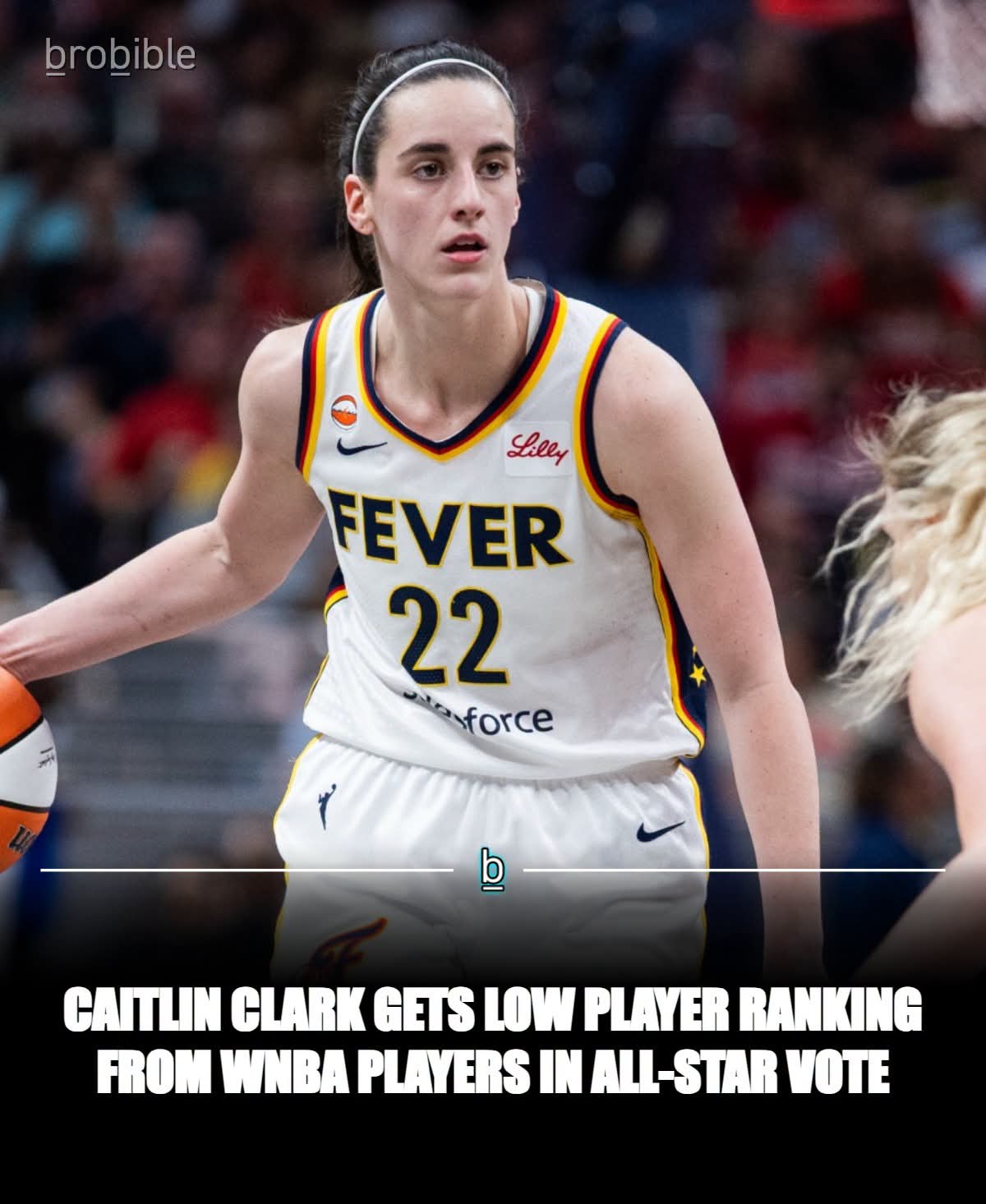
Caitlin Clark has once again become the center of one of the WNBA’s biggest talking points—this time because of how her fellow players view her. Despite earning a starting spot in the 2026 WNBA All-Star Game through the league’s voting process, newly released voting results revealed that Clark was ranked only the 11th-best guard by her peers.
The revelation has sparked widespread discussion among fans, analysts, and former players alike. While Clark continues to produce elite numbers and remains one of the league’s biggest attractions, her relatively low ranking among fellow WNBA players has reignited questions about whether respect inside the league is keeping pace with her impact on the court.
HOW THE WNBA ALL-STAR VOTING WORKS
Unlike many professional sports leagues, the WNBA uses a combined voting system to determine its All-Star starters.
Fan voting carries the greatest influence, accounting for 50 percent of the final result. Media members contribute another 25 percent, while active WNBA players make up the remaining 25 percent.
This system is designed to balance popularity with professional evaluation. Fans reward excitement and star power, media members often focus on performance and storylines, while players provide insight from those competing against each other every night.
Clark performed exceptionally well among fans and media voters, securing enough support to earn an All-Star starting position. However, the player vote told a very different story.
PLAYERS RANKED CLARK OUTSIDE THE TOP TEN
According to the released voting breakdown, WNBA players placed Clark as the 11th-best guard in the league.
That ranking surprised many observers considering Clark’s production this season.
She currently ranks among the league leaders in assists while also sitting near the top in scoring, numbers that typically place players firmly within All-Star conversations. Even more striking is that players ranked her ninth among guards during her rookie campaign, meaning her standing actually declined despite another outstanding statistical season.
The contrast between her production and peer evaluation immediately became one of the biggest discussions surrounding this year’s All-Star selections.
THE NUMBERS PAINT A DIFFERENT PICTURE
Statistically, Clark continues to perform like one of the WNBA’s elite guards.
Her ability to create offense for teammates has made her one of the league’s premier playmakers, while her scoring threat forces defenses to adjust every time she steps onto the floor.
Opposing teams routinely dedicate multiple defenders to limiting her influence, often trapping her well beyond the three-point line or designing defensive schemes specifically to disrupt Indiana’s offense.
Those defensive strategies suggest opponents clearly recognize Clark as one of the league’s most dangerous offensive players—even if the player voting results appear to indicate otherwise.
WHY THE PLAYER VOTE HAS CREATED SO MUCH CONTROVERSY
The player vote has always generated debate because athletes naturally possess perspectives different from fans or media members.
Players compete directly against one another, understand defensive responsibilities better than anyone, and often evaluate skills that traditional statistics cannot fully capture.
However, critics argue that player voting may also be influenced by personal rivalries, competitive emotions, previous encounters, or broader narratives that develop throughout a season.
Clark’s arrival has transformed the WNBA’s visibility unlike almost any rookie in league history. Increased media attention, larger television audiences, and sold-out arenas have simultaneously elevated the league while placing Clark under constant scrutiny.
Some observers believe that dynamic may contribute to differing opinions among players.
FANS RESPOND WITH IMMEDIATE BACKLASH
Social media reacted almost instantly once the player rankings became public.
Many fans questioned how someone producing elite statistics and commanding so much defensive attention could rank outside the top ten among guards.
One argument repeatedly surfaced across basketball discussions: opposing defenses certainly do not treat Clark like the 11th-best guard in the league.
Others suggested the player voting system itself should be reconsidered, arguing that competitive bias may influence results more heavily than objective evaluation.
Supporters of the current format counter that player opinions remain valuable precisely because they come from athletes facing Clark directly on the court.
WHAT THIS MEANS FOR THE WNBA
Beyond the individual ranking, the controversy highlights how much attention now surrounds every aspect of Clark’s career.
Only a few years ago, detailed All-Star voting breakdowns would have generated relatively modest discussion. Today, they dominate sports conversations across multiple platforms.
That increased visibility reflects the WNBA’s remarkable growth. Every award, ranking, suspension, and coaching decision now receives unprecedented public attention.
While debates can create division, they also demonstrate expanding fan engagement—something every professional league ultimately seeks.
COULD THIS BECOME EXTRA MOTIVATION?
Throughout her basketball career, Clark has consistently responded well when doubted.
Whether facing criticism during college or adjusting to the physical demands of professional basketball, she has repeatedly used outside opinions as motivation to improve.
This latest ranking may provide another opportunity to do exactly that.
Elite athletes often thrive on perceived disrespect, and Clark has shown she possesses the competitive mindset to channel criticism into stronger performances.
As the second half of the WNBA season unfolds, every standout game will inevitably be viewed through the lens of these voting results.
FINAL THOUGHTS
Caitlin Clark’s placement as the 11th-ranked guard in the player portion of the WNBA All-Star vote has become one of the season’s most fascinating storylines.
While fans and media clearly view her as one of the league’s premier stars, the player rankings reveal that opinions inside the league remain more divided.
Whether those rankings reflect genuine basketball evaluation, competitive bias, or simply differing perspectives, one fact remains undeniable: Clark continues producing at an elite level while helping drive unprecedented attention toward the WNBA.
As the All-Star Game approaches and the playoff race intensifies, Clark now has another opportunity to let her performances—not the rankings—shape the conversation.