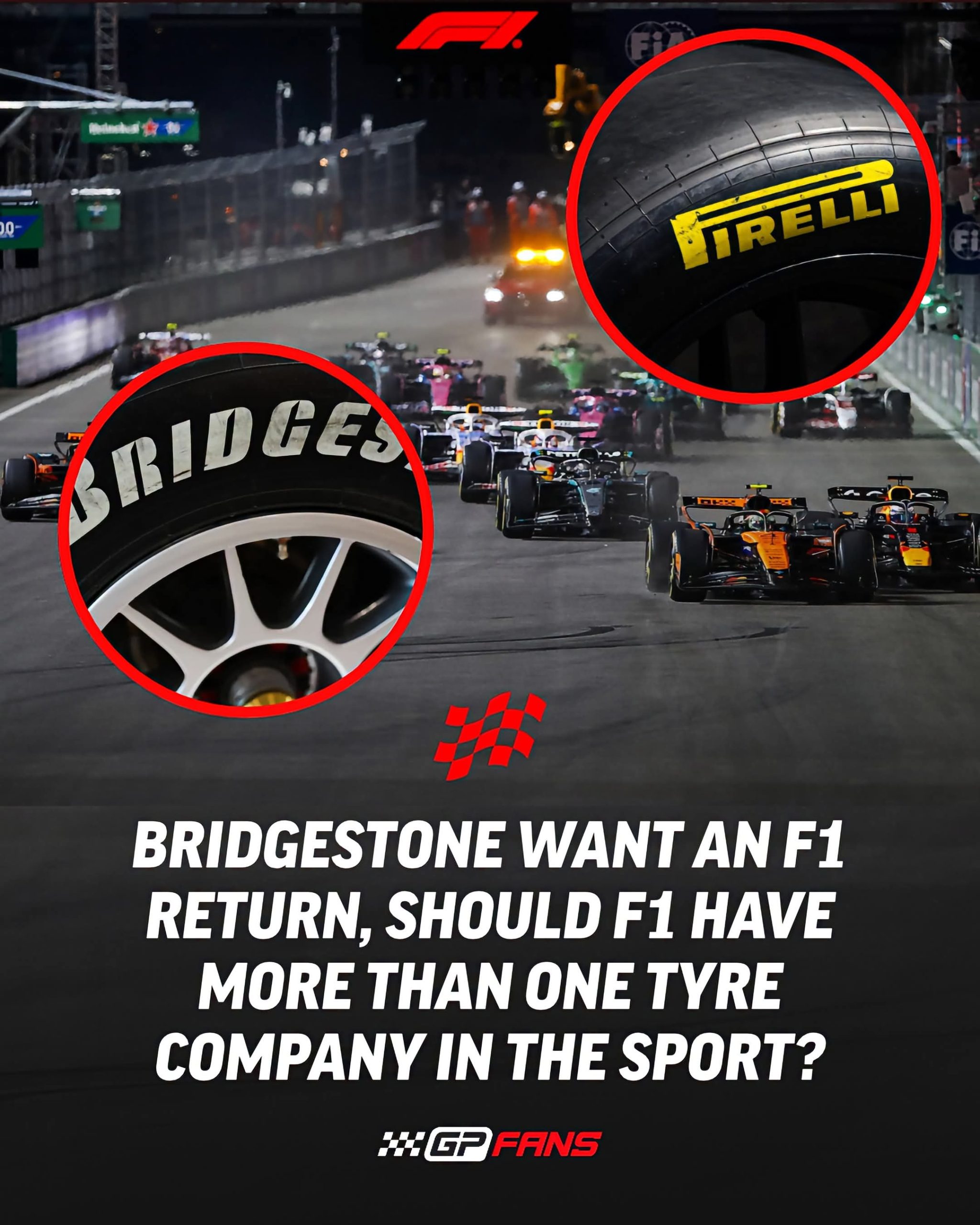
Formula 1 could be heading towards another major technical shake-up, with legendary tyre manufacturer Bridgestone reportedly pushing for a return to the sport ahead of the 2029 season. The Japanese company, which enjoyed considerable success during its previous involvement in F1, is preparing a fresh bid to become the championship’s official tyre supplier and potentially end Pirelli’s long-standing monopoly.
According to reports cited by GPFans and RacingNews365, Bridgestone is developing a technological, commercial and business package designed to strengthen its chances of winning the next tyre supply contract. The manufacturer reportedly has a strong opportunity after previously challenging Pirelli during the 2023 selection process but ultimately missing out.
Pirelli has supplied every Formula 1 team since 2011 and recently received a one-year contract extension that takes its current agreement through the end of 2028. However, the next tender process could open the door to a new competitor and introduce a different chapter in the sport’s tyre development.
BRIDGESTONE MAKES ITS MOVE FOR A FORMULA 1 COMEBACK
Bridgestone is not approaching the possibility of an F1 return without experienced personnel. Hiroshi Imai, who worked with the manufacturer between 1990 and 2008 before spending 15 years at McLaren, returned to Bridgestone in 2025.
Imai is reportedly leading the company’s efforts to secure a return to Formula 1. He is also understood to be part of the Bridgestone delegation that has attended recent Grands Prix, including the United States Grand Prix.
His experience across both sides of the sport could prove valuable. Having worked with Bridgestone during its previous F1 involvement and later gained extensive experience inside the McLaren garage, Imai understands the demands placed on tyre manufacturers by teams and drivers.
The reported bid is therefore about more than simply supplying tyres. Bridgestone will need to demonstrate that it can meet Formula 1’s technical requirements while offering a commercially attractive partnership.
A HISTORY OF 175 F1 VICTORIES
Bridgestone’s previous record in Formula 1 explains why its potential return is attracting attention.
The Japanese manufacturer entered the championship in 1997 with its Potenza tyres, initially competing against established supplier Goodyear. Although Bridgestone faced a difficult opening season, its development programme quickly produced results.
By the end of 1998, Goodyear had left Formula 1, leaving Bridgestone as the championship’s sole tyre supplier for the following seasons.
The company later faced competition from Michelin, which entered the sport in 2001 and helped create one of the most memorable tyre battles in modern F1 history.
Bridgestone eventually departed after the 2010 season, having accumulated an impressive 175 victories from 244 races since its 1976 debut in the championship.
That record gives the manufacturer a powerful historical connection to Formula 1 and provides a reminder of how competitive its tyres once were.
THE 2005 UNITED STATES GRAND PRIX REMAINS A WARNING
One of the most controversial moments in Formula 1’s tyre history came at the 2005 United States Grand Prix.
Michelin discovered that its tyres could not safely withstand the demands of Indianapolis Motor Speedway’s surface, particularly the diamond-cut asphalt on the banked final corner.
Despite efforts to find a solution, the Michelin-equipped teams withdrew before the race. Only six cars using Bridgestone tyres took the start, including the Ferraris of Michael Schumacher and Rubens Barrichello.
Schumacher went on to win one of the strangest races in F1 history, with the event becoming a major embarrassment for the championship.
Michelin subsequently left Formula 1 at the end of 2006, and the sport eventually moved towards maintaining a single official tyre supplier.
That decision has helped Formula 1 avoid the complications associated with competing tyre manufacturers, although the possibility of Bridgestone returning could reopen discussions about how much competition the sport actually wants.
PIRELLI’S POSITION IS UNDER INCREASING SCRUTINY
Despite the speculation surrounding Bridgestone, Pirelli has established a strong position in Formula 1.
The Italian manufacturer has supplied the championship continuously since 2011 and has worked closely with the FIA, teams and Formula 1 to develop tyres suited to modern racing.
Its tyre compounds are designed to create different levels of degradation, encouraging teams to consider strategic pit stops and giving drivers different performance options throughout a race.
However, Pirelli has also faced criticism, particularly over the performance of its full wet-weather tyres.
The full wet compound has frequently struggled to provide the confidence and visibility drivers need in heavy rain. In certain conditions, intermediates have been considered a more practical option, even when the track remains significantly wet.
The problem is not entirely down to the tyres. Modern F1 cars generate substantial spray, making visibility extremely difficult for drivers following closely behind another car.
Nevertheless, improving wet-weather performance remains an important challenge for any manufacturer hoping to become Formula 1’s next tyre supplier.
2029 COULD MARK THE BEGINNING OF A NEW TYRE ERA
With Pirelli’s current agreement running until the end of 2028, the next contract decision could become one of the most significant behind-the-scenes developments in Formula 1.
Bridgestone will need to convince the sport that its proposal offers meaningful technological benefits and the ability to support the championship’s long-term ambitions.
A return would also create an interesting situation for teams, particularly those that have become accustomed to working exclusively with Pirelli products for more than a decade.
However, a change of supplier would not automatically mean a return to the intense tyre wars of the early 2000s. Formula 1 may still prefer a single manufacturer to maintain consistency and avoid the technical and sporting complications of direct competition.
For now, Bridgestone’s reported interest remains a developing story rather than a confirmed agreement. Pirelli remains the official supplier, and no final decision on the next contract has been announced in the report.
But with a manufacturer boasting 175 F1 victories reportedly preparing another serious challenge, the battle for Formula 1’s next tyre contract could become one of the biggest stories heading towards 2029.