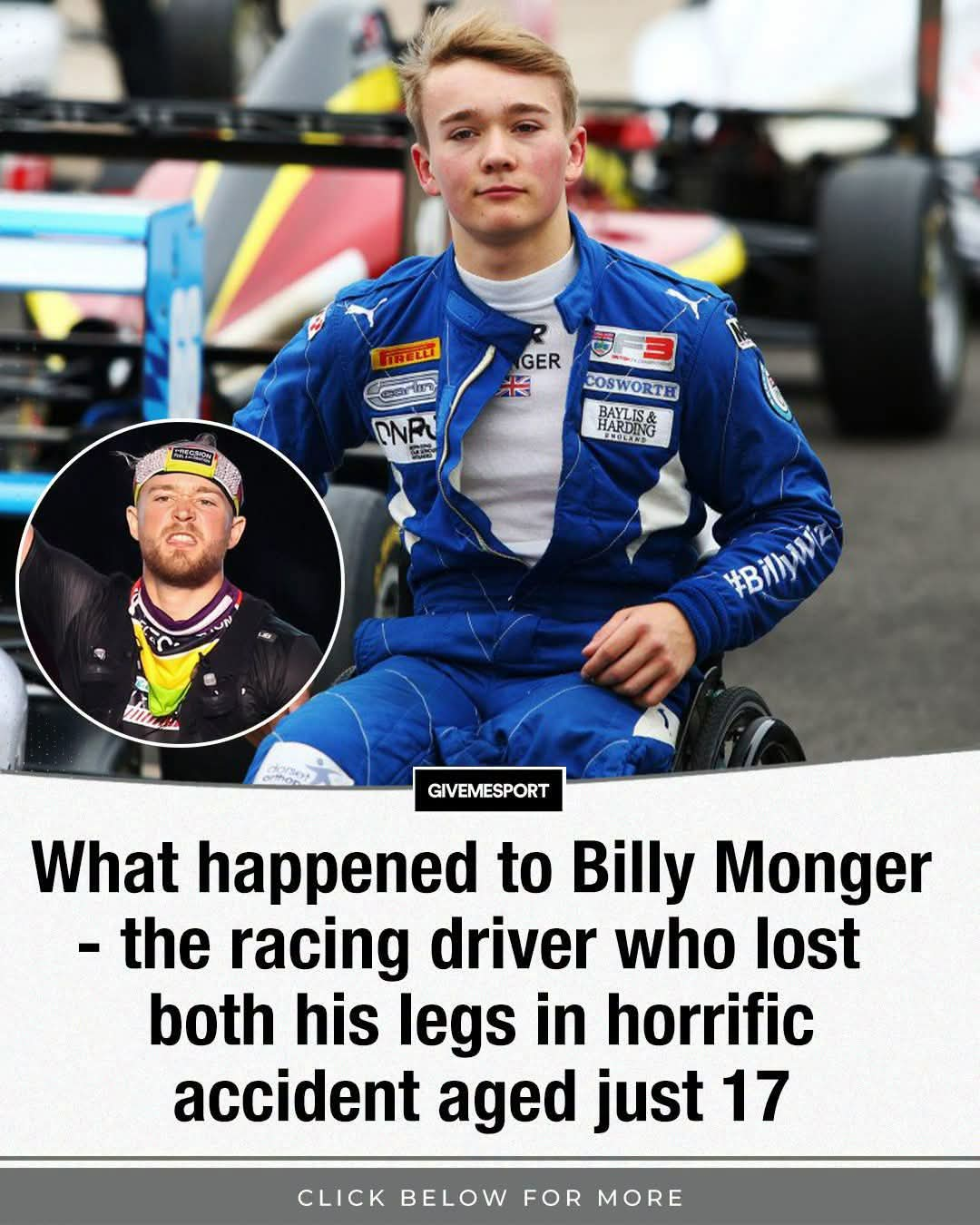
Few stories in motorsport capture the extraordinary relationship between determination, courage and ambition quite like that of Billy Monger. Once regarded as one of Britain’s most promising young racing talents, Monger’s life changed dramatically following a devastating accident that resulted in the amputation of both his legs.
At just 17 years old, he faced a situation that could have ended not only his promising racing career but also his ambitions of reaching the highest level of international motorsport.
Yet, rather than allowing the tragedy to define his future, Monger embarked on an extraordinary journey that eventually took him back behind the wheel of a single-seater racing car.
His story is about much more than surviving a horrific accident. It is about challenging established limitations, changing attitudes towards disability in motorsport and demonstrating that a devastating setback does not necessarily mean the end of an ambitious sporting career.
Today, the former racing driver has established himself as a respected motorsport broadcaster, endurance athlete and record-breaker. His journey remains one of the most remarkable comeback stories associated with modern British motorsport.
BILLY MONGER WAS ON THE FAST TRACK TO MOTORSPORT SUCCESS
Before the accident that changed his life, Billy Monger was already attracting attention as a talented young driver with ambitions of reaching Formula 1.
Born on May 5, 1999, in England, Monger developed a passion for motorsport at an early age. Like many aspiring professional racing drivers, he began his journey in karting before progressing through the junior racing categories.
His performances eventually earned him opportunities in the Ginetta Junior Championship and the British Formula 4 Championship.
Known by the nickname “Billy Whizz”, he developed a reputation for his competitive attitude and natural speed.
British Formula 4 represented an important stage in his development because it provided young drivers with an opportunity to demonstrate their abilities in single-seater machinery.
For Monger, the objective was straightforward: continue improving, attract attention from influential teams and sponsors, and eventually progress towards Formula 3, Formula 2 and, potentially, Formula 1.
However, his promising career would encounter an unimaginable obstacle in April 2017.
THE HORRIFIC DONINGTON PARK CRASH THAT CHANGED EVERYTHING
On April 16, 2017, Monger was competing in a British Formula 4 race at Donington Park when disaster struck.
During the race, he collided with a stationary vehicle on the circuit at a reported speed of more than 120mph.
The impact was devastating.
Monger became trapped inside the wreckage, requiring an extensive rescue operation before he could be transported to hospital for emergency treatment.
The young driver sustained catastrophic injuries, and doctors ultimately had to amputate both of his legs.
The accident shocked the British motorsport community and attracted widespread attention across the international racing world.
At a time when most teenagers were concentrating on their education and planning their futures, Monger was suddenly facing an entirely different challenge: learning how to rebuild his life after a life-threatening accident.
The consequences extended far beyond his immediate physical injuries.
He had to confront the emotional and psychological challenges associated with losing both legs, while also considering whether returning to professional motorsport would ever be possible.
For someone whose ambitions had revolved around racing, the uncertainty must have been overwhelming.
However, Monger was not prepared to abandon his passion.
THE MOTORSPORT COMMUNITY RALLIED AROUND THE YOUNG DRIVER
The response to Monger’s accident demonstrated the remarkable solidarity that exists within the motorsport community.
Drivers, teams, fans and influential figures from across the racing world offered their support.
Among those who publicly backed him were Formula 1 world champions Lewis Hamilton and Jenson Button.
A fundraising campaign also attracted enormous support, helping provide financial assistance during his recovery.
However, the most important development was Monger’s determination to return to competitive racing.
Rather than immediately accepting that his motorsport career was over, he began exploring the possibilities of driving again.
This ambition also raised an important question about the sport’s existing regulations.
Could a driver with two amputated legs compete in a modern single-seater racing car?
At the time, the regulations presented significant challenges for disabled competitors.
Monger and his family subsequently challenged the restrictions, helping bring attention to the need for greater accessibility within international motorsport.
Their efforts contributed to regulatory changes that allowed appropriately modified vehicles to be used by disabled drivers.
It was an important development that extended beyond one individual.
THE EXTRAORDINARY RETURN TO RACING LESS THAN A YEAR AFTER THE ACCIDENT
One of the most remarkable chapters in Monger’s story arrived in March 2018.
Less than 12 months after the accident, he returned to competitive single-seater racing in the British Formula 3 Championship.
His comeback required considerable technical innovation.
Carlin, the team supporting him, worked on a specially adapted racing car that allowed him to operate the vehicle using modified controls.
The throttle was positioned on the steering wheel, while braking was managed through a specially adapted system involving his prosthetic leg.
These modifications required careful engineering and extensive preparation.
However, the biggest question was whether Monger could remain competitive against drivers who had no comparable physical limitations.
His first race provided an extraordinary answer.
At Oulton Park, Monger qualified fifth and went on to finish third in the opening race of the championship.
Standing on the podium after everything he had experienced was an emotional moment.
He subsequently recorded two pole positions and three podium finishes during the 2018 British F3 season, finishing sixth overall.
This was not simply a symbolic return.
Monger had demonstrated that he could genuinely compete in a demanding single-seater championship.
His performance challenged assumptions about disability and the physical requirements of professional motorsport.
BILLY MONGER’S 2019 PAU GRAND PRIX VICTORY PROVED HE COULD STILL WIN
If Monger’s return to racing in 2018 was remarkable, his achievement in 2019 took his comeback to another level.
Competing in the Euroformula Open Championship with Carlin, Monger secured his first single-seater victory since the accident.
The breakthrough came at the famous Pau Grand Prix in France in May 2019.
Starting 11th, Monger faced difficult conditions as rain affected the race.
His team made the decision to switch to wet-weather tyres, a strategic gamble that initially appeared to put him at a disadvantage.
However, the decision eventually paid off.
As other competitors struggled for grip, Monger worked his way through the field. A collision between Motopark drivers Julian Hanses and Liam Lawson also helped open the opportunity for him to take the lead.
He maintained his advantage to secure victory.
It was a significant sporting achievement.
Winning a race after returning from such a devastating accident demonstrated that his comeback was about genuine competition rather than simply making an emotional appearance on the grid.
For Monger, the Pau victory was evidence that he could still pursue his ambitions as a racing driver.
It also provided an important message to young athletes facing life-changing injuries: adaptation and determination can create opportunities that initially appear impossible.
COULD BILLY MONGER HAVE REACHED FORMULA 1?
One of the most interesting questions surrounding Monger’s career concerns his original ambition of reaching Formula 1.
Before his accident, he was progressing through the junior single-seater categories that traditionally provide a pathway towards motorsport’s biggest championship.
His performances suggested that he possessed considerable potential.
However, reaching Formula 1 requires more than talent.
Drivers must demonstrate exceptional consistency, secure financial backing, attract the attention of leading teams and progress through increasingly competitive championships.
The physical and technical demands are also considerable.
Monger’s accident introduced additional challenges that made the journey significantly more complicated.
Nevertheless, his return to single-seater racing demonstrated that disability did not automatically make competing at a high level impossible.
It would be unfair to suggest that his accident alone determined what his ultimate racing career could have achieved.
There are countless talented drivers who never reach Formula 1, even without experiencing comparable obstacles.
But what cannot be disputed is that Monger demonstrated the determination, adaptability and competitive ability required to continue pursuing an ambitious motorsport career.
His Formula 1 dream may have taken a different direction, but his connection with the championship would eventually continue in another capacity.
FROM RACING DRIVER TO RESPECTED FORMULA 1 BROADCASTER
Monger’s relationship with Formula 1 did not end when his competitive racing career moved in a different direction.
He gradually established himself as a motorsport broadcaster and analyst, becoming part of Channel 4’s Formula 1 coverage.
This provided him with an opportunity to remain closely connected to the sport while sharing his technical knowledge and racing experience with viewers.
His background as a competitive driver gives him a valuable perspective when discussing racing incidents, driver performance, overtaking manoeuvres and strategic decisions.
Unlike commentators whose experience comes primarily from journalism, Monger understands the challenges of controlling a racing car at high speed.
He also understands the pressure young drivers face when attempting to progress through the junior categories.
His broadcasting work has allowed him to maintain relationships within the motorsport paddock and remain part of the wider Formula 1 conversation.
He has also expanded into presenting and covering other sporting events, including Paralympic competition.
This transition demonstrates an important aspect of his journey: professional success does not always have to follow the path originally imagined.
Sometimes, an individual discovers a different way to remain involved in the environment they love.
THE IRONMAN CHALLENGE THAT TOOK HIS DETERMINATION TO ANOTHER LEVEL
Just when many people believed Monger had already demonstrated the limits of human determination, he embarked on another extraordinary challenge.
In October 2024, he competed in the Ironman World Championship in Kona, Hawaii.
The event is widely regarded as one of the toughest endurance competitions in international sport.
Participants must complete:
– A 3.8-kilometre swim.
– A 180-kilometre cycling course.
– A 42.2-kilometre marathon.
The combined distance is approximately 226 kilometres.
For Monger, completing such a demanding event presented additional physical and technical challenges because of his double amputation.
Nevertheless, he crossed the finish line in an extraordinary time of 14 hours, 23 minutes and 56 seconds.
His performance broke the previous record for a double-amputee male competitor in the relevant classification by more than two hours.
He also became the youngest double amputee to complete the Ironman World Championship course.
The achievement was particularly impressive considering the enormous amount of preparation required to compete in an endurance event of that magnitude.
Swimming, cycling and running each demand different physical capabilities, and Monger had to develop techniques that worked with his prosthetics and individual physical requirements.
His performance demonstrated that the determination he had displayed in motorsport could translate into an entirely different sporting environment.
It also helped raise substantial funds for Comic Relief.
The Ironman achievement subsequently received international recognition, with Guinness World Records highlighting his extraordinary accomplishment.
WHY MONGER’S STORY MATTERS FOR THE FUTURE OF MOTORSPORT
Beyond the personal achievements, Monger’s journey has important implications for the motorsport industry.
For decades, professional racing has been associated with demanding physical requirements and strict technical regulations.
Although safety improvements have transformed the sport, accessibility for disabled competitors remains an important subject.
Monger’s return to single-seater racing demonstrated that technological adaptation can create opportunities for drivers who might otherwise be excluded.
His experience also highlighted the importance of reviewing regulations when existing rules create unnecessary barriers.
This does not mean that safety requirements should be compromised.
Motorsport is an extremely demanding environment, and every competitor must demonstrate that they can operate their vehicle safely.
However, there is an important distinction between maintaining safety standards and unnecessarily restricting participation.
Appropriately engineered adaptations, individual assessments and cooperation between teams and governing bodies can help make racing more accessible.
Monger’s journey provides a powerful example of what can happen when determination is supported by technical innovation and institutional flexibility.
His achievements could also encourage greater investment in adaptive racing technology and create opportunities for future generations of disabled drivers.
WHAT THE NEXT CHAPTER COULD HOLD FOR BILLY MONGER
Monger has already achieved more than many people would have imagined possible following his 2017 accident.
However, his ambitions have not stopped.
Following his Ironman success, he has continued exploring opportunities in endurance sport, broadcasting and public speaking.
One particularly interesting ambition is his interest in competing for Great Britain in paratriathlon at the 2028 Paralympic Games in Los Angeles.
Such a move would represent another major sporting challenge.
Paratriathlon requires athletes to combine swimming, cycling and running, demanding a different combination of endurance, technical ability and preparation.
His experience in the Ironman World Championship provides an impressive foundation, although competing at Paralympic level would require another demanding development programme.
Meanwhile, his broadcasting career offers an opportunity to remain involved in Formula 1 and contribute to the sport’s growing global audience.
There is also potential for his story to influence future discussions about disability, athlete development and accessibility in professional sport.
Whatever direction he chooses, Monger has already demonstrated that his ambitions are not restricted to one particular sporting discipline.
BILLY MONGER’S LEGACY IS BIGGER THAN HIS FORMULA 1 DREAM
It is easy to describe Billy Monger’s journey as an inspirational comeback story.
However, reducing his achievements to the language of inspiration alone overlooks the competitive qualities that have defined his career.
He was a talented young racing driver before the accident.
He returned to single-seater competition and achieved podium finishes.
He won an international racing event in 2019.
He subsequently established himself as a respected broadcaster and completed one of the world’s toughest endurance challenges.
These are substantial sporting accomplishments in their own right.
Perhaps the most significant part of his story is that he has never allowed other people’s expectations to determine what he should attempt.
The 2017 accident changed his life, but it did not remove his passion for competition or his desire to achieve ambitious goals.
His journey also offers an important lesson to motorsport organisations: talent should not be overlooked simply because an athlete requires a different approach to competing.
FINAL THOUGHTS: THE DRIVER WHO REFUSED TO LET ONE ACCIDENT DEFINE HIS FUTURE
Billy Monger’s story remains one of the most extraordinary journeys in modern motorsport.
At 17, he experienced a devastating accident that resulted in the loss of both his legs and threatened to end his dreams of becoming a professional racing driver.
Less than a year later, he was back competing in single-seater machinery.
By 2019, he had won the Pau Grand Prix.
He subsequently moved into broadcasting, remained connected to Formula 1 and achieved an extraordinary endurance milestone at the Ironman World Championship.
His journey is a reminder that sporting careers do not always develop according to the original plan.
The Formula 1 dream that once defined his teenage years may have evolved, but his determination to compete and achieve extraordinary things has remained.
For the motorsport community, Monger represents more than a remarkable comeback.
He represents the importance of opportunity, innovation, accessibility and refusing to underestimate what an athlete can accomplish.
And perhaps that is the most important part of his legacy: Billy Monger did not simply find a way to return to racing after losing both legs. He showed the world that his ambitions could extend far beyond the limits that others might have expected him to accept.SOURCES FOR FACTUAL BACKGROUND
[BBC Sport – Billy Monger’s racing comeback and Pau Grand Prix victory](https://www.bbc.co.uk/sport/motorsport/48329869?utm_source=chatgpt.com)
[BBC Sport – Monger’s Ironman World Championship record](https://www.bbc.co.uk/sport/triathlon/articles/cly2v2233wro?utm_source=chatgpt.com)
[FIA British F4 – Billy Monger’s Ironman achievement](https://fiaformula4.com/former-british-f4-driver-billy-monger-breaks-ironman-record/?utm_source=chatgpt.com)
[Guinness World Records – Billy Monger’s achievements and recognition](https://www.guinnessworldrecords.com/news/icons/billy-monger-fastest-ironman-world-championship?utm_source=chatgpt.com)
SEO KEYWORDS: Billy Monger, Billy Monger crash, Billy Monger F1 dream, Billy Monger racing comeback, Billy Monger accident 2017, Billy Monger Ironman record, double amputee racing driver, British Formula 4, Formula 1 disability inclusion.