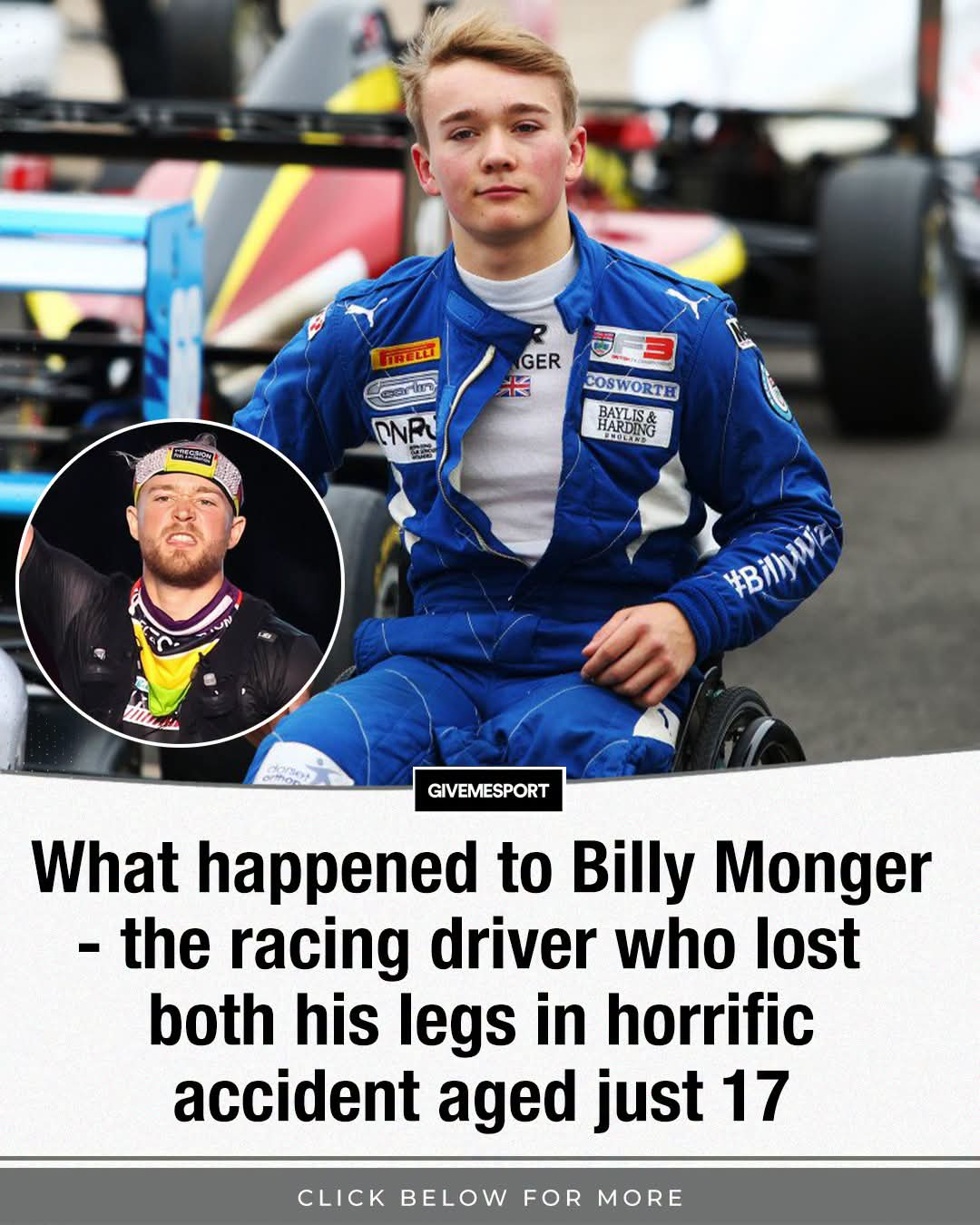
Billy Monger was just 17 years old when a devastating racing accident at Donington Park changed his life forever. Once regarded as one of Britain’s promising young motorsport talents, Monger suffered catastrophic injuries that resulted in the amputation of both legs, bringing his teenage ambitions of reaching Formula One into immediate uncertainty.
Nearly a decade later, however, his story has become one of the most remarkable comeback journeys in modern motorsport. Rather than abandoning racing, Monger returned to competitive single-seaters, built a career in broadcasting and became an influential advocate for disability inclusion.
His journey is a powerful reminder that sporting ambition can survive circumstances that appear impossible, and that the definition of success can change without losing its significance.
BILLY MONGER’S EARLY RACING CAREER AND F1 AMBITIONS
Born on May 5, 1999, in Charlwood, Surrey, Billy Monger developed an interest in motorsport at an early age.
Like many aspiring professional racing drivers, he began his journey through karting before progressing into more competitive junior championships. His performances eventually earned him opportunities in the Ginetta Junior Championship, where he continued developing his racing skills.
By 2017, Monger had reached the British Formula 4 Championship, competing for JHR Developments.
Formula 4 represented an important stepping stone towards the higher categories of motorsport. Drivers who excel in the championship can progress through Formula 3 and Formula 2, potentially earning opportunities to reach Formula One.
Monger was considered a promising British prospect, and his ambition was to continue climbing that ladder.
At just 17, he had already demonstrated the determination and competitive instinct required to pursue a professional racing career.
However, his progress was interrupted by an accident that would become one of the most devastating moments in British junior motorsport.
THE DONINGTON PARK CRASH THAT CHANGED EVERYTHING
<AsyncImageGroup query={[“Billy Monger British Formula 4 Donington Park 2017 racing car”,”Billy Monger 2017 crash Donington Park motorsport”]} aspectRatio=”16:9″/>
On April 16, 2017, Monger was competing in a British Formula 4 race at Donington Park when his car collided with a stationary vehicle driven by Patrik Pasma.
The impact was catastrophic.
Monger became trapped in the wreckage, requiring emergency services to work carefully to free him. He was subsequently airlifted to hospital, where medical teams placed him in an induced coma while treating his devastating injuries.
The severity of the damage to both legs ultimately forced doctors to amputate them.
For a teenager whose life had revolved around racing, the consequences were unimaginable. In a matter of moments, the physical demands of motorsport and the future he had envisioned became uncertain.
The accident shocked the racing community, attracting widespread attention and prompting an enormous outpouring of support from fellow drivers, teams and fans.
Among those who supported Monger were Formula One stars Lewis Hamilton and Jenson Button, reflecting the solidarity that motorsport can demonstrate during its most difficult moments.
HOW THE MOTORSPORT COMMUNITY HELPED BILLY MONGER
The aftermath of Monger’s accident demonstrated how closely connected the motorsport community can be.
Fundraising efforts attracted significant support, helping provide assistance during his recovery and rehabilitation.
However, financial assistance was only one part of the support he received.
The encouragement from fellow competitors and fans became an important reminder that his identity as a racing driver had not disappeared because of his injuries.
Monger faced an enormous physical and emotional challenge, but he remained determined to return to the sport.
His recovery required patience, rehabilitation and adjustments to everyday life. More importantly, it required him to reconsider how he could continue pursuing the ambitions that had defined his teenage years.
Rather than accepting that his racing career had ended, Monger began exploring ways to return to the cockpit.
BILLY MONGER RETURNED TO RACING JUST SEVEN MONTHS AFTER THE ACCIDENT
<AsyncImageGroup query={[“Billy Monger adapted racing car return 2017″,”Billy Monger British Formula 3 racing 2018”]} aspectRatio=”16:9″/>
One of the most remarkable moments in Monger’s recovery came in November 2017, when he returned behind the wheel of a specially adapted racing car.
The return happened just seven months after the accident.
It was an emotional milestone, but Monger’s ambitions extended far beyond simply driving again.
He wanted to compete.
In 2018, he returned to single-seater racing in the British Formula 3 Championship, finishing sixth overall and securing three podium finishes.
That achievement demonstrated that his accident had not removed his ability to compete at a serious level.
He subsequently participated in the Euroformula Open Championship and British GT Championship, continuing to establish himself as a racing driver rather than simply someone making an inspirational appearance.
His comeback also helped challenge assumptions about disability in motorsport, demonstrating how engineering adaptations and determination can create opportunities for athletes with physical disabilities.
FROM RACING DRIVER TO RECOGNISED TELEVISION PERSONALITY
<AsyncImageGroup query={[“Billy Monger BBC Countryfile presenter”,”Billy Monger BBC television presenter”]} aspectRatio=”16:9″/>
Monger’s achievements eventually opened opportunities beyond competitive racing.
In 2018, he became a presenter on BBC’s Countryfile, introducing himself to audiences who may not have followed his motorsport career.
His broadcasting work allowed him to communicate his experiences, explore different subjects and demonstrate the personality that had attracted so much support during his recovery.
He also became involved in endurance challenges and charitable activities, using his public profile to promote disability awareness and encourage people facing difficult circumstances.
This transition was particularly significant because it allowed Monger to build a professional career that did not depend exclusively on his ability to compete in racing championships.
Motorsport remained central to his identity, but broadcasting gave him another platform through which he could influence audiences.
THE ENDURANCE CHALLENGE THAT SHOWED HIS EXTRAORDINARY DETERMINATION
<AsyncImageGroup query={[“Billy Monger Red Bull Trans Siberian Extreme 2021 cycling”,”Billy Monger endurance cycling challenge 2021″]} aspectRatio=”16:9″/>
In 2021, Monger completed the 140-mile Red Bull Trans-Siberian Extreme cycling challenge, an extraordinary endurance achievement following the loss of both legs.
The challenge demonstrated another dimension of his determination.
Competitive racing requires speed, precision and courage, while endurance cycling demands sustained physical effort, discipline and the ability to manage fatigue over extended periods.
Completing the challenge reinforced the message that Monger’s sporting ambitions had expanded rather than disappeared.
His achievements also helped raise awareness about disability sport and the importance of making athletic opportunities accessible to people with different physical abilities.
In 2022, Monger received an MBE for services to disability awareness and charity, recognising the impact of his work beyond the racetrack.
BILLY MONGER’S CELEBRITY RACE ACROSS THE WORLD APPEARANCE
Monger also expanded his television profile through the BBC’s Celebrity Race Across the World in 2023.
The programme introduced him to another audience and allowed viewers to see a different side of his personality away from racing circuits.
His participation demonstrated how his career had developed into a combination of broadcasting, endurance challenges, public appearances and motorsport.
That broader profile has helped him become one of Britain’s most recognisable disability sport advocates.
For many viewers, his story is no longer defined solely by the accident at Donington Park. It is increasingly associated with his achievements afterwards.
WHAT IS BILLY MONGER DOING IN 2026?
<AsyncImageGroup query={[“Billy Monger 2026 Formula 1 broadcasting”,”Billy Monger motorsport presenter recent”]} aspectRatio=”16:9″/>
As of 2026, Monger remains involved in motorsport and broadcasting, continuing to build on the career he fought so hard to reclaim.
His experience as a competitive racing driver gives him a valuable perspective when discussing motorsport, while his television work allows him to reach audiences beyond traditional racing fans.
He has also continued advocating for disability inclusion, encouraging greater accessibility and challenging assumptions about what disabled athletes can accomplish.
Although the Formula One dream that inspired his teenage career did not follow the path he originally imagined, Monger has established a meaningful professional identity within the wider motorsport industry.
His journey illustrates how an athlete can continue contributing to a sport even when the circumstances surrounding their original ambitions change dramatically.
BILLY MONGER’S LEGACY GOES FAR BEYOND MOTORSPORT
Nearly nine years after the Donington Park accident, Monger’s story remains one of the most powerful examples of resilience in British motorsport.
His return to racing was remarkable not simply because he overcame physical challenges, but because he refused to allow the accident to determine the limits of his future.
He competed again, achieved podium finishes, completed extraordinary endurance challenges, built a broadcasting career and became an advocate for disability inclusion.
That combination of achievements has given his story significance far beyond Formula 4.
For aspiring drivers, Monger represents the importance of determination and adaptability. For disabled athletes, his achievements demonstrate how opportunities can exist when barriers are challenged and accessibility improves.
His Formula One ambitions may have changed, but his connection to motorsport remains strong.
Billy Monger’s greatest achievement may ultimately be that he transformed one of the darkest moments of his life into a career that continues to inspire people across sporting communities.
His journey proves that sometimes the most extraordinary victories happen long after the chequered flag has fallen.