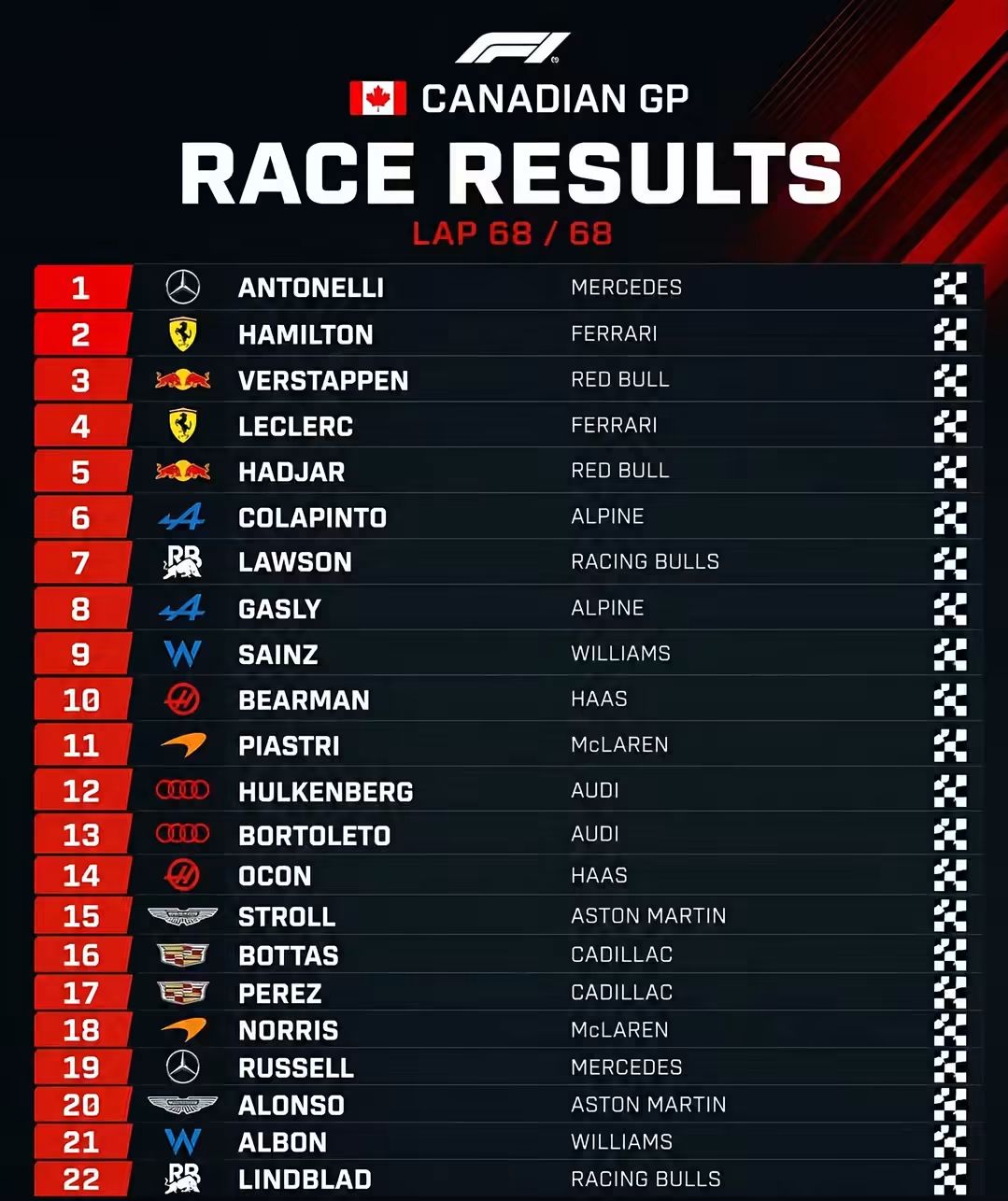
The Canadian Grand Prix delivered pure Formula 1 chaos and brilliance in equal measure. Under the familiar spray and unpredictability of Circuit Gilles Villeneuve, Kimi Antonelli claimed another victory after a fierce early scrap with teammate George Russell. What began as a promising intra-team duel ended abruptly when Russell’s car developed issues, while McLaren’s bold gamble on intermediate tires at the start spectacularly unravelled. The result was a race packed with drama from lights to flag.
This was more than just another win for the young Mercedes driver. It underlined shifting dynamics inside one of the sport’s most powerful teams and raised fresh questions about strategy risk in changeable conditions.
EARLY FIREWORKS BETWEEN THE MERCEDES PAIR SET THE TONE
From the moment the lights went out, Antonelli and Russell locked horns. The two Mercedes cars ran nose-to-tail through the opening laps, exchanging positions and applying relentless pressure. The battle showcased the raw speed both drivers possess and the fine margins that separate them when the machinery is equal.
Russell’s challenge ultimately faded when technical problems struck. The timing was cruel. What had looked like a potential classic teammate fight for the win evaporated, leaving Antonelli clear to control the race. For Russell, it was a bitter reminder of how quickly a strong Sunday can turn. For Antonelli, it was further proof that he can convert opportunity into results when the chance appears.
The intra-team tension adds another layer. Mercedes has long prided itself on managed competition between its drivers. Moments like this test that philosophy. A healthy rivalry can elevate both, but unresolved car reliability or setup differences risk turning internal competition into frustration.
MCLAREN’S INTERMEDIATE GAMBLE BACKFIRES SPECTACULARLY
While Mercedes fought among themselves, McLaren made the race’s boldest call. Starting on intermediate tires in conditions that did not fully support the choice proved costly. The decision left both cars struggling for grip and pace as the track evolved differently than expected. What was intended as a clever opportunistic move instead handed rivals a clear advantage and dropped McLaren down the order.
Strategy in mixed or transitional weather remains one of Formula 1’s highest-risk, highest-reward elements. Get it right and you look like geniuses. Get it wrong and the damage is immediate and public. McLaren’s misjudgment will be dissected in the days ahead, particularly given the team’s recent competitiveness. In a season where every point matters for championship positioning, such errors carry extra weight.
WHY THIS RESULT MATTERS BEYOND THE PODIUM
Antonelli’s second win of the campaign strengthens his standing as a genuine force rather than a promising newcomer. Each victory builds confidence, data, and internal credibility within Mercedes. For a driver still early in his top-flight career, stacking results against established teammates and rivals accelerates the learning curve and raises expectations around him.
Russell’s misfortune, by contrast, highlights the fine line drivers walk. Strong pace and racecraft mean little if the car does not cooperate. Consistency across a full season often separates title contenders from also-rans, and reliability remains non-negotiable.
For Mercedes as a whole, the result is largely positive. A one-two was denied by Russell’s issues, yet the team still left Canada with a dominant win and valuable data. The performance reinforces that the car remains competitive in a variety of conditions.
McLaren faces a different set of questions. Bold strategy is part of their identity, but repeated high-profile failures can erode confidence in the decision-making process. In a tightly contested midfield-to-front battle, the difference between a calculated risk and a costly error is often measured in tenths of a second and championship points.
LOOKING AHEAD: WHAT THIS RACE SIGNALS FOR THE SEASON
The Canadian Grand Prix rarely fails to produce stories, and this edition was no exception. Antonelli’s ability to win under pressure suggests he will remain a regular threat in the remaining rounds. Russell will be determined to bounce back quickly and reassert himself in the internal order. Mercedes will focus on eliminating the reliability glitches that cost them a potential maximum score.
McLaren must refine their weather and tire decision-making. One misjudged call does not define a season, but patterns do. Their recovery trajectory from this setback will reveal much about the team’s resilience.
Broader implications touch the championship picture. Every win redistributes momentum. Every strategy failure hands rivals breathing room. In a sport where margins are microscopic, races like Canada remind everyone that preparation, adaptability, and a bit of luck still decide outcomes as much as pure pace.
The biggest takeaway? Formula 1 at its best remains unpredictable theatre. Teammate battles, strategic brinkmanship, and sudden mechanical drama combined to produce a memorable afternoon in Montreal. Antonelli seized the moment. Others were left reflecting on what might have been. The season rolls on, and the next chapter already looks compelling.