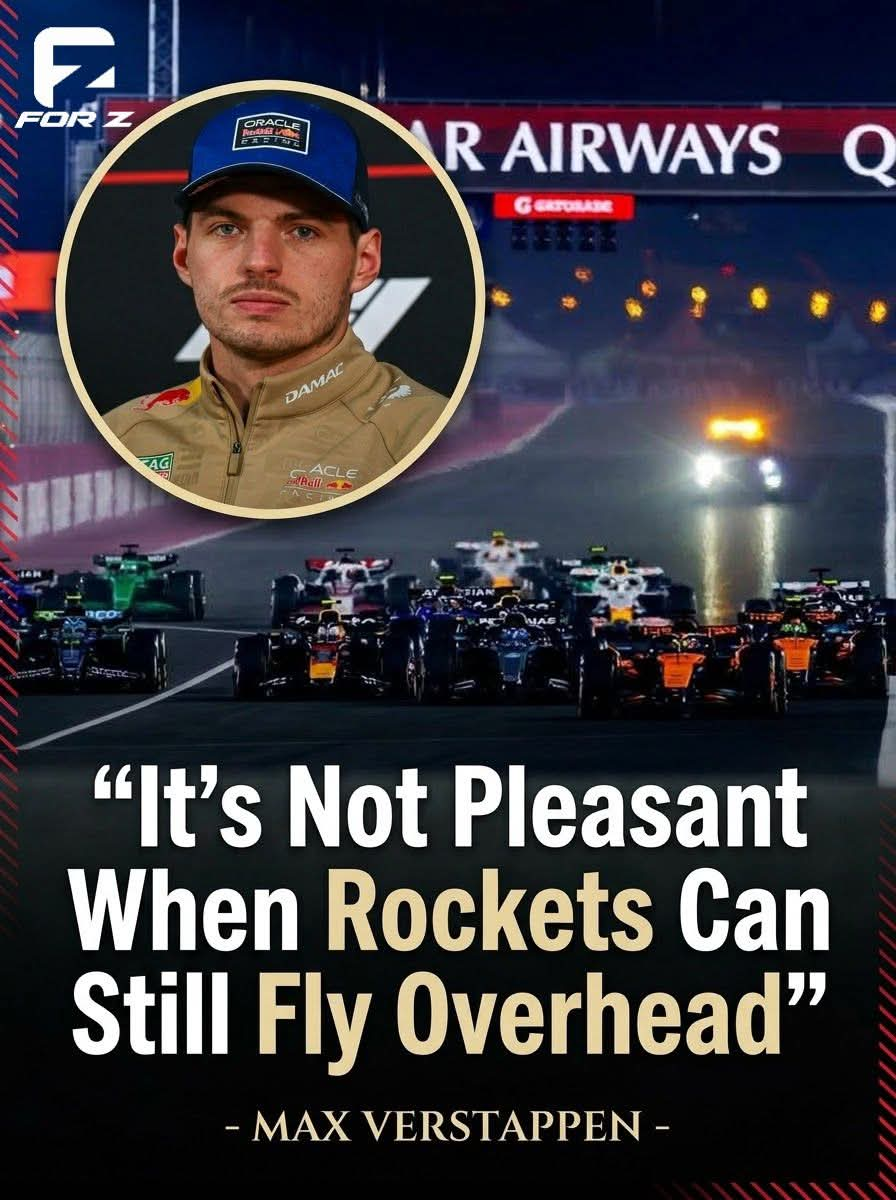
Four-time Formula 1 world champion Max Verstappen has made no secret of his feelings ahead of this weekend’s Qatar Grand Prix and the Abu Dhabi season finale. While organisers and the FIA insist the events are safe, the Red Bull driver has been characteristically blunt: he would prefer to remain at home rather than race while missiles continue flying in neighbouring countries.
Verstappen confirmed he will still compete. As a professional he accepts the private and public guarantees provided by Formula 1 and the FIA. Yet his discomfort is real, and it reflects a wider tension that has shadowed the 2026 season.
WHY VERSTAPPEN’S CANDID WORDS CARRY WEIGHT
Verstappen is not a driver who seeks the spotlight for drama. When he says “Do I feel good about it? No. I’d rather stay at home,” the comment lands harder because of his usual pragmatism. He has repeatedly stressed that he trusts the information F1 and the FIA hold, information most drivers and teams never see. Private briefings have taken place. Public statements from FIA President Mohammed Ben Sulayem have underlined that safety remains the priority.
Still, the Dutchman’s honesty cuts through the corporate language. Racing under the knowledge that rockets are active in the region is, in his words, “certainly not nice.” That distinction between official assurance and personal unease is important. Drivers are the ones who must step into the car. Their families and team personnel travel with them. When a multiple champion voices private discomfort so openly, it gives voice to quieter concerns that exist across the paddock.
THE LONG SHADOW OVER THE 2026 CALENDAR
This is not a sudden crisis. The Middle East conflict has already forced major changes to the 2026 season. The Saudi Arabian Grand Prix was cancelled. The Bahrain round was relocated to Sepang in Malaysia. For months Imola stood ready as a cold-weather contingency for the finale. Only in mid-November did Formula 1 stand those plans down and commit fully to Qatar (27-29 November) and Abu Dhabi (4-6 December).
MotoGP’s recent Qatar event passed without incident, giving organisers a useful reference point. Yet the security picture remains fluid. Strikes and intercepts continue in the wider region. Airspace and logistics have required constant monitoring. F1 has significant commercial ties to the Gulf, and the two races form a lucrative and prestigious close to the championship. That commercial reality sits alongside the duty of care owed to every person who travels for these events.
WHAT THIS MEANS FOR DRIVERS, TEAMS AND THE SPORT
For the athletes the immediate impact is psychological as much as practical. High-performance sport demands total focus. Knowing that the wider region remains unstable creates an extra mental layer, even when track security is tight and intelligence briefings are thorough. Teams must manage not only car performance but the welfare of hundreds of staff, many of whom have partners and children at home watching the news.
Broader industry questions also arise. How many times can a global championship rearrange its calendar before the product itself is damaged? What message does it send when the season ends in a region still experiencing military activity? Fans, sponsors and broadcasters all watch how the sport balances risk against revenue and tradition. Some media organisations have already adjusted their coverage plans. That quiet recalibration is itself a signal.
At the same time, the decision to proceed shows confidence in local security arrangements and in the intelligence shared with the sport. Verstappen’s acceptance of those guarantees, however reluctant, carries weight precisely because he has been willing to express the alternative view.
THE ON-TRACK STAKES REMAIN HIGH
Amid the security conversation, the sporting narrative has not disappeared. Verstappen arrives in Qatar on strong late-season form, with a string of strong results that have kept Red Bull competitive. The constructors’ battle remains live, and every point in the final two rounds carries significance. Drivers will still push to the limit once the lights go out. The professional instinct that Verstappen himself cited is real: when the car is ready and the grid forms, the race becomes the focus.
Yet the backdrop cannot be ignored. A championship that has already been reshaped by geopolitics now closes under the same cloud. How the next fortnight unfolds will shape not only the final standings but also future decisions about calendar risk and contingency planning.
LOOKING AHEAD: WHAT COMES AFTER THE FINALE
In the short term the priority is a clean, safe pair of events. If Qatar and Abu Dhabi pass without major incident, the sport will claim validation of its risk assessment. If tensions escalate, the decision to proceed will face sharper scrutiny. Longer term, Formula 1 must decide how much exposure to volatile regions it is willing to accept, and how transparent it can be with drivers and the public about the information guiding those choices.
Verstappen’s comments serve as a useful pressure test. They remind everyone that elite athletes are human beings first. They can accept professional obligations while still feeling the weight of the environment around them. That honesty is more valuable than forced positivity.
The cars will run this weekend. The championship will reach its conclusion in Abu Dhabi. Whether the paddock leaves the region with a sense of relief or renewed confidence will depend on events still to come. For now, Max Verstappen has said out loud what many have been thinking quietly: the guarantees are there, the professionalism remains, but given a free choice, home would have been preferable.