Kimi Antonelli has revealed the crucial mistake that potentially cost him victory at the 2026 Formula 1 Las Vegas Grand Prix, admitting that an attempt to position himself perfectly for a late-race overtake on Max Verstappen triggered an energy recovery problem that ultimately destroyed his chances of challenging for the win.
The Mercedes youngster had been targeting a decisive move against Verstappen during the closing stages of the race. However, a split-second decision to lift off the accelerator instead of maintaining his usual driving approach had unintended consequences, leaving him struggling with battery deployment when he needed maximum power.
What initially appeared to be a clever strategic move quickly turned into a costly technical problem, allowing Lando Norris and Oscar Piastri to take advantage and move ahead of the Italian.
Antonelli eventually finished fourth, missing out on what could have been one of the biggest victories of his young Formula 1 career.
ANTONELLI EXPLAINS THE MISTAKE THAT CHANGED HIS RACE
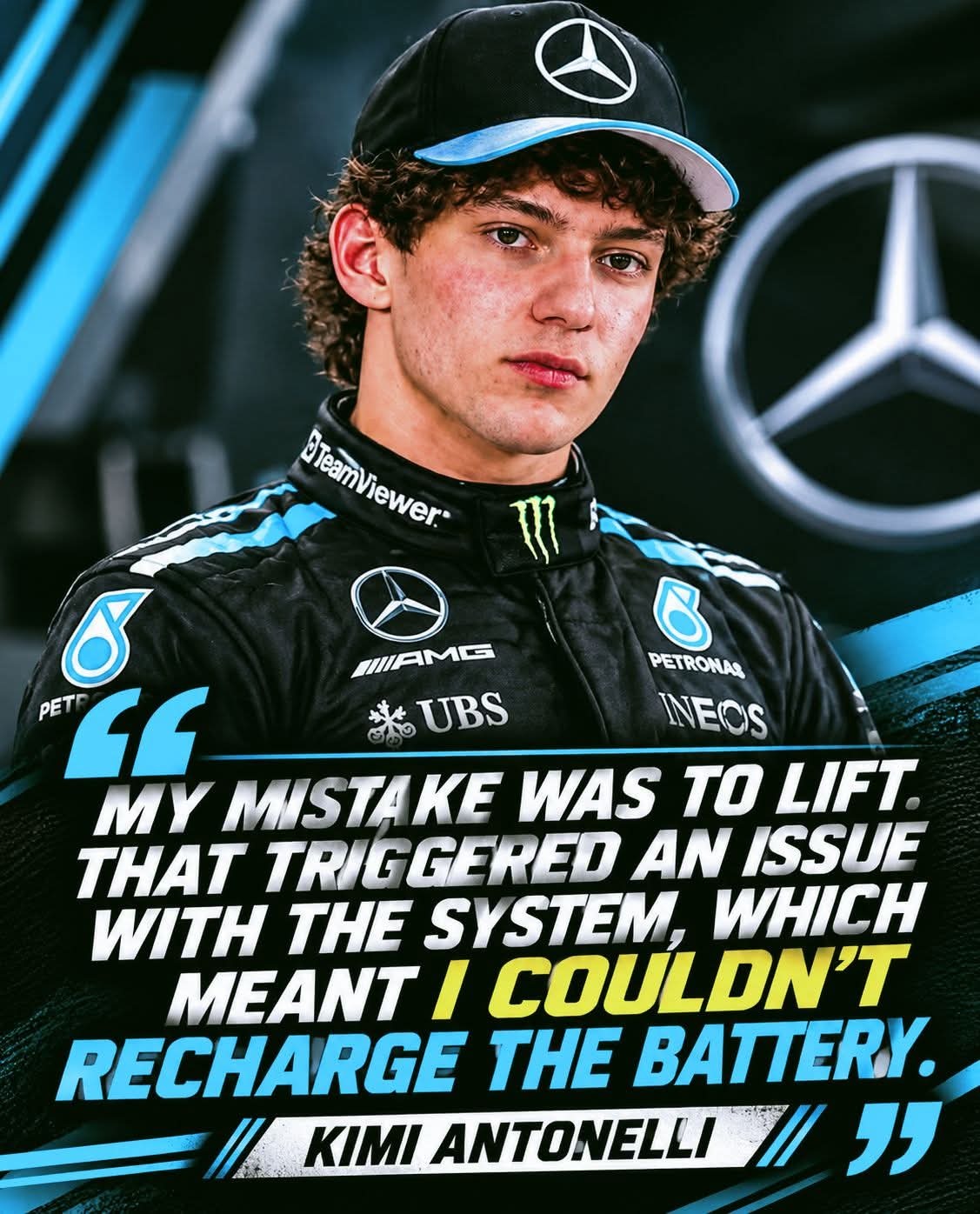
Speaking about the incident, Antonelli openly accepted responsibility for the error, explaining how his decision to lift off the throttle affected Mercedes’ energy recovery system.
The Italian explained:
“My mistake was to lift. That triggered an issue with the system, which meant I couldn’t recharge the battery.”
His explanation highlights just how complicated modern Formula 1 racing has become. Drivers are no longer focused exclusively on braking points, cornering speeds and tyre management. They must also carefully manage electrical energy, battery deployment and power recovery throughout a lap.
Antonelli was attempting to manage his position behind Verstappen while preparing for a potential attack. Unfortunately, lifting off the accelerator interfered with the energy recovery process, leaving him without the electrical assistance required to defend his position effectively.
In a championship where overtaking opportunities can depend on just a few kilometres per hour, the consequences were significant.
HOW MERCEDES’ ENERGY MANAGEMENT BECAME ANTONELLI’S BIGGEST PROBLEM
Energy management has become one of the most important aspects of modern Formula 1, particularly under the hybrid regulations that have shaped the sport over recent seasons.
Drivers must constantly balance acceleration, braking, energy harvesting and battery deployment. Every decision can influence how much electrical power is available later in the lap.
Antonelli’s situation demonstrates how even a seemingly harmless adjustment to driving technique can create unexpected complications.
His intention was understandable. By easing off the accelerator, he wanted to position himself strategically behind Verstappen and prepare for a possible late-race attack.
However, the resulting energy recovery issue left him unable to recharge the battery as expected.
This created a major disadvantage on the straights, where electrical deployment can make a substantial difference in overall performance.
For Mercedes, the incident also provides an important technical lesson. Drivers and engineers must ensure that energy management strategies remain predictable, particularly when operating close to competitors during critical stages of a race.
NORRIS AND PIASTRI CAPITALISE ON ANTONELLI’S POWER LOSS
Once Antonelli began struggling with his battery recovery, his position became increasingly vulnerable.
Lando Norris and Oscar Piastri were quick to take advantage of the Mercedes driver’s reduced straight-line performance.
Without sufficient electrical power, Antonelli found himself unable to defend effectively against their attacks. What had previously looked like an opportunity to challenge Verstappen for victory instead became a fight to limit the damage.
For Norris and Piastri, the situation presented an opportunity to gain valuable positions without necessarily needing to produce an extraordinary overtaking manoeuvre.
Their ability to recognise and exploit Antonelli’s weakness underlined the importance of situational awareness in Formula 1.
The incident also demonstrated how quickly the competitive picture can change. A driver can spend several laps preparing an attack, only for one technical complication to completely reverse the situation.
Antonelli’s fourth-place finish was therefore particularly frustrating because his race had offered the possibility of a much stronger result.
A VALUABLE LESSON FOR MERCEDES AND ITS YOUNG DRIVER
Although Antonelli will understandably be disappointed, this experience could prove valuable for his development.
The young Italian is still building experience at the highest level of motorsport, where successful racecraft requires much more than outright speed.
Knowing when to attack, when to conserve energy and how to manage complicated technical systems under pressure are essential skills for any driver hoping to become a Formula 1 world champion.
Importantly, Antonelli’s willingness to acknowledge his mistake is encouraging.
Rather than blaming Mercedes or pointing fingers at the car, he identified the decision that triggered the problem. That level of accountability is important for a driver working closely with engineers to understand and correct weaknesses.
Mercedes will also be interested in examining whether its energy management procedures can be improved to prevent similar situations.
The objective will be to ensure that Antonelli can make tactical adjustments during wheel-to-wheel battles without unintentionally compromising the car’s energy recovery capabilities.
WHAT THIS MEANS FOR ANTONELLI’S FUTURE AT MERCEDES
Despite the disappointment in Las Vegas, one mistake should not overshadow Antonelli’s potential.
The Italian has the speed and ambition required to become an important figure in Formula 1. However, the difference between a promising young driver and a consistent race winner often comes down to decision-making during the most demanding moments.
Mercedes will want him to learn from this experience rather than become overly cautious.
There is also an important psychological challenge involved. Drivers must remain confident enough to make aggressive decisions while understanding when a particular strategy carries unnecessary risks.
Antonelli’s attempt to position himself behind Verstappen demonstrated his willingness to fight for the biggest prizes. The problem was not his ambition but the unintended technical consequence of his decision.
If he can turn this experience into a better understanding of energy management, it could make him a more complete competitor.
COULD ANTONELLI HAVE WON THE 2026 LAS VEGAS GRAND PRIX?
It is impossible to say with certainty whether Antonelli would have beaten Verstappen without the battery recovery problem.
Verstappen would still have been a formidable opponent, and Norris and Piastri also demonstrated the pace needed to compete at the front.
Nevertheless, Antonelli’s explanation suggests that the energy recovery issue significantly compromised his ability to challenge during the closing stages.
The most interesting aspect is that his mistake occurred while attempting to create an opportunity for victory.
That is precisely what makes the incident so frustrating. He was not simply losing pace or struggling with tyre degradation. He was trying to execute a tactical move that ultimately worked against him.
Mercedes will undoubtedly analyse the incident carefully, particularly the relationship between throttle inputs and energy recovery.
Future races could provide an opportunity for Antonelli to demonstrate that he has learned from the experience.
FINAL VERDICT: A PAINFUL MISTAKE, BUT AN IMPORTANT LEARNING EXPERIENCE
Kimi Antonelli’s fourth-place finish at the 2026 Las Vegas Grand Prix will leave Mercedes wondering what might have been.
A decision intended to improve his chances of overtaking Max Verstappen instead triggered an energy recovery problem that left him vulnerable to Lando Norris and Oscar Piastri.
The incident is a reminder that modern Formula 1 rewards precision in every department. Speed alone is no longer enough. Drivers must understand the technical behaviour of their machinery while making split-second decisions under enormous pressure.
For Antonelli, the disappointment could eventually become an important step in his development.
He has experienced how quickly a potential victory can disappear because of one small decision. The next challenge is ensuring that the same mistake does not happen again.
Mercedes will want answers, Antonelli will want redemption, and his rivals will know that every small mistake can create a major opportunity in Formula 1.