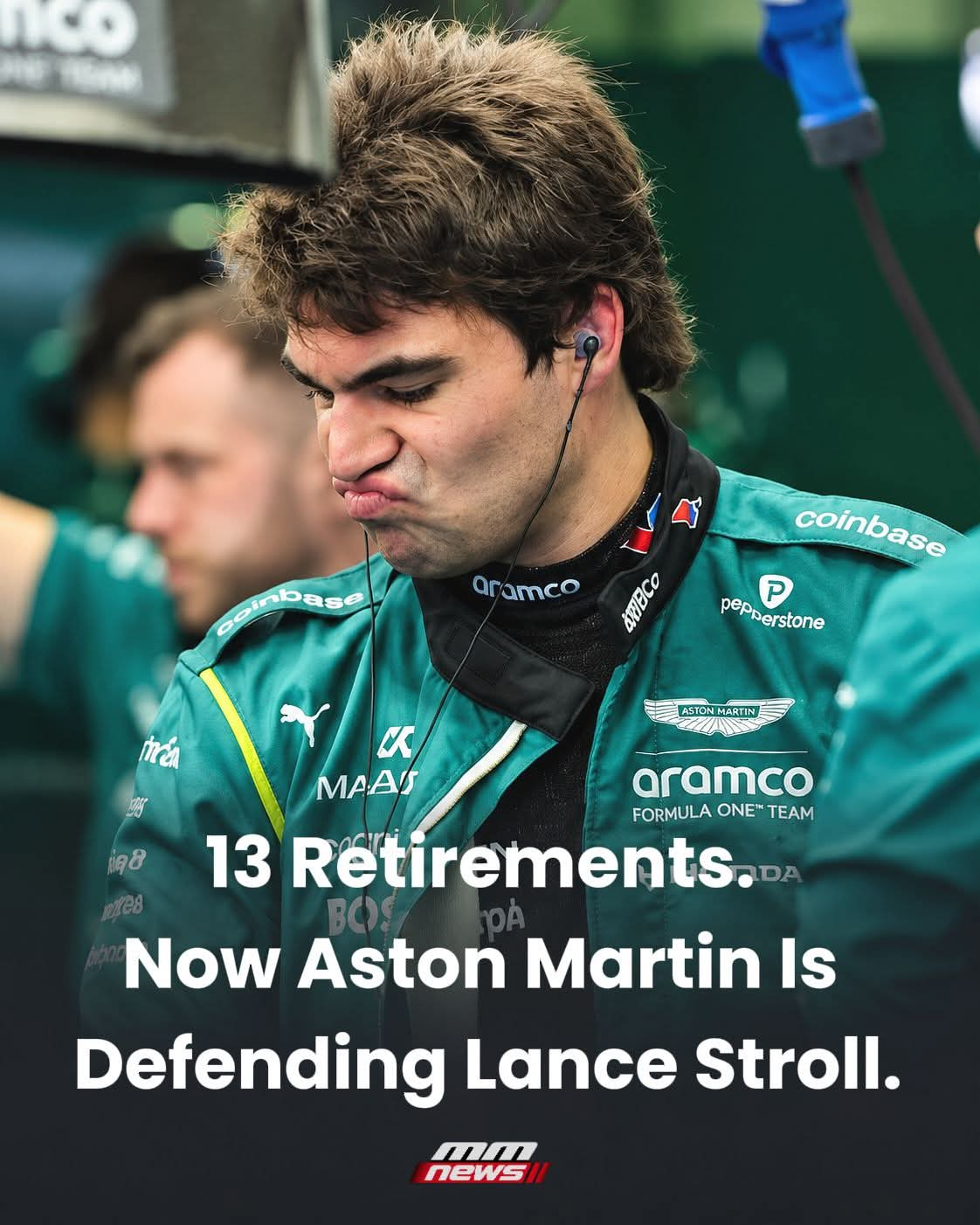
Lance Stroll’s difficult 2026 Formula 1 campaign has taken another disappointing turn, with the Canadian driver recording an alarming 13 Grand Prix retirements. However, amid growing scrutiny of his performances, Aston Martin has made one thing clear: Stroll should not be blamed for every race-ending problem.
Aston Martin’s struggles have become increasingly difficult to ignore, particularly when it comes to reliability. While Stroll has faced criticism throughout the season, team representative Mike Krack has acknowledged that the machinery provided to the Canadian has not been dependable enough.
His comments offer an important perspective on a season that has repeatedly tested both Stroll’s patience and Aston Martin’s credibility as a competitive Formula 1 operation.
ASTON MARTIN ACCEPTS RESPONSIBILITY FOR LANCE STROLL’S RETIREMENTS
Stroll’s 13 retirements in the 2026 season place him dangerously close to an unwanted position in Formula 1 history.
For any driver, repeatedly failing to reach the chequered flag is frustrating. However, the circumstances surrounding those retirements matter considerably.
According to Mike Krack, Aston Martin has not done a sufficiently good job of delivering a reliable car. He specifically highlighted battery-related problems that have particularly affected Stroll.
Krack’s admission is significant because it shifts attention away from the driver and towards the engineering and operational challenges facing the team.
Formula 1 drivers are expected to extract maximum performance from their machinery, manage tyre degradation, make intelligent decisions and avoid unnecessary mistakes. However, there is very little they can do when a mechanical or electrical failure prevents them from continuing.
A driver cannot solve a battery problem from inside the cockpit.
By acknowledging these shortcomings, Aston Martin is effectively accepting that at least some of Stroll’s disappointing results have been influenced by circumstances beyond his control.
BATTERY RELIABILITY BECOMES A MAJOR HEADACHE FOR ASTON MARTIN
Modern Formula 1 cars are extraordinarily complex machines. Their performance depends on the seamless interaction of mechanical components, electrical systems, energy recovery technology and sophisticated software.
The battery and associated energy systems are particularly important in the current generation of Formula 1 machinery.
Any persistent problem in this area can have serious consequences, potentially compromising performance or forcing a driver to retire.
For Aston Martin, the battery issues identified by Krack represent more than isolated technical inconveniences. Repeated failures can undermine an entire race weekend, destroy opportunities to score championship points and create additional pressure on engineers searching for solutions.
Reliability is especially important for teams attempting to establish themselves among Formula 1’s leading competitors.
A fast car that regularly fails to finish is rarely capable of delivering consistent championship results.
Aston Martin therefore needs to investigate whether Stroll’s problems are connected to a recurring technical weakness, component durability or difficulties within its wider engineering package.
Finding the underlying cause will be more important than simply addressing individual failures as they happen.
WHY LANCE STROLL SHOULD NOT CARRY ALL THE BLAME
Stroll has frequently found himself under the microscope during his Formula 1 career.
His performances have generated plenty of discussion, particularly when compared with his teammate Fernando Alonso. However, evaluating a driver’s contribution requires looking beyond finishing positions and championship statistics.
When a driver retires because of a mechanical failure, the result cannot automatically be interpreted as evidence of poor driving.
There is an important distinction between mistakes committed behind the wheel and technical failures caused by the machinery.
That distinction becomes particularly relevant when a team openly acknowledges reliability shortcomings.
Stroll still has responsibilities. He must deliver strong performances, minimise mistakes and demonstrate that he deserves his place on the grid. But Aston Martin must also provide him with equipment capable of completing races.
It would be unfair to evaluate his entire season without considering how frequently technical problems have interrupted his campaigns.
In Formula 1, driver performance and car reliability are inseparable parts of the same competitive equation.
ASTON MARTIN’S CREDIBILITY IS ALSO AT STAKE
The consequences of Aston Martin’s reliability problems extend beyond Stroll’s personal statistics.
The team has invested considerable resources into becoming a regular contender at the front of the Formula 1 grid. Its ambitions require more than impressive facilities, technical recruitment and long-term development plans.
Ultimately, success must be demonstrated on the circuit.
Repeated retirements can damage a team’s championship ambitions, reduce opportunities to collect valuable data and place additional pressure on its technical department.
Every completed race provides engineers with information about component durability, energy management, tyre behaviour and overall vehicle performance.
When a car repeatedly fails to finish, the team loses opportunities to gather that information under competitive conditions.
There is also a psychological dimension.
Drivers need confidence that their machinery will respond when they push hard. Engineers need confidence in the reliability of their designs, while management needs to trust that its development programme is delivering measurable improvements.
Without that confidence, even a potentially competitive package can become difficult to maximise.
THE COMPARISON WITH FERNANDO ALONSO WILL NOT DISAPPEAR
Another unavoidable aspect of Stroll’s situation is the comparison with Fernando Alonso.
Having an experienced two-time world champion in the opposite garage naturally creates additional pressure.
Alonso’s reputation, racecraft and ability to extract performance from difficult machinery make him a demanding benchmark.
However, comparisons between teammates must account for the reliability of their respective cars.
If one driver experiences more technical failures, the resulting championship standings may not accurately reflect the difference in their underlying performances.
Aston Martin must therefore ensure that both sides of the garage receive dependable equipment.
Equal opportunity is essential when assessing drivers, particularly in a season where reliability appears to have become such a significant issue.
For Stroll, completing races consistently would provide a better opportunity to demonstrate his capabilities without having every weekend interrupted by technical problems.
WHAT ASTON MARTIN MUST DO TO TURN THINGS AROUND
Aston Martin cannot afford to treat its reliability difficulties as a minor inconvenience.
The team needs a systematic approach to identifying and eliminating the problems affecting its machinery.
That means investigating recurring battery failures, reviewing component durability, improving preventative monitoring and ensuring that technical updates do not introduce additional weaknesses.
It must also establish whether the problems are isolated incidents or symptoms of a broader weakness within the car’s electrical architecture.
Most importantly, Aston Martin needs to demonstrate improvement through completed races rather than promises.
The team’s immediate priority should be reliability. Performance improvements mean very little if the car cannot consistently reach the finish line.
A dependable package would also give Stroll and Alonso a much stronger foundation from which to evaluate the car’s genuine competitiveness.
CAN LANCE STROLL RECOVER FROM HIS DIFFICULT 2026 CAMPAIGN?
Despite the disappointing statistics, Stroll’s season should not necessarily be viewed as a complete reflection of his driving ability.
Thirteen retirements create an enormous challenge for any competitor, especially when several are connected to technical problems outside the driver’s control.
Nevertheless, the Canadian still needs to take advantage of whatever opportunities remain.
If Aston Martin can resolve its reliability concerns, Stroll will have a chance to rebuild confidence, complete more races and produce results that better represent his potential.
The team’s response will be equally important.
If the technical problems continue, questions about its engineering direction and ability to deliver a dependable car will become increasingly difficult to avoid.
Aston Martin needs to show that it can turn its public acceptance of responsibility into meaningful improvements on the track.
FINAL VERDICT: ASTON MARTIN MUST FIX THE CAR BEFORE JUDGING STROLL
Lance Stroll’s 13 retirements have placed his 2026 Formula 1 campaign under an uncomfortable spotlight.
However, Mike Krack’s comments provide an important reminder that not every disappointing result should be blamed on the driver.
Aston Martin has acknowledged that its reliability has not been good enough, with battery-related problems particularly affecting the Canadian.
That admission deserves attention because it highlights a fundamental truth about Formula 1: drivers can only perform as well as their machinery allows.
Stroll must still deliver when given a competitive opportunity, but Aston Martin has an equally important responsibility to provide a car that can finish races.
The team’s long-term ambitions depend on solving these problems.
Until that happens, the biggest question surrounding Stroll’s season may not be how many races he has failed to finish, but why Aston Martin has struggled to give him a reliable opportunity to compete.
Sometimes, the problem really isn’t behind the wheel. It’s the machine itself.