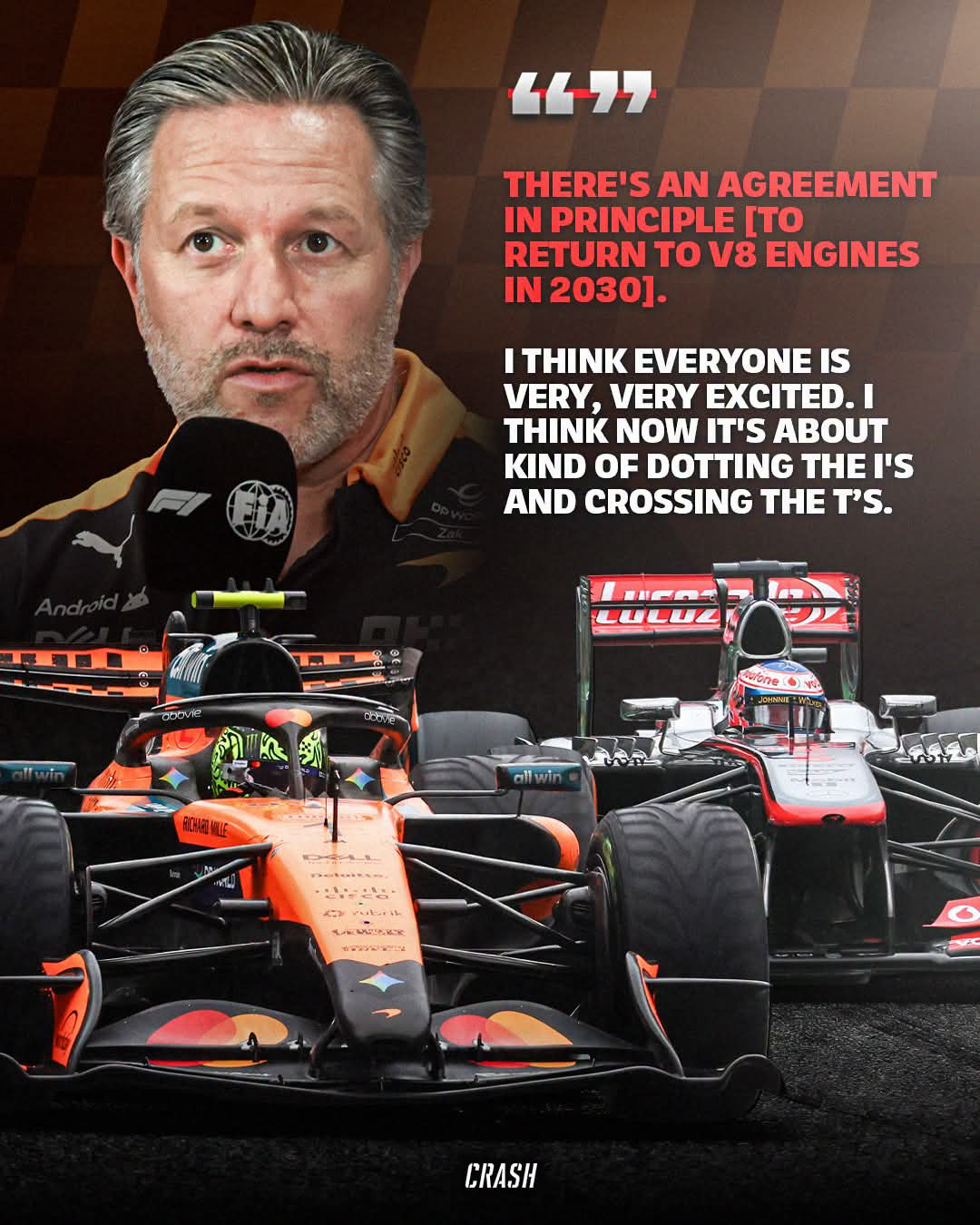
Formula 1 could be heading towards one of the most significant technical transformations in its modern history, with McLaren Racing CEO Zak Brown confirming that the sport’s major stakeholders have reached an agreement in principle to bring back V8 engines in 2030.
Speaking ahead of the Las Vegas Grand Prix, Brown delivered an encouraging update on discussions surrounding Formula 1’s next-generation power units. According to the McLaren boss, the key stakeholders have broadly agreed on the direction of the proposed changes, with attention now turning towards finalising the remaining technical and regulatory details.
The development represents a potentially important victory for fans who have repeatedly called for Formula 1 to return to louder, simpler and more traditional engine configurations.
Although the proposed regulations have not yet received final formal approval, Brown’s comments suggest that the return of V8 power is considerably closer to reality than many initially expected.
ZAK BROWN CONFIRMS AGREEMENT ON V8 ENGINE RETURN
Brown made his position clear when questioned about the outcome of recent discussions involving Formula 1, the FIA and power unit manufacturers.
“There’s an agreement in principle. I think everyone is very, very excited. I think now it’s about kind of dotting the I’s and crossing the T’s,” Brown explained.
His comments provide an important indication that the sport is moving towards a common position on its future engine regulations.
The discussions have gained momentum following growing criticism of aspects of the current hybrid power unit philosophy, particularly concerns surrounding electrical energy management and the impact it can have on racing.
Brown also expressed confidence in Formula 1’s overall direction, praising the work being undertaken by the FIA and Formula 1 management.
He believes the championship is in a strong position and that further changes could make the sport even more attractive to fans, manufacturers and commercial partners.
WHY FORMULA 1 WANTS TO BRING BACK V8 ENGINES
To understand the importance of this development, it is necessary to look at Formula 1’s engine history.
The championship last used naturally aspirated V8 engines between 2006 and 2013. That generation became particularly popular because of its distinctive high-pitched sound, relatively straightforward architecture and the incredible performances produced by the cars.
However, Formula 1 moved to turbocharged V6 hybrid power units in 2014 as part of a broader effort to improve fuel efficiency and demonstrate technological relevance to the automotive industry.
The hybrid era brought impressive engineering developments, but it also changed the character of the sport.
For many traditional supporters, the quieter engine sound became one of the biggest disappointments of the new era.
The latest proposal offers an opportunity to address some of those concerns without completely abandoning modern technology.
The emerging concept centres on a 2.1-litre turbocharged V8 running on sustainable fuels, with substantially reduced reliance on electrical assistance compared with the current generation.
The objective is to create a power unit that delivers a more traditional Formula 1 experience while remaining compatible with the sport’s environmental ambitions.
A BIG WIN FOR FORMULA 1 FANS
One of the biggest potential beneficiaries of this proposed change will be the global Formula 1 fanbase.
Engine sound has always been an important part of the championship’s identity. For generations of supporters, the screaming noise of a naturally aspirated V8 or V10 engine represented everything that made Formula 1 special.
The return of V8 power could help restore some of that emotional connection.
It is not simply about making the cars louder. It is also about creating a more recognisable racing experience that appeals to both traditional supporters and newer audiences.
Formula 1 has enjoyed enormous commercial growth in recent years, attracting younger audiences, new sponsors and international markets.
However, maintaining that growth requires the championship to preserve the elements that originally made it attractive.
A more exciting engine formula could strengthen the connection between the sport and its supporters.
There is also a potential sporting benefit. Reducing the complexity of energy management could allow drivers to focus more naturally on racing rather than constantly managing electrical deployment and harvesting.
The precise impact will depend on the final regulations, but the direction is certainly encouraging.
WHAT THE V8 RETURN MEANS FOR F1 TEAMS AND ENGINE MANUFACTURERS
The proposed changes could have enormous consequences for the manufacturers currently involved in Formula 1.
Developing a competitive power unit requires substantial financial investment, specialist engineering knowledge and years of research.
A simpler engine architecture could potentially reduce development costs and make participation more attractive to manufacturers.
This is particularly important as Formula 1 continues to expand its manufacturer involvement.
However, the proposed 2030 introduction also creates a demanding development schedule.
Manufacturers will need to make important decisions about their existing programmes while preparing for a completely different technical direction.
Teams that successfully adapt their engineering operations could gain a significant competitive advantage.
Those that struggle with the transition may find themselves losing ground during the early stages of the new regulations.
The challenge will not simply be building a powerful V8 engine. Manufacturers must also develop reliable systems, efficient turbocharging solutions and effective integration with the car’s overall aerodynamic and mechanical package.
CADILLAC COULD BE ONE OF THE BIGGEST BENEFICIARIES
The proposed return of V8 engines has already influenced the plans of Formula 1 newcomer Cadillac.
The American manufacturer had initially targeted introducing its own General Motors power unit in 2029.
However, Cadillac CEO Dan Towriss confirmed that the team now intends to remain a Ferrari customer through 2029 before introducing its own V8 power unit in 2030.
This is a significant development because it demonstrates that the proposed regulations are already influencing manufacturers’ long-term investment decisions.
Rather than spending considerable resources developing a power unit for what could become a single-season programme, Cadillac can concentrate its efforts on the next major engine cycle.
For General Motors, this creates an opportunity to enter Formula 1’s next technical era with a more competitive and strategically valuable engine programme.
It also demonstrates how changes in the regulations can reshape the championship’s competitive landscape before the new rules even arrive.
MCLAREN IS HAPPY TO CONTINUE ITS MERCEDES ENGINE PARTNERSHIP
Interestingly, Brown’s enthusiasm for the V8 proposal does not mean McLaren intends to become an independent engine manufacturer.
The McLaren CEO has indicated that the team is happy with its existing relationship with Mercedes High Performance Powertrains.
The partnership has delivered significant success, including championship-winning machinery, and Brown sees little reason to abandon an arrangement that continues to provide competitive value.
This is an important distinction.
Formula 1’s future engine regulations may encourage new manufacturers to enter the championship, but they will not necessarily persuade every established team to develop its own power unit.
For McLaren, concentrating on chassis development, aerodynamics, race operations and overall car performance could remain a more effective business and sporting strategy.
The team’s decision also highlights an important reality of modern Formula 1: having a competitive engine partnership can be just as valuable as manufacturing your own power unit.
WILL THE NEW V8 ENGINES MAKE FORMULA 1 CARS FASTER?
This is one of the biggest questions surrounding the proposed regulations.
Although V8 engines could deliver a more traditional driving experience, their introduction does not automatically guarantee faster lap times.
Formula 1 performance depends on several interconnected factors, including engine output, aerodynamic efficiency, tyre performance, vehicle weight and mechanical grip.
The proposed reduction in hybrid complexity could potentially help produce lighter and more straightforward cars.
However, the final performance will depend on how the FIA balances combustion power, electrical assistance and aerodynamic regulations.
There is also an important consideration involving sustainability.
Formula 1 cannot simply return to its previous engine philosophy without addressing the environmental expectations that have become central to the championship’s future.
The use of sustainable fuels and a smaller hybrid component could provide a compromise between traditional engine characteristics and modern technological requirements.
If the FIA gets the balance right, the next generation could offer an exciting combination of strong engine performance, improved drivability and a more engaging sound.
THE FIA STILL HAS IMPORTANT WORK TO COMPLETE
Despite the excitement surrounding Brown’s announcement, Formula 1 supporters should remember that an agreement in principle is not the same as a fully approved technical regulation.
Several important details still need to be finalised.
These include the precise engine architecture, electrical power contribution, cost controls, development restrictions and the transition arrangements for manufacturers.
The timing is also significant.
The original expectation was that the next major engine cycle would arrive in 2031, but the emerging agreement points towards bringing the V8 regulations forward to 2030.
That would shorten the current power unit cycle and create additional pressure on manufacturers to prepare their new programmes.
A definitive regulatory framework is expected to be presented to the FIA World Motor Sport Council in Shanghai in December 2026.
Until the necessary approvals are completed, some uncertainty will remain.
Nevertheless, the public support expressed by Brown and other senior figures suggests that the proposal has considerable momentum.
OUR VERDICT: FORMULA 1 COULD BE MAKING THE RIGHT DECISION
The potential return of V8 engines in 2030 could become one of the defining decisions of Formula 1’s modern era.
The championship has spent years moving towards greater electrification, efficiency and technological complexity.
While those developments have delivered impressive engineering achievements, they have also generated difficult questions about the balance between technological innovation and sporting entertainment.
Formula 1 must remain relevant to the automotive industry, but it must also remember that its primary attraction is competitive motor racing.
The proposed V8 direction could offer a sensible compromise.
A turbocharged V8 running on sustainable fuels with reduced hybrid assistance would allow the championship to preserve modern environmental objectives while restoring some of the traditional characteristics that supporters miss.
However, the FIA must ensure that the final regulations do not create another expensive development competition dominated by a handful of manufacturers.
Cost control, competitive balance and reliability will be just as important as engine sound.
If the regulations deliver on their promises, the 2030 season could introduce one of the most exciting technical eras in recent Formula 1 history.
WHAT HAPPENS NEXT?
The immediate priority is for the FIA, Formula 1 management, teams and engine manufacturers to complete the remaining discussions and formalise the proposed regulations.
Manufacturers will then need to accelerate their development programmes, while teams begin planning how the new power units will influence their future car designs.
For fans, the possibility of hearing V8 engines return to Formula 1 is undoubtedly exciting.
For manufacturers, it represents another major engineering challenge.
And for the championship itself, it could be an opportunity to reconnect with some of the traditional elements that made Formula 1 one of the world’s most recognisable sporting competitions.
Zak Brown’s comments suggest that the direction is becoming increasingly clear.
The V8 era may not officially be back yet, but 2030 is now looking like a realistic target.
SEO KEYWORDS: Formula 1 V8 engines 2030, Zak Brown V8 announcement, F1 engine regulations, Formula 1 engine changes, FIA V8 return, McLaren F1 news, Cadillac F1 engine, 2030 F1 regulations.Sources checked for factual context: FIA’s official Las Vegas press conference transcript and reporting from Motorsport.com and RacingNews365.