Formula 1 history is filled with dominant champions, record-breaking dynasties, and unforgettable title battles. Yet some of the sport’s most cherished moments have little to do with championships. Few victories are remembered as fondly as Jean Alesi’s maiden—and ultimately only—Formula 1 win at the 1995 Canadian Grand Prix.
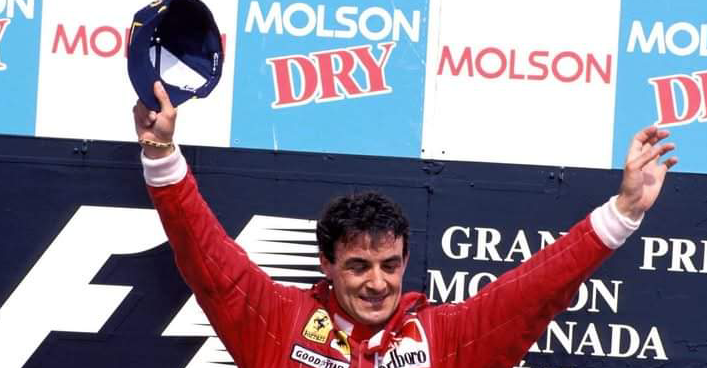
More than three decades later, the image remains iconic: a passionate Ferrari driver celebrating on his birthday after finally reaching the top step of the podium. It was a victory that brought tears, relief, and a sense of destiny. But it also carried a deeper emotional complexity that continues to make the story resonate with fans today.
THE DAY EVERYTHING FINALLY CAME TOGETHER
By the summer of 1995, Jean Alesi had already established himself as one of Formula 1’s most talented and exciting drivers. His aggressive style, fearless overtaking, and emotional connection with fans made him a favorite wherever he raced.
Yet despite his obvious speed, victory remained frustratingly elusive.
When the Formula 1 circus arrived in Montreal for the Canadian Grand Prix, Alesi was still searching for his first win after years of near misses. Few could have predicted that the breakthrough would come on one of the most memorable afternoons of his career.
Starting from fifth position, Alesi faced a difficult challenge against some of the strongest drivers and teams in the sport. However, changing weather conditions and a strong Ferrari package gave him confidence from the start.
A rainy morning warm-up session saw him set impressive pace, and when the race began, he immediately felt that something special was possible.
Early overtakes on teammate Gerhard Berger and Williams driver David Coulthard pushed him into contention. Ahead of him stood Damon Hill and Michael Schumacher, the dominant figures of the era.
One by one, circumstances began to swing in Alesi’s favor.
THE MOMENT ALESI DIDN’T KNOW HE WAS LEADING
One of the most fascinating aspects of Alesi’s victory is that he was unaware of his race position at a critical moment.
After overtaking Hill and closing the gap to the front, Schumacher encountered gearbox problems that forced the Benetton driver to pit. From the cockpit, however, Alesi never saw the German peel away.
Without modern telemetry displays and constant radio communication, drivers often relied heavily on pit boards for information.
As Alesi passed the Ferrari pit wall, confusion remained. Then something unusual caught his attention.
The grandstands began to erupt.
Thousands of Ferrari supporters started waving flags and celebrating. The crowd seemed to know something he did not.
Only on the next lap did his pit board confirm the incredible news: P1.
Jean Alesi was leading the Canadian Grand Prix.
The realization triggered an overwhelming emotional response. Years of frustration, pressure, expectation, and missed opportunities suddenly flooded into his mind.
He later revealed that he began crying inside his helmet while driving.
For any athlete, that would be an extraordinary moment. For a Ferrari driver carrying the hopes of the Tifosi, it was even more powerful.
WHY THIS WIN MEANT SO MUCH TO FERRARI
Ferrari has always been more than just a Formula 1 team. It is an institution built on passion, history, and expectation.
When Alesi joined Ferrari in 1991, fans believed he could become the next great Scuderia hero. His fearless driving style reminded many of Ferrari legends from previous generations.
The problem was that Ferrari struggled competitively throughout much of the early 1990s.
While rivals such as Williams and Benetton fought for championships, Ferrari often found itself chasing from behind. Alesi frequently delivered exceptional performances but lacked the machinery required to consistently challenge for victories.
That is what made Montreal so special.
For one afternoon, everything aligned. Ferrari, Alesi, and the passionate fanbase finally received the reward they had been chasing for years.
The celebrations that followed felt less like a single race victory and more like the release of years of pent-up emotion.
THE DECISION THAT CHANGED HIS CAREER
Any discussion about Alesi’s Formula 1 legacy inevitably returns to one question:
What if he had chosen Williams instead of Ferrari?
At the end of 1990, Alesi found himself at the center of a major driver market battle. Williams, which would soon become the dominant force of the early 1990s, offered him a long-term future.
Ferrari, however, came calling.
For many drivers, saying yes to Ferrari is an irresistible opportunity. Alesi ultimately chose passion and loyalty over what may have been the more competitive option.
History suggests that decision likely cost him multiple race victories and perhaps even championship opportunities.
Williams went on to produce some of the most dominant cars in Formula 1 history, while Ferrari endured several difficult seasons.
Yet Alesi has rarely expressed outright regret.
His choice was driven by emotion, relationships, and the dream of racing in red. In many ways, that decision perfectly reflected his character.
THE MOST TALENTED DRIVER NEVER TO FIGHT FOR A TITLE?
Formula 1 has seen numerous drivers whose talent exceeded their statistics.
Alesi belongs firmly in that conversation.
His remarkable second-place finish at the 1990 United States Grand Prix in Phoenix remains one of the greatest breakthrough performances in modern Formula 1 history. Driving a Tyrrell that had no business challenging for victory, he pushed Ayrton Senna to the limit and briefly looked capable of producing a stunning upset.
Many observers expected future world championships to follow.
Instead, Alesi became one of Formula 1’s most famous nearly-men.
His career included 16 second-place finishes and countless races where victory slipped away due to reliability issues, strategy misfortune, or superior machinery from rivals.
Competing against legends such as Ayrton Senna, Alain Prost, Nelson Piquet, Nigel Mansell, Damon Hill, and Michael Schumacher only made the challenge even greater.
The result is one of the sport’s most fascinating career records: a driver widely respected as elite but with only a single Formula 1 victory to his name.
WHY THE CANADIAN GRAND PRIX WIN REMAINS SO ICONIC
Some victories are remembered because they decide championships.
Others become legendary because of the human story behind them.
Alesi’s Canadian Grand Prix success belongs firmly in the second category.
Fans saw a driver who never stopped fighting despite years of disappointment. They saw genuine emotion rather than carefully managed celebrations. Most importantly, they witnessed a reminder that Formula 1 is not only about statistics and records.
Sometimes the most meaningful moments come from perseverance.
Even today, many fans remember Alesi’s lone victory more vividly than some championship-winning seasons.
That speaks volumes about the impact of the moment.
WHAT MODERN FORMULA 1 CAN LEARN FROM ALESI’S STORY
In today’s Formula 1 environment, success is often measured by titles, wins, and data-driven performance metrics.
Alesi’s story offers a different perspective.
Legacy is not always determined by trophies alone.
Drivers earn lasting respect through passion, authenticity, and their connection with fans. Despite never winning a championship, Alesi remains one of the most beloved figures in Formula 1 history because supporters recognized his commitment every time he climbed into the cockpit.
His Montreal victory serves as a reminder that sport is ultimately about emotion.
The tears inside the helmet, the Ferrari flags in the grandstands, and the sense of relief after years of frustration created a moment that statistics can never fully capture.
THE LASTING LEGACY OF JEAN ALESI
Thirty-one years after that unforgettable afternoon in Montreal, Jean Alesi’s only Formula 1 victory continues to hold a special place in the sport’s history.
It was a win born from perseverance, heartbreak, and unwavering belief.
While many drivers have collected more trophies, few have delivered a victory with such emotional significance.
For Ferrari fans, it remains one of the team’s most cherished moments of the 1990s. For Formula 1 enthusiasts, it stands as proof that sometimes a single victory can define a career more powerfully than an entire collection of championships.
Jean Alesi may have won only once, but that one victory ensured his place among Formula 1’s most unforgettable drivers. JEAN ALESI’S EMOTIONAL FERRARI TRIUMPH: THE STORY OF FORMULA 1’S MOST BITTERSWEET VICTORY
Formula 1 history is filled with dominant champions, record-breaking dynasties, and unforgettable title battles. Yet some of the sport’s most cherished moments have little to do with championships. Few victories are remembered as fondly as Jean Alesi’s maiden—and ultimately only—Formula 1 win at the 1995 Canadian Grand Prix.
More than three decades later, the image remains iconic: a passionate Ferrari driver celebrating on his birthday after finally reaching the top step of the podium. It was a victory that brought tears, relief, and a sense of destiny. But it also carried a deeper emotional complexity that continues to make the story resonate with fans today.
THE DAY EVERYTHING FINALLY CAME TOGETHER
By the summer of 1995, Jean Alesi had already established himself as one of Formula 1’s most talented and exciting drivers. His aggressive style, fearless overtaking, and emotional connection with fans made him a favorite wherever he raced.
Yet despite his obvious speed, victory remained frustratingly elusive.
When the Formula 1 circus arrived in Montreal for the Canadian Grand Prix, Alesi was still searching for his first win after years of near misses. Few could have predicted that the breakthrough would come on one of the most memorable afternoons of his career.
Starting from fifth position, Alesi faced a difficult challenge against some of the strongest drivers and teams in the sport. However, changing weather conditions and a strong Ferrari package gave him confidence from the start.
A rainy morning warm-up session saw him set impressive pace, and when the race began, he immediately felt that something special was possible.
Early overtakes on teammate Gerhard Berger and Williams driver David Coulthard pushed him into contention. Ahead of him stood Damon Hill and Michael Schumacher, the dominant figures of the era.
One by one, circumstances began to swing in Alesi’s favor.
THE MOMENT ALESI DIDN’T KNOW HE WAS LEADING
One of the most fascinating aspects of Alesi’s victory is that he was unaware of his race position at a critical moment.
After overtaking Hill and closing the gap to the front, Schumacher encountered gearbox problems that forced the Benetton driver to pit. From the cockpit, however, Alesi never saw the German peel away.
Without modern telemetry displays and constant radio communication, drivers often relied heavily on pit boards for information.
As Alesi passed the Ferrari pit wall, confusion remained. Then something unusual caught his attention.
The grandstands began to erupt.
Thousands of Ferrari supporters started waving flags and celebrating. The crowd seemed to know something he did not.
Only on the next lap did his pit board confirm the incredible news: P1.
Jean Alesi was leading the Canadian Grand Prix.
The realization triggered an overwhelming emotional response. Years of frustration, pressure, expectation, and missed opportunities suddenly flooded into his mind.
He later revealed that he began crying inside his helmet while driving.
For any athlete, that would be an extraordinary moment. For a Ferrari driver carrying the hopes of the Tifosi, it was even more powerful.
WHY THIS WIN MEANT SO MUCH TO FERRARI
Ferrari has always been more than just a Formula 1 team. It is an institution built on passion, history, and expectation.
When Alesi joined Ferrari in 1991, fans believed he could become the next great Scuderia hero. His fearless driving style reminded many of Ferrari legends from previous generations.
The problem was that Ferrari struggled competitively throughout much of the early 1990s.
While rivals such as Williams and Benetton fought for championships, Ferrari often found itself chasing from behind. Alesi frequently delivered exceptional performances but lacked the machinery required to consistently challenge for victories.
That is what made Montreal so special.
For one afternoon, everything aligned. Ferrari, Alesi, and the passionate fanbase finally received the reward they had been chasing for years.
The celebrations that followed felt less like a single race victory and more like the release of years of pent-up emotion.
THE DECISION THAT CHANGED HIS CAREER
Any discussion about Alesi’s Formula 1 legacy inevitably returns to one question:
What if he had chosen Williams instead of Ferrari?
At the end of 1990, Alesi found himself at the center of a major driver market battle. Williams, which would soon become the dominant force of the early 1990s, offered him a long-term future.
Ferrari, however, came calling.
For many drivers, saying yes to Ferrari is an irresistible opportunity. Alesi ultimately chose passion and loyalty over what may have been the more competitive option.
History suggests that decision likely cost him multiple race victories and perhaps even championship opportunities.
Williams went on to produce some of the most dominant cars in Formula 1 history, while Ferrari endured several difficult seasons.
Yet Alesi has rarely expressed outright regret.
His choice was driven by emotion, relationships, and the dream of racing in red. In many ways, that decision perfectly reflected his character.
THE MOST TALENTED DRIVER NEVER TO FIGHT FOR A TITLE?
Formula 1 has seen numerous drivers whose talent exceeded their statistics.
Alesi belongs firmly in that conversation.
His remarkable second-place finish at the 1990 United States Grand Prix in Phoenix remains one of the greatest breakthrough performances in modern Formula 1 history. Driving a Tyrrell that had no business challenging for victory, he pushed Ayrton Senna to the limit and briefly looked capable of producing a stunning upset.
Many observers expected future world championships to follow.
Instead, Alesi became one of Formula 1’s most famous nearly-men.
His career included 16 second-place finishes and countless races where victory slipped away due to reliability issues, strategy misfortune, or superior machinery from rivals.
Competing against legends such as Ayrton Senna, Alain Prost, Nelson Piquet, Nigel Mansell, Damon Hill, and Michael Schumacher only made the challenge even greater.
The result is one of the sport’s most fascinating career records: a driver widely respected as elite but with only a single Formula 1 victory to his name.
WHY THE CANADIAN GRAND PRIX WIN REMAINS SO ICONIC
Some victories are remembered because they decide championships.
Others become legendary because of the human story behind them.
Alesi’s Canadian Grand Prix success belongs firmly in the second category.
Fans saw a driver who never stopped fighting despite years of disappointment. They saw genuine emotion rather than carefully managed celebrations. Most importantly, they witnessed a reminder that Formula 1 is not only about statistics and records.
Sometimes the most meaningful moments come from perseverance.
Even today, many fans remember Alesi’s lone victory more vividly than some championship-winning seasons.
That speaks volumes about the impact of the moment.
WHAT MODERN FORMULA 1 CAN LEARN FROM ALESI’S STORY
In today’s Formula 1 environment, success is often measured by titles, wins, and data-driven performance metrics.
Alesi’s story offers a different perspective.
Legacy is not always determined by trophies alone.
Drivers earn lasting respect through passion, authenticity, and their connection with fans. Despite never winning a championship, Alesi remains one of the most beloved figures in Formula 1 history because supporters recognized his commitment every time he climbed into the cockpit.
His Montreal victory serves as a reminder that sport is ultimately about emotion.
The tears inside the helmet, the Ferrari flags in the grandstands, and the sense of relief after years of frustration created a moment that statistics can never fully capture.
THE LASTING LEGACY OF JEAN ALESI
Thirty-one years after that unforgettable afternoon in Montreal, Jean Alesi’s only Formula 1 victory continues to hold a special place in the sport’s history.
It was a win born from perseverance, heartbreak, and unwavering belief.
While many drivers have collected more trophies, few have delivered a victory with such emotional significance.
For Ferrari fans, it remains one of the team’s most cherished moments of the 1990s. For Formula 1 enthusiasts, it stands as proof that sometimes a single victory can define a career more powerfully than an entire collection of championships.
Jean Alesi may have won only once, but that one victory ensured his place among Formula 1’s most unforgettable drivers.