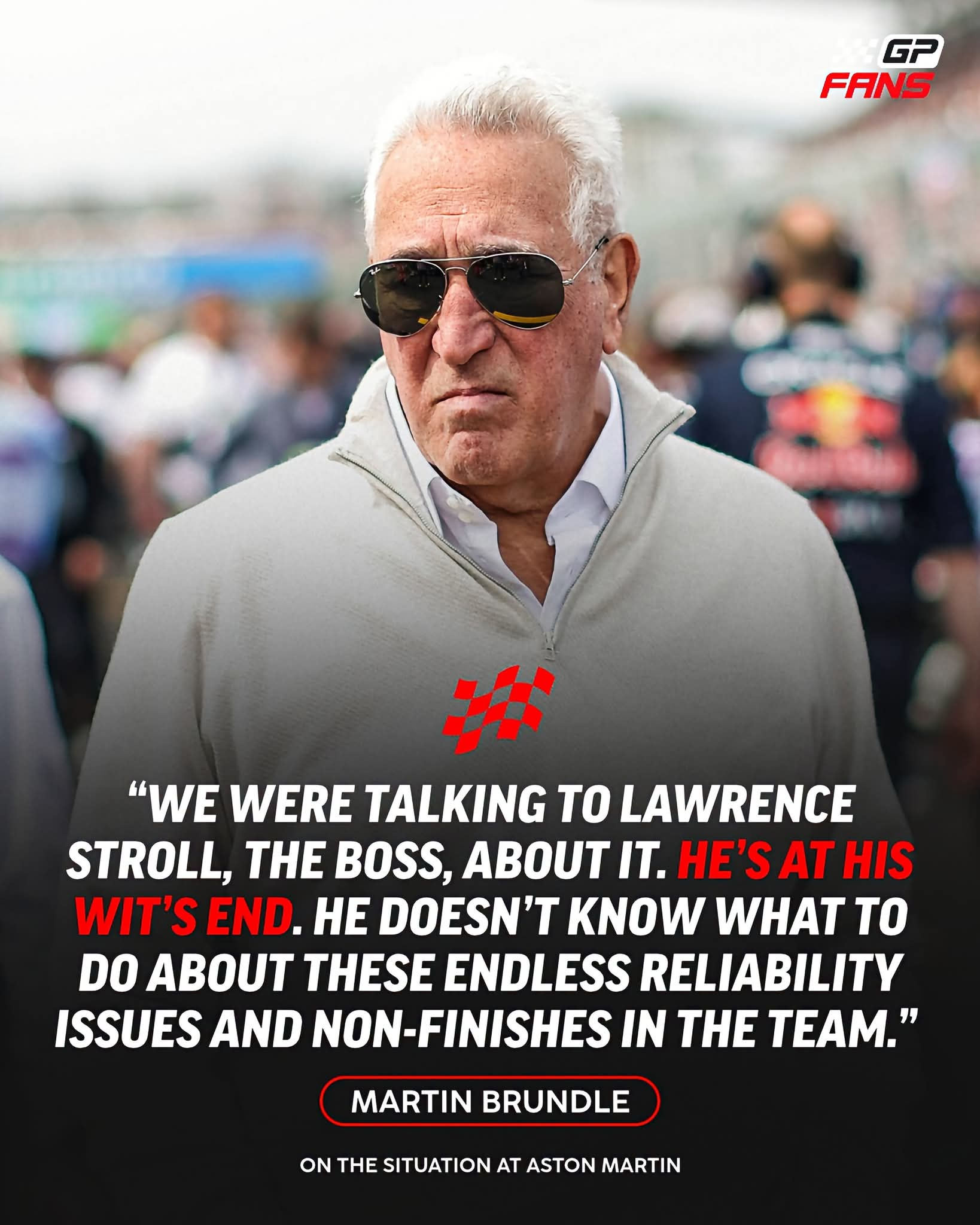
The Formula 1 paddock has seen plenty of frustrated team owners over the decades, but few situations look quite as bleak as the one currently enveloping Aston Martin. After yet another costly retirement for Lance Stroll at the São Paulo Grand Prix, Sky F1’s Martin Brundle delivered a blunt assessment that captured the mood inside the team: owner Lawrence Stroll is “at his wit’s end.”
The Canadian billionaire, who has poured enormous resources into turning Aston Martin into a genuine championship contender, now finds himself staring at a season defined by broken cars, unfinished races, and unanswered technical questions. The nightmare, as Brundle put it, simply continues.
ANOTHER BATTERY FAILURE, ANOTHER EARLY EXIT
At Interlagos, Lance Stroll’s race ended mid-distance with yet another energy recovery system and battery-related issue. It was his 13th or 14th retirement of the 2026 campaign depending on classification, a brutal tally that has left the team haemorrhaging points and momentum. Honda, the power unit partner, admitted after the race that while they understand what failed, the root cause remains unclear. Investigations will take weeks.
This was not an isolated incident. Similar battery and ERS problems have plagued the AMR26 throughout the latter part of the season, arriving on top of earlier chassis vibration issues, power deficits, and general reliability frailty. Fernando Alonso has suffered his share of DNFs too, but the sheer volume of non-finishes for the No. 18 car has become impossible to ignore.
For a team that entered the year with title aspirations and one of the healthiest budgets on the grid, the results feel especially cruel.
WHY THIS MATTERS BEYOND ONE BAD SEASON
Aston Martin’s struggles are not just a story about bad luck or a difficult car. They strike at the heart of the team’s long-term project. Lawrence Stroll’s investment thesis has always rested on attracting top talent, building a world-class facility, and leveraging Honda’s engineering might to close the gap to the front. Persistent reliability failures undermine every one of those pillars.
Drivers lose confidence. Engineers burn time chasing ghosts instead of performance. Sponsors begin to question the return on investment. And the wider championship picture shifts as points that should have been banked evaporate. In a sport where constructors’ championship position determines prize money and future development resources, every DNF carries a compounding cost.
The human element is equally significant. Lance Stroll has endured a season of almost relentless disappointment. Even the most resilient drivers eventually feel the psychological weight of climbing into a car that seems determined not to finish. Alonso, a two-time world champion still capable of extracting magic from imperfect machinery, can only do so much when the hardware keeps failing.
THE HONDA QUESTION AND THE ROAD TO 2027
Brundle’s most pointed observation concerned the future. “What are they going to do for next year?” he asked. “Have they got different ideas, different people to sort the problem out? The battery pack, the ERS… and just the power deficit they’ve got. That’s the problem Aston Martin have at the moment: Where do they go from here?”
That question hangs over Silverstone and Sakura alike. Honda has a proud history in Formula 1, but the current hybrid-era partnership with Aston Martin has yet to deliver the consistency the British team needs. With major regulation changes still on the horizon and 2027 development already underway, the clock is ticking. Continuing with the same approach risks carrying the same problems forward. Making radical changes risks destabilising an already fragile operation.
Some will argue that big money should buy better reliability. In reality, Formula 1 has repeatedly shown that financial firepower alone cannot solve complex power unit integration issues. Mercedes, Ferrari, and Red Bull have all lived through painful reliability phases even with far deeper institutional knowledge. Aston Martin is learning that lesson the hard way.
WHAT COMES NEXT
The remaining races of 2026 offer limited opportunities to salvage the season, but they matter for data collection and morale. More importantly, the winter will reveal whether Lawrence Stroll and the leadership group still believe the current technical direction can deliver, or whether personnel and structural changes are coming.
For Lance Stroll, the priority must be simple: finish races. Consistent points, even modest ones, would restore some belief. For the team, the priority is harder: diagnose the battery and ERS failures properly, restore power competitiveness, and stop the bleeding before the next regulatory cycle hardens the current hierarchy.
Formula 1 is unforgiving. Ambition without reliability is just expensive frustration. Right now, that is the story of Aston Martin in 2026. Lawrence Stroll has the resources and the will. What he needs most is answers — and cars that actually reach the chequered flag.
The nightmare continues. The question is how much longer the team can afford to live inside it.