The Austrian Grand Prix may have ended with George Russell standing on the top step of the podium, but one of the race weekend’s biggest talking points continued long after the chequered flag. Fresh attention has now shifted to Max Verstappen’s sarcastic team radio message, which resurfaced following the dramatic qualifying controversy involving yellow flags and Russell’s pole-winning lap.
The Red Bull star’s comments have once again highlighted Formula 1’s ongoing debate about yellow-flag consistency, driver safety, and whether the FIA’s current procedures are fit for purpose.
VERSTAPPEN’S RADIO MESSAGE ADDS FUEL TO THE CONTROVERSY
During qualifying at the Red Bull Ring, Verstappen crashed heavily at Turn 9 while pushing on his final Q3 attempt. The accident immediately brought out yellow flags, but confusion quickly followed over exactly what type of warning drivers behind received.
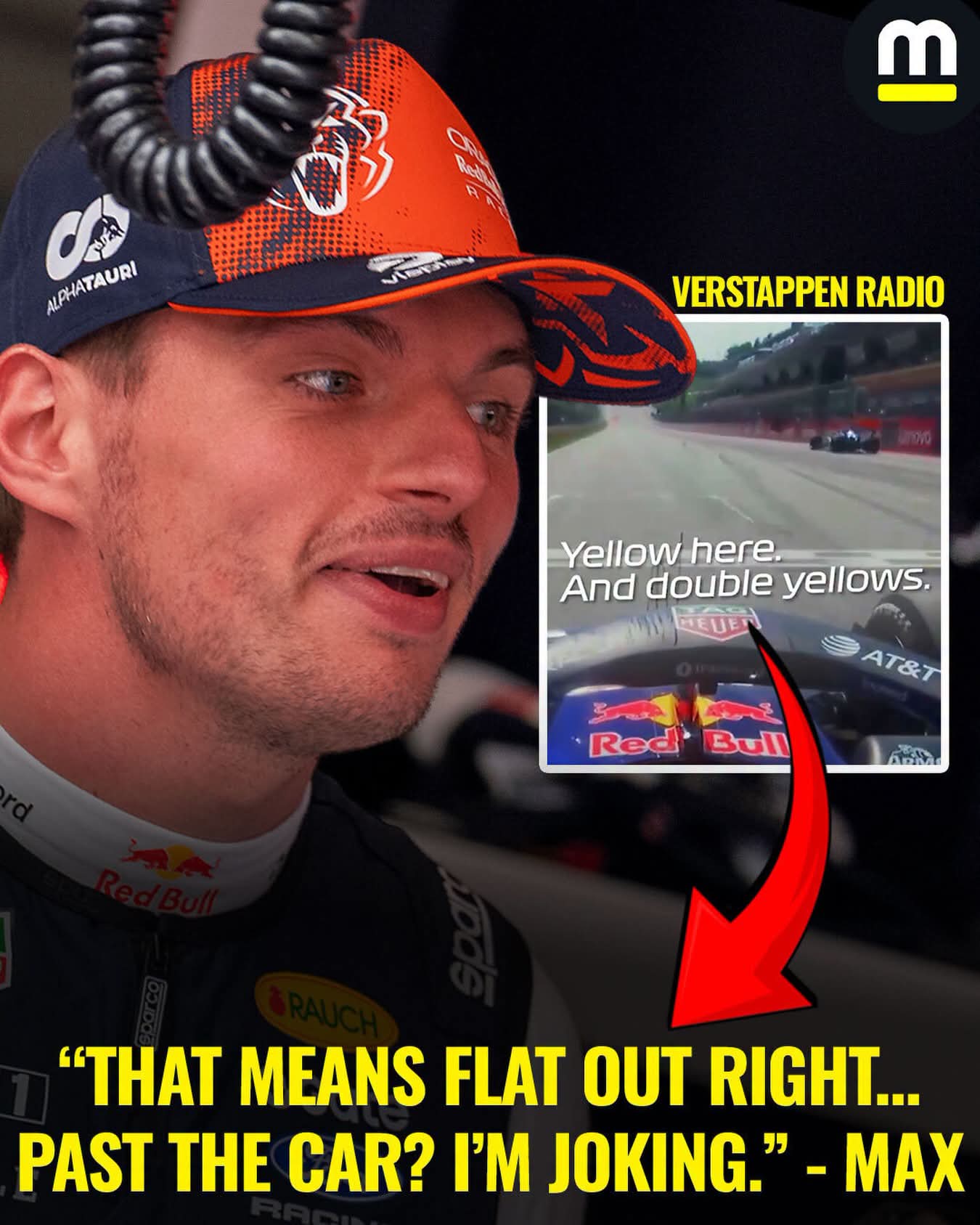
After hearing over team radio that yellow and double-yellow flags had been displayed, Verstappen jokingly responded:
“That means flat out right… past the car? I’m joking.”
While clearly delivered with sarcasm, the comment reflected growing frustration surrounding how yellow flags were being handled during one of qualifying’s most decisive moments.
The incident became even more controversial because George Russell completed his lap through the affected sector and secured pole position, while several rivals believed stronger flag signals should have immediately neutralized the session.
WHY THE YELLOW FLAG INCIDENT CAUSED SO MUCH DEBATE
Formula 1’s flag regulations are straightforward in theory but can become extremely complicated in practice.
A single yellow flag instructs drivers to slow down and be prepared for danger ahead, while a double yellow requires drivers to reduce speed significantly because marshals or stranded cars may be on the racing line.
The controversy in Austria centered on timing.
Russell encountered only a single yellow while completing his lap, allowing him to lift briefly before continuing. The FIA later concluded that he had complied with the regulations and allowed his pole position to stand.
However, several drivers, teams, and fans questioned whether the situation escalated quickly enough to warrant an immediate double yellow.
Verstappen’s radio message perfectly captured the uncertainty surrounding the decision.
FIA STOOD BY ITS DECISION
Following the session, the FIA reviewed Russell’s onboard footage, telemetry, and timing data before confirming that the Mercedes driver had reduced speed sufficiently through the yellow-flag zone.
No penalty was issued, meaning Russell retained pole position.
Although the governing body followed the regulations as written, the incident sparked fresh discussion about whether the rules themselves need clarification.
Consistency remains one of the biggest concerns among drivers.
Several recent Formula 1 weekends have produced similar debates over yellow-flag interpretation, leaving competitors unsure how aggressively they can continue pushing while remaining within the regulations.
VERSTAPPEN’S FRUSTRATION IS UNDERSTANDABLE
From Verstappen’s perspective, the frustration goes beyond losing a qualifying opportunity.
When a driver crashes at high speed, safety becomes the immediate priority.
The four-time world champion has repeatedly advocated for clearer and faster decision-making from race control whenever dangerous incidents occur.
His sarcastic remark was less about attacking another driver and more about questioning whether the warning system provided sufficient protection for everyone involved.
Given Formula 1’s relentless pursuit of safety improvements over recent decades, every yellow-flag controversy naturally attracts significant attention.
THE INCIDENT COULD LEAD TO FUTURE RULE CHANGES
The Austrian Grand Prix may ultimately become another case study for the FIA.
Modern Formula 1 relies heavily on electronic marshalling systems that communicate flag information instantly to drivers through dashboard displays as well as traditional trackside signals.
However, Austria demonstrated that even fractions of a second can create major controversy when qualifying margins are measured in hundredths of a second.
Formula 1 officials may now review whether additional safeguards are necessary to ensure dangerous incidents trigger immediate and unmistakable warnings for every driver still on a flying lap.
Such discussions have become increasingly common as cars continue reaching extraordinary speeds around modern circuits.
RED BULL STILL HAS BIGGER CHALLENGES AHEAD
While the qualifying controversy dominated headlines, Red Bull’s larger concern remains performance.
Verstappen continues extracting remarkable pace from the RB22, but Mercedes has strengthened its position at the front of both championships.
George Russell converted pole into victory in Austria, while Andrea Kimi Antonelli extended his Drivers’ Championship lead with another podium finish.
Meanwhile, Red Bull still faces questions over whether upcoming upgrades can return the team to consistent race-winning form before the championship battle slips further away.
SILVERSTONE COULD BRING ANOTHER CHAPTER
Attention now turns to the British Grand Prix, where every championship contender will look to build momentum before the season enters its crucial summer stretch.
The Austrian controversy is unlikely to disappear quickly, particularly if another yellow-flag incident occurs in the coming races.
For Verstappen, the focus will remain on closing the gap to Mercedes while hoping Red Bull’s development programme delivers the performance needed to fight consistently at the front again.
For the FIA, however, Austria serves as another reminder that even when decisions are technically correct under the rulebook, perceptions of inconsistency can quickly overshadow the sporting spectacle.
As Formula 1 continues evolving, ensuring complete confidence in race control decisions may prove just as important as the action unfolding on track.