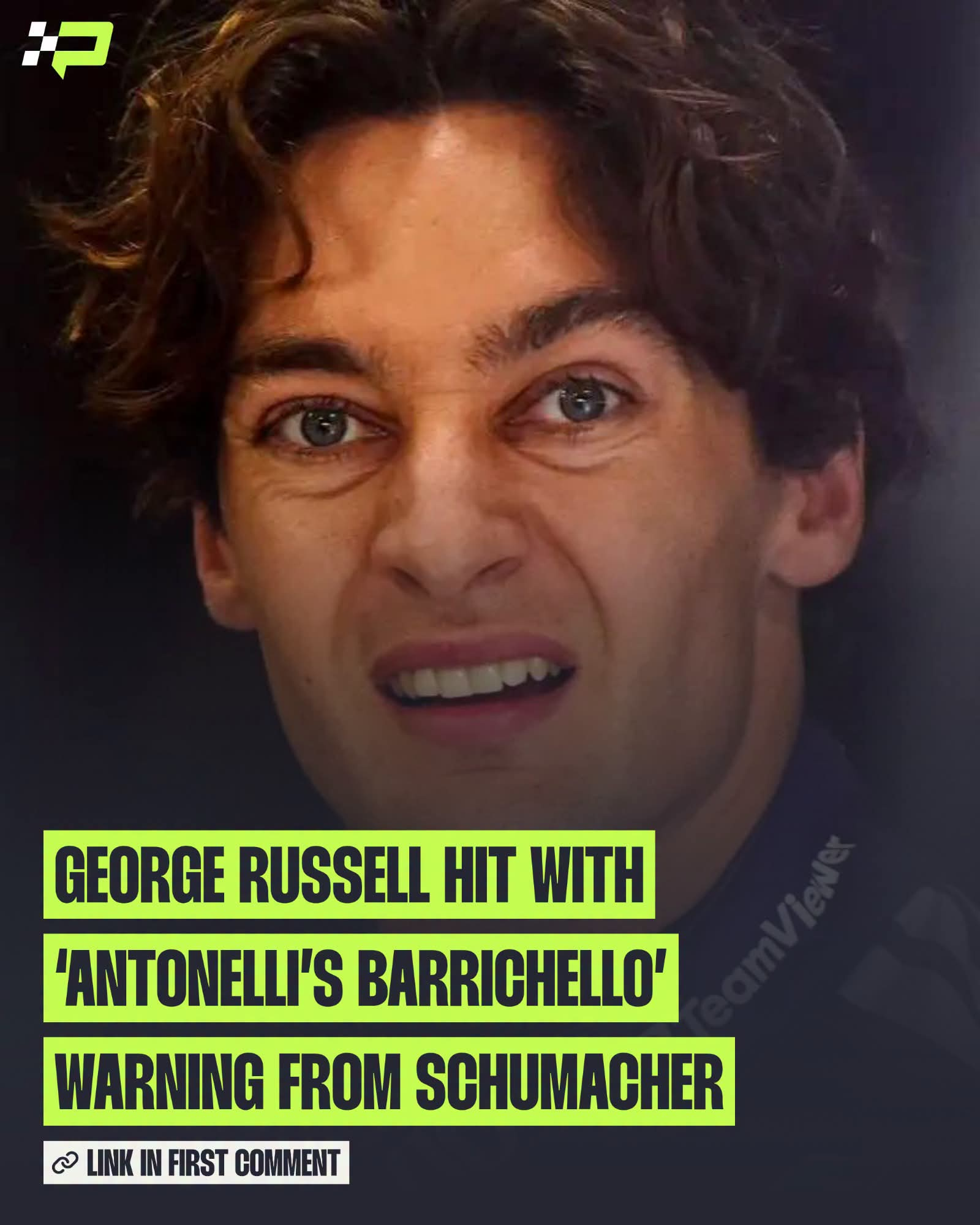
George Russell entered the 2026 Formula 1 season as the clear favourite. After outperforming young teammate Kimi Antonelli throughout 2025 and helping Mercedes stay competitive, the British driver looked set to finally claim the world championship that had long been predicted for him. Instead, the new technical regulations flipped everything. Antonelli stormed to nine victories, sealed the title with four races remaining, and became the youngest world champion in history. Russell managed three wins and finished well back in the points race.
Now Ralf Schumacher has delivered one of the harshest assessments of Russell’s future. Speaking on the Sky Germany podcast *Backstage Boxengasse*, the former Formula 1 driver and expert declared that Russell is destined to become “the Barrichello for Kimi Antonelli.” The comparison is loaded with history, and it raises serious questions about where Russell goes from here.
THE BARRICHELLO COMPARISON AND WHAT IT REALLY MEANS
Rubens Barrichello remains one of Formula 1’s most successful drivers never to win a world championship. Between 2000 and 2005 he partnered Michael Schumacher at Ferrari during the team’s most dominant era. Schumacher claimed five consecutive titles. Barrichello won races, stood on podiums regularly, and played a vital role in car development, yet he was always the clear number two. The 2002 Austrian Grand Prix, when team orders forced him to hand victory to Schumacher, became the defining image of that hierarchy.
Ralf Schumacher’s point is straightforward. With Antonelli now a world champion and driving with greater freedom and confidence, Russell faces the same structural reality Barrichello once did. “The case is closed,” Schumacher said. Russell’s only realistic path back to equal status would be if Antonelli somehow fails to adapt to the next major package of updates. Otherwise, the internal pecking order at Mercedes looks settled for the foreseeable future.
HOW ANTONELLI TURNED THE TABLES IN 2026
The shift did not happen by accident. Under the 2026 regulations, which placed far greater emphasis on electrical power and new aerodynamic concepts, Antonelli extracted more consistent performance from the Mercedes. Head-to-head data across practice and qualifying sessions remained relatively close, yet race results told a different story. Antonelli converted opportunities into wins with remarkable regularity while Russell endured a string of technical problems, strategic misfortune, and moments where the car simply did not respond to his preferred driving style.
Russell has been open about the difficulty of the season. He described it as the first year of his career in which the bad days outnumbered the good, admitting to frequent confusion and the mental challenge of bouncing back week after week. Martin Brundle has suggested that the experience could either break Russell or force him into a higher gear. The coming months will reveal which outcome materialises.
WHY THIS MATTERS FOR MERCEDES AND THE WIDER GRID
Mercedes has spent years rebuilding after the hybrid-era dominance faded. Pairing an experienced, race-winning driver like Russell with a generational talent like Antonelli was designed to create a long-term platform for success. The 2026 constructors’ title success shows the plan worked on a team level. Yet the internal dynamic now carries risk.
A settled number-one and number-two arrangement can deliver consistency and constructors’ points, but it can also create tension if the second driver refuses to accept the role. Russell is not a natural number-two personality. He fought hard for his Mercedes seat, delivered under pressure alongside Lewis Hamilton, and expected to lead the team into the next era. Accepting a Barrichello-style supporting role would represent a significant mental and professional adjustment.
For the rest of the grid, the situation is equally significant. Other teams will watch closely to see whether Russell remains content at Mercedes or begins exploring options. A frustrated, highly capable driver with multiple Grand Prix wins on his record becomes an attractive target for any squad seeking an immediate upgrade.
RUSSELL’S PATH FORWARD AND THE REALITY OF NUMBER-TWO STATUS
History shows that second drivers can still enjoy long and successful careers. Barrichello himself continued winning races after leaving Ferrari and remained a respected figure in the paddock for years. Valtteri Bottas filled a similar role alongside Hamilton at Mercedes and collected multiple victories and pole positions. The financial rewards and competitive machinery are substantial.
Yet the psychological cost is real. Drivers who once saw themselves as future champions must redefine success. For Russell, that may mean focusing on extracting the maximum from every weekend, contributing to car development, and waiting for any opportunity that arises if Antonelli hits a rough patch. Whether he possesses the temperament for that role remains an open question.
PREDICTIONS FOR 2027 AND BEYOND
The most likely scenario for 2027 is continuity. Mercedes has already committed to both drivers, and Antonelli’s championship status gives the team every reason to protect its young star. Russell will almost certainly remain the more experienced hand, expected to score solid points and provide technical feedback while Antonelli leads the title challenge.
A more dramatic outcome is possible if Russell produces a strong start to the next season and forces a reassessment of the internal balance. New regulations often create temporary performance windows. If the 2027 Mercedes suits Russell’s aggressive throttle application and corner-exit style better than Antonelli’s approach, the hierarchy could shift again.
Longer term, Russell’s future may depend on how patiently he can wait. At 28 years old he still has time, but the window for a sustained championship challenge is finite. Should the Barrichello comparison harden into permanent reality, other opportunities on the grid will eventually look more appealing.
THE BROADER LESSON FOR FORMULA 1
Driver hierarchies have always existed in Formula 1. Teams prioritise the driver they believe gives them the best chance of the drivers’ title while maximising constructors’ points. What feels different in Russell’s case is the speed of the reversal. One strong season from a 20-year-old has rewritten the narrative around a driver who was widely viewed as Mercedes’ long-term leader.
Ralf Schumacher’s comparison is deliberately provocative, yet it captures a genuine shift in power at Brackley. Whether George Russell becomes the new Rubens Barrichello depends less on public commentary and more on how both he and Mercedes respond to the new reality. The next twelve months will determine if the British driver can rewrite the script or if history is already repeating itself in the silver cars.