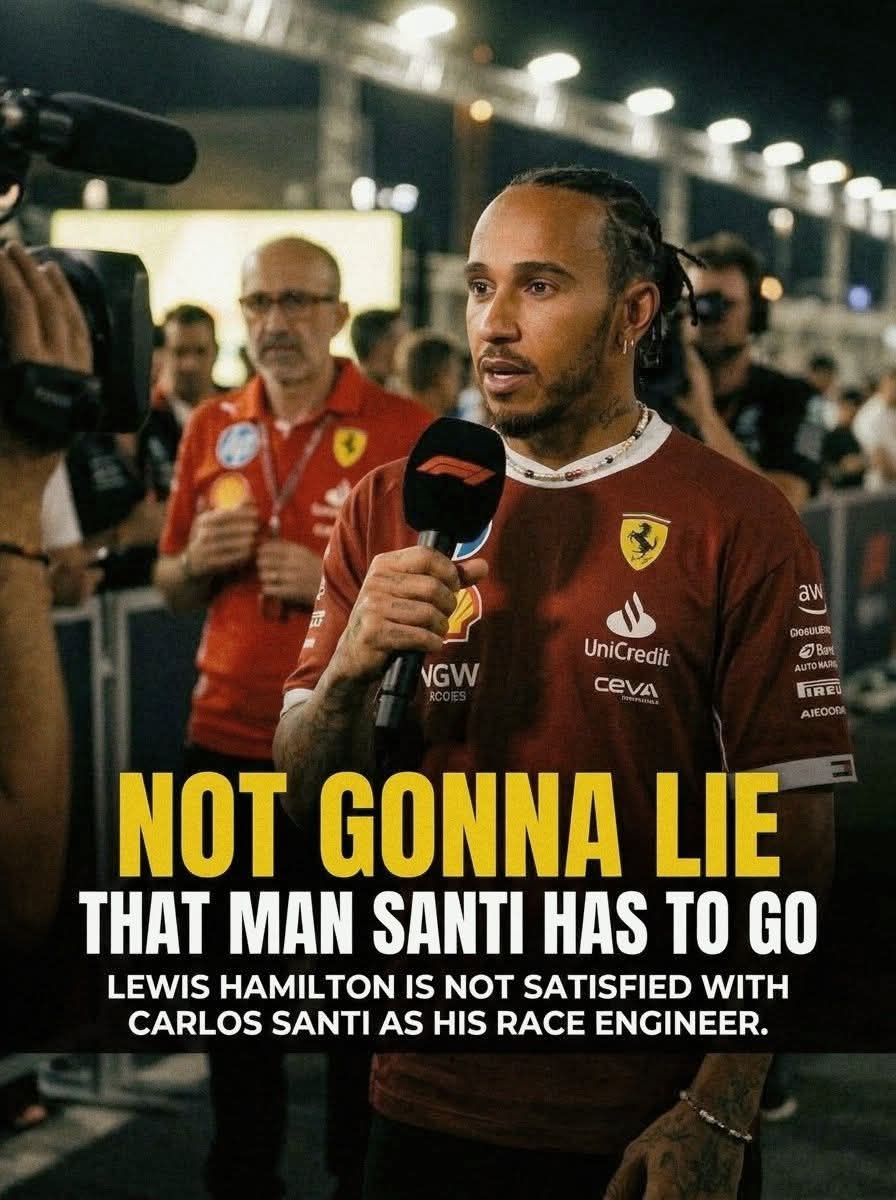
The relationship between a Formula 1 driver and their race engineer ranks among the most intimate and decisive partnerships in professional sport. When it works, the results can define eras. When it falters, even the most talented driver can look lost. Lewis Hamilton has lived both sides of that equation since switching to Ferrari.
After a difficult debut campaign in red, the seven-time world champion has rediscovered his rhythm in 2026 thanks to a soft-spoken Italian engineer who stepped into the role as a temporary measure and refused to leave. Hamilton now calls Carlo Santi his “Italian Bono.” The comparison carries weight.
THE LONG SHADOW OF PETER BONNINGTON
Peter “Bono” Bonnington spent 12 seasons as Hamilton’s race engineer at Mercedes. Together they delivered six drivers’ championships and a catalogue of iconic radio calls that became part of F1 folklore. Their partnership set a near-impossible standard for calm under pressure, precise technical feedback, and mutual trust.
When Hamilton arrived at Maranello for 2025, that standard became a measuring stick. Riccardo Adami, an experienced engineer who had previously worked with Sebastian Vettel and Carlos Sainz, took the seat. The relationship never fully clicked. Public team radio exchanges during the season revealed moments of friction and frustration that underlined how difficult it can be to replace a long-standing connection. Adami was reassigned ahead of 2026, moving into a role overseeing the Ferrari Driver Academy.
FROM INTERIM TO INDISPENSABLE
Ferrari turned to Carlo Santi. Born in Verona in 1974, Santi is a Ferrari lifer with deep roots in the team. He studied mechanical engineering at the Politecnico di Milano, specialised in vehicle dynamics, and joined Ferrari after time at Fiat’s research centre. He worked as a performance engineer for Kimi Räikkönen before becoming the Finn’s race engineer in 2018, the year Räikkönen scored his final Grand Prix victory at Austin. After that, Santi moved into Ferrari’s remote engineering operations, supporting the pit wall from Maranello.
He was brought in as a stop-gap solution for Hamilton while the team considered longer-term options. The temporary label did not last. The pair developed an immediate understanding. Hamilton has described Santi as calm, experienced, and technically sharp—an “OG” who has seen enough of the sport to stay measured when the pressure rises. The chemistry translated onto the track. By mid-season 2026, Hamilton had claimed his first victory for Ferrari at the Barcelona-Catalunya Grand Prix, with Santi joining him on the podium. Multiple further strong results followed, restoring the seven-time champion to genuine championship contention.
WHY THIS PARTNERSHIP MATTERS BEYOND THE RADIO
Driver-engineer chemistry is often underestimated by casual fans, yet it sits at the centre of performance extraction. Modern Formula 1 cars are complex machines that respond to tiny setup changes and strategic calls. The engineer acts as translator, strategist, and psychological anchor in the same role. A driver who trusts the voice in his ear can push closer to the limit. One who second-guesses that voice loses time and confidence.
Hamilton’s revival has wider implications. Ferrari has spent years chasing consistent race-winning form. Pairing their highest-profile signing with an engineer who understands both the car and the driver’s preferred communication style removes one major variable. The early success also reinforces the value of internal promotion and institutional knowledge over external hires. Santi already knew the organisation’s systems, culture, and people. That familiarity accelerated the working relationship.
For Hamilton personally, the change appears to have restored enjoyment as well as results. Late-career moves often carry the risk of diminishing returns. Finding a technical partner who enables him to extract performance from the car has extended the competitive window of one of the sport’s most decorated drivers.
THE ROAD AHEAD FOR FERRARI AND HAMILTON
The story is not finished. One breakthrough win and a handful of podiums do not equal a championship. Ferrari still faces the usual challenges of car development, tyre management, and the relentless pace of rival teams. Yet the foundation looks more solid than it did twelve months earlier. Hamilton has made clear that the engineering dialogue feels sharper and more productive. Santi has shown he can operate at the highest level under the intense spotlight that follows the most successful driver of his generation.
If the partnership continues to deliver, it could mark the beginning of a new chapter rather than a temporary upswing. History shows that the strongest driver-engineer combinations often last for years and define teams. Ferrari has found its replacement for the Adami experiment. The next test is whether that replacement can help turn competitive form into sustained silverware.
In a sport measured in thousandths of a second, the human connection on the other end of the radio still decides races. Lewis Hamilton has found his Italian Bono. The rest of the grid has been put on notice.