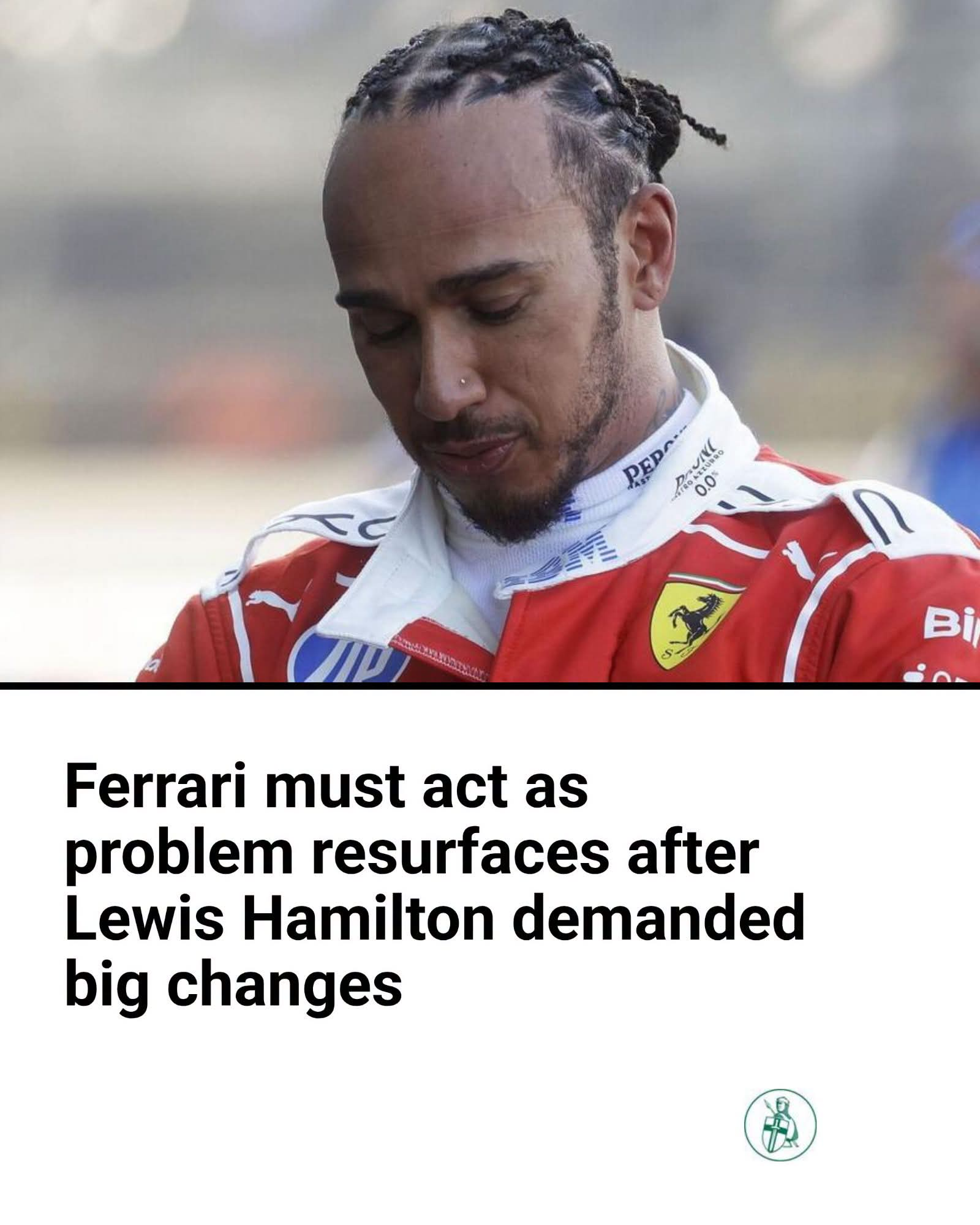
Lewis Hamilton’s difficult relationship with Ferrari has encountered another frustrating setback after a communication breakdown during the Brazilian Grand Prix once again raised questions about how effectively the seven-time world champion and his race engineers are working together.
With only three races remaining in the 2026 Formula 1 season, Ferrari are facing an uncomfortable reality: some of the problems that affected Hamilton during his disappointing first campaign with the team have not disappeared. Despite changes to his engineering arrangements and signs of improved cooperation earlier in the year, the Brazilian Grand Prix demonstrated that important information is still not reaching the driver at the right moment.
For a driver approaching his 42nd birthday in January, these repeated setbacks are becoming increasingly significant. Hamilton did not move to Maranello simply to compete in the midfield. His ambition was to help Ferrari return to championship-winning form, but the team must resolve its internal weaknesses if that partnership is ever going to deliver the success both sides expected.
BRAZILIAN GRAND PRIX EXPOSES FAMILIAR FERRARI PROBLEM
Hamilton’s race at Interlagos was already complicated before the lights went out. Like Max Verstappen, he started towards the back of the grid following an engine-related penalty, leaving him with a difficult recovery challenge.
Verstappen eventually produced an impressive drive to finish second, while Hamilton crossed the line in ninth position. Ferrari’s difficulties with tyre performance in both wet and dry conditions limited his ability to make meaningful progress, but the final stages of the race introduced another problem that could have been avoided.
A late shower changed the conditions at Interlagos, making intermediate tyres increasingly important. Hamilton remained on slick tyres while the track became wetter, losing valuable time as the Ferrari struggled for grip.
The situation became particularly concerning when he approached the pit lane and his car spun, with the rear wing making contact with the barrier. Fortunately, the incident did not cause serious damage, but it illustrated how quickly a communication mistake can develop into a potentially expensive accident.
The incident also revived an uncomfortable discussion about Ferrari’s ability to manage Hamilton’s races effectively.
THE RADIO EXCHANGE THAT PUT FERRARI UNDER PRESSURE
The most revealing moment came through the radio conversation between Hamilton and his race engineer, Carlo Santi.
Hamilton had been instructed to come into the pits for intermediate tyres. However, he did not immediately follow the instruction, believing that the worsening rain had not been clearly communicated to him.
His response was direct: “You hadn’t told me it was raining, I thought I could carry on.”
The exchange exposed a gap between what Ferrari believed it had communicated and what Hamilton understood while driving at high speed.
Hamilton later explained that he had not received sufficient information about how much the rain had intensified during the first half of the lap. By the time he reached Turn One, he realised the conditions were significantly worse than he had expected.
He acknowledged his own responsibility and apologised to the team for not following the pit instruction. However, his explanation also made it clear that he expected more detailed information from the people responsible for guiding his race.
This distinction matters. Formula 1 drivers make the final decisions inside the cockpit, but they depend heavily on engineers monitoring weather conditions, tyre performance, traffic and strategic developments. When information is incomplete or delayed, even an experienced driver can make the wrong decision.
FERRARI THOUGHT THEY HAD SOLVED THE HAMILTON ENGINEERING PROBLEM
The latest incident is particularly frustrating because Ferrari had already taken steps to address Hamilton’s difficulties communicating with his previous race engineer.
During his first season with the Italian team, Hamilton worked with Riccardo Adami, an experienced engineer who had been involved in several years of Ferrari operations.
However, their working relationship became a regular subject of discussion following tense radio exchanges and moments when Hamilton appeared dissatisfied with the information provided during races.
The difficulties were not simply about personality differences. Hamilton had spent more than a decade at Mercedes developing a highly successful working relationship with Peter Bonnington, widely known as Bono.
Bonnington understood Hamilton’s communication preferences, racing instincts and expectations. Their partnership became one of the foundations of his success, helping him secure six of his seven world championships with Mercedes.
Moving to Ferrari meant starting that process again with a completely different organisation, communication structure and working culture.
Hamilton eventually requested changes, and team principal Frederic Vasseur approved adjustments that included a new race engineer. Carlo Santi initially stepped into the position as a temporary arrangement before the partnership became permanent.
There were encouraging signs that the change had improved Hamilton’s comfort within the team. However, Brazil demonstrated that changing personnel alone does not automatically eliminate deeper communication problems.
WHY CARLO SANTI AND HAMILTON MUST FIND A BETTER UNDERSTANDING
The relationship between a Formula 1 driver and race engineer is among the most important partnerships within a modern racing team.
The driver sees only what is happening around the car, while the engineer has access to information from multiple sources, including weather radar, tyre data, telemetry and strategic calculations.
That difference makes clear communication essential.
Hamilton needs concise instructions, but he also needs enough context to understand why Ferrari are making a particular strategic decision. Telling a driver to pit is one thing; explaining that rain is intensifying across the circuit and that slick tyres are becoming increasingly unsuitable can make the instruction much more effective.
Ferrari must also understand that communication needs to be adapted to the driver. Hamilton has decades of experience and knows how he prefers to receive information under pressure.
This does not mean the team should simply agree with every decision he makes. It means both sides must establish a consistent method of exchanging information, particularly when changing weather conditions create uncertainty.
The Brazilian incident should therefore be treated as an opportunity for Ferrari to review its procedures rather than another isolated radio misunderstanding.
LEWIS HAMILTON’S FERRARI DREAM IS RUNNING OUT OF TIME
Hamilton’s age adds another dimension to the situation.
He will turn 42 in January 2027, and while age alone does not determine a driver’s competitiveness, the remaining time in his career makes every difficult season more important.
Hamilton joined Ferrari with the ambition of winning another world championship and helping the Scuderia end its long wait for another drivers’ title.
Instead, his early years with the team have been marked by adaptation challenges, disappointing results and questions about whether Ferrari can provide the environment he needs.
The comparison with Mercedes is unavoidable. At his previous team, Hamilton had an established support system and a race engineer who understood his expectations almost instinctively.
At Ferrari, that familiarity has not yet been fully recreated.
The longer the team takes to establish a dependable working relationship, the more difficult it becomes to turn Hamilton’s experience into consistent results.
However, it would be premature to conclude that the partnership cannot succeed. Ferrari still have an opportunity to improve their operations, and Hamilton’s experience remains a valuable asset in a team attempting to rebuild its competitive identity.
FERRARI MUST ALSO ADDRESS ITS STRATEGIC WEAKNESSES
Although communication has become the main talking point, Ferrari cannot afford to treat it as the only problem.
Hamilton’s Brazilian Grand Prix was affected by several factors, including tyre difficulties, his starting position and the changing weather. Even perfect radio communication would not necessarily have put him in contention for victory.
Nevertheless, the late pit-stop situation demonstrated how operational weaknesses can make an already difficult race considerably worse.
Ferrari need to examine how quickly weather information reaches the pit wall, how strategic instructions are delivered and whether drivers receive sufficient warnings before conditions change dramatically.
The team must also ensure that its two drivers receive clear and consistent strategic support. In a championship where small decisions can determine several positions, mistakes that cost only a handful of seconds can have a significant effect on the final result.
Charles Leclerc’s own difficulties during the Brazilian Grand Prix, including the penalty that dropped him from seventh to eighth, further underline how much Ferrari need to improve their overall race execution.
The Scuderia cannot afford to repeatedly lose opportunities through avoidable operational mistakes while expecting its drivers to compensate through individual performance.
THE FINAL THREE RACES COULD SHAPE HAMILTON’S 2027 EXPECTATIONS
With Las Vegas, Qatar and Abu Dhabi remaining on the 2026 calendar, Ferrari have limited opportunities to demonstrate that they are making meaningful progress.
The immediate priority should be restoring confidence between Hamilton and his engineering team.
A strong finish to the season would not erase the difficulties experienced throughout the campaign, but it could provide an important foundation for 2027. More importantly, it would show Hamilton that Ferrari are capable of learning from mistakes rather than allowing familiar problems to return.
The team also needs to understand that Hamilton’s frustration is not necessarily a sign that he has lost faith in the project. His comments about communication suggest that he believes certain problems can still be corrected.
However, patience will not last forever.
Hamilton has already experienced what a successful Formula 1 partnership looks like. He knows the level of coordination required to compete for championships, and Ferrari must demonstrate that they can provide it consistently.
FERRARI’S BIGGEST CHALLENGE IS NO LONGER JUST THE CAR
Ferrari’s 2026 campaign has exposed a problem that goes beyond outright speed. The team must improve the way it operates under pressure, particularly when unpredictable race conditions demand quick decisions and precise communication.
Hamilton cannot be expected to make every strategic decision alone while travelling at more than 300km/h. At the same time, Ferrari cannot ignore his responsibility to follow instructions when the pit wall has made a clear call.
Both sides must take responsibility.
The Brazilian Grand Prix was another reminder that a world-class driver and a famous racing organisation do not automatically become a successful partnership. Trust, understanding and consistency have to be built through thousands of small interactions.
Hamilton still has the experience and ambition to deliver meaningful results, but Ferrari must give him the support required to do so.
If the communication problems continue into 2027, the consequences could extend beyond individual race results and place even greater pressure on the future of the partnership.
For now, Ferrari have three remaining races to show that the changes they made were more than a temporary solution. The question is whether they can finally give Hamilton the dependable communication system he needs to fight at the front.