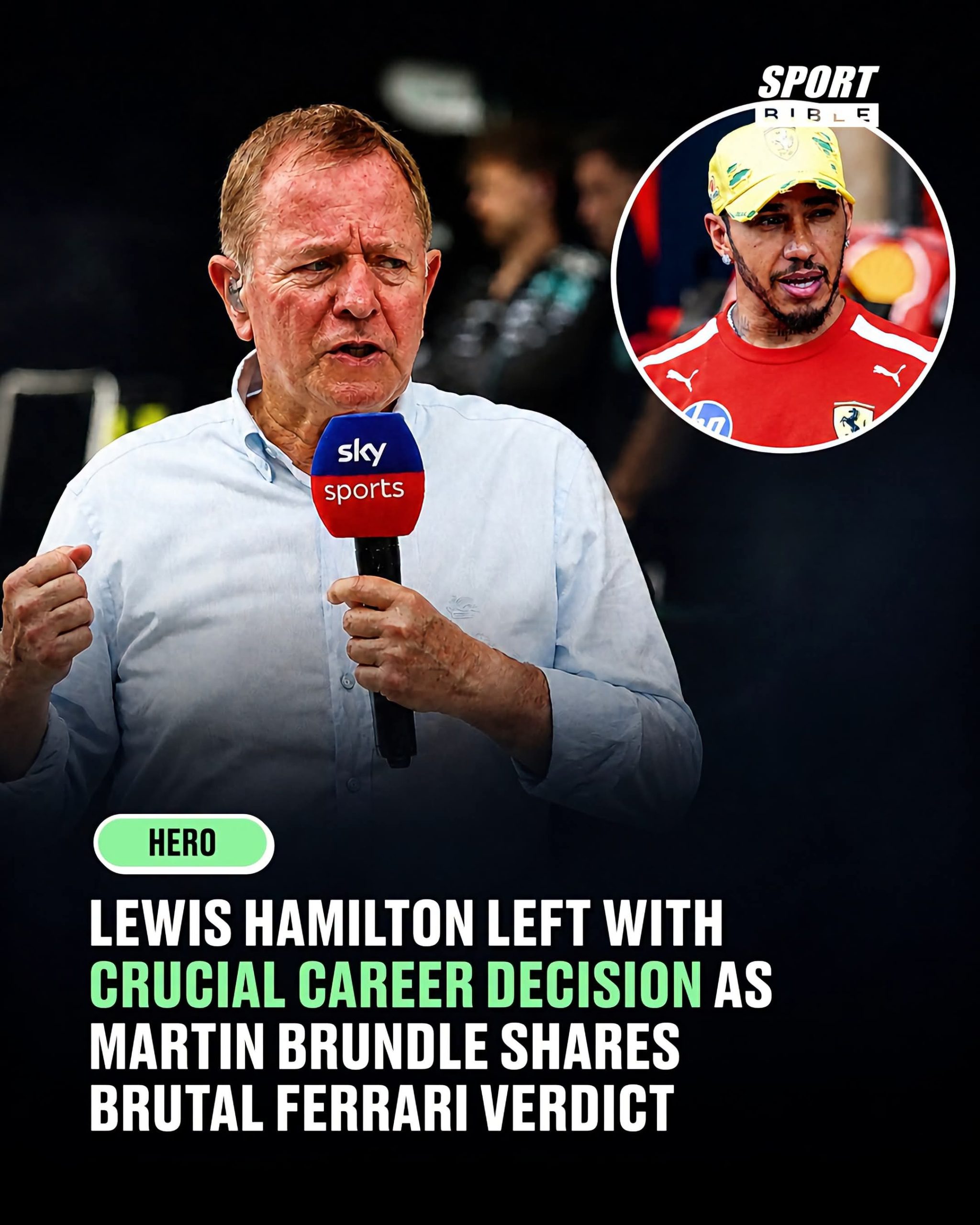
Martin Brundle has delivered a provocative assessment of Lewis Hamilton’s escalating Ferrari controversy, suggesting the seven-time Formula 1 world champion could be using his disagreement with Charles Leclerc to strengthen his influence within the Scuderia. The former F1 driver and respected broadcaster believes Hamilton has recognised an opportunity to establish a more dominant position inside Ferrari following the explosive Mexican Grand Prix. With Hamilton refusing to apologise for his criticism and Ferrari team principal Fred Vasseur maintaining that both drivers are treated equally, the situation has developed into a potentially defining moment for Hamilton’s future with the Italian giants.
MARTIN BRUNDLE BELIEVES HAMILTON HAS IDENTIFIED A FERRARI OPPORTUNITY
Brundle believes Hamilton’s frustration following the Mexican Grand Prix extends beyond the immediate consequences of his opening-lap battle with Leclerc.
According to the Sky Sports commentator, Hamilton may have recognised an opportunity to increase his authority within Ferrari after the incident exposed potential weaknesses in the team’s approach to managing its drivers.
Brundle suggested that Hamilton is unlikely to abandon the issue quickly because it could help him establish a stronger position within the organisation.
“I think Lewis has realised there’s a really good platform to carve himself out more of a number one spot there, more clout in that situation,” Brundle explained.
The broadcaster also interpreted Hamilton’s angry radio communication during the Mexican Grand Prix as something directed beyond the immediate race environment.
His suggestion was that Hamilton wanted Ferrari’s senior decision-makers to understand the consequences of allowing the situation to develop as it did.
Although Brundle’s assessment remains an interpretation rather than confirmation of Hamilton’s intentions, it introduces an intriguing possibility about the direction of the Ferrari partnership.
MEXICO GRAND PRIX BECOMES A TURNING POINT IN FERRARI’S DRIVER RELATIONSHIP
The controversy originated during the opening lap of the Mexican Grand Prix when Leclerc attempted an aggressive move against Hamilton around Turn Four.
The battle resulted in Leclerc leaving the track and gaining an advantage, while Hamilton also went off the circuit before rejoining appropriately.
The incident eventually contributed to a dramatic race outcome for Ferrari.
Leclerc received a five-second penalty and finished fourth, while Hamilton recovered to second behind Max Verstappen.
Hamilton subsequently argued that Ferrari had sacrificed a potential one-two finish because of the confrontation between its drivers.
The seven-time world champion was particularly frustrated because Ferrari had demonstrated considerable progress with its recent upgrades, giving the team an opportunity to challenge for victory.
Brundle described Leclerc’s manoeuvre as an unnecessarily risky decision, suggesting that the Monegasque driver had taken a gamble that was heavily weighted against success.
From Hamilton’s perspective, the incident presented an opportunity to question Ferrari’s management of its internal competition.
HAMILTON’S EXPERIENCE COULD GIVE HIM GREATER INFLUENCE AT FERRARI
Hamilton’s extensive Formula 1 experience is one of the most important factors in understanding Brundle’s assessment.
The British driver has spent years competing at the highest level, winning seven world championships and establishing himself as one of the most influential figures in the sport.
His experience includes navigating intense teammate rivalries, championship pressure and the political complexities of working within major Formula 1 organisations.
At Ferrari, Hamilton is attempting to combine that experience with his ambition to help the team return to championship-winning form.
However, the situation is complicated by Leclerc’s established relationship with Ferrari.
The Monegasque driver has spent several seasons building his position within the organisation and remains a central figure in its long-term ambitions.
Hamilton’s arrival therefore created an unusual dynamic involving two drivers who possess legitimate reasons to demand equal competitive opportunities.
Brundle’s argument suggests Hamilton may now be attempting to turn the Mexico controversy into an opportunity to strengthen his standing.
FRED VASSEUR REJECTS THE IDEA OF A FERRARI NUMBER ONE DRIVER
Ferrari team principal Fred Vasseur has already addressed the question of whether Hamilton or Leclerc should receive preferential treatment.
The Frenchman explained that Ferrari deliberately chose a structure involving two drivers capable of winning races rather than establishing a permanent number one and number two arrangement.
Vasseur also revealed that this philosophy was clearly communicated to both drivers before they joined or continued with the team.
According to the Ferrari boss, Hamilton understood the arrangement and accepted the conditions under which the team operates.
Vasseur insisted that Ferrari remains committed to treating both drivers equally and believes its approach provides the best opportunity for competitive success.
That position directly complicates the possibility of Hamilton securing a more dominant role within the organisation.
Even if the British driver believes the Mexico incident provides grounds for stronger influence, Ferrari’s management has made clear that its existing philosophy is not easily abandoned.
THE NUMBER ONE DRIVER DEBATE COULD BECOME HAMILTON’S BIGGEST FERRARI CHALLENGE
The disagreement raises a fundamental question about how Ferrari should manage two championship-calibre drivers.
A number one and number two arrangement can simplify strategic decisions, particularly when a team is fighting for the drivers’ championship.
However, such a structure can also create dissatisfaction if the designated second driver believes their opportunities are being unnecessarily restricted.
Ferrari’s two-number-one philosophy offers both Hamilton and Leclerc the opportunity to compete freely, but it also increases the responsibility placed on the drivers to avoid damaging the team’s objectives.
The Mexican Grand Prix demonstrated how quickly that balance can become difficult to maintain.
Hamilton’s frustration suggests that he believes Ferrari must establish clearer expectations about how its drivers approach battles against each other.
If the team cannot find an effective solution, similar incidents could become increasingly expensive during future championship campaigns.
MARTIN BRUNDLE HIGHLIGHTS A NEW PROBLEM FOR MODERN FORMULA 1
Brundle also raised a broader issue concerning the increasingly complicated relationship between individual drivers and enormous Formula 1 organisations.
He explained that teams have grown dramatically compared with the smaller operations that existed during his own racing career.
Modern Formula 1 organisations employ thousands of people, creating an environment where drivers are expected to represent an entire workforce while simultaneously competing as individuals.
That contradiction can become particularly difficult when teammates are fighting for position on the track.
Drivers are judged individually on their performances, but their decisions can affect the careers and ambitions of hundreds or thousands of people working behind the scenes.
Brundle believes this creates a new challenge for modern competitors, particularly when they are criticised for prioritising their personal ambitions over the team’s interests.
The issue is not exclusive to Ferrari. Similar questions have emerged at McLaren, where Lando Norris and Oscar Piastri have also competed under a structure designed to give both drivers opportunities.
The growing size and complexity of Formula 1 teams make internal competition increasingly difficult to manage without compromising either individual ambition or collective objectives.
HAMILTON’S FUTURE AT FERRARI COULD DEPEND ON WHAT HAPPENS NEXT
Hamilton’s Ferrari future remains another important element of the controversy.
The British driver joined Ferrari with enormous expectations, hoping to add another championship to his remarkable career and help the team return to the top of Formula 1.
However, achieving that objective requires more than competitive machinery.
Hamilton must also establish a productive relationship with Ferrari’s leadership, engineering staff and teammate while adapting to the organisation’s existing structure.
If he believes the current arrangement prevents him from maximising his championship opportunities, questions about his long-term position could become increasingly relevant.
Brundle’s comments suggest Hamilton may be considering how much influence he can establish within Ferrari rather than simply accepting the team’s existing hierarchy.
Nevertheless, there is no confirmation that Hamilton is planning to leave Ferrari or demanding a formal number one designation.
His immediate priority remains improving the team’s competitiveness and ensuring that future opportunities are not lost through avoidable internal battles.
BRAZILIAN GP COULD PROVIDE THE FIRST ANSWER TO FERRARI’S CRISIS
The Brazilian Grand Prix arrives at a crucial moment for Hamilton, Leclerc and Ferrari.
Hamilton has doubled down on his criticism, while Brundle’s analysis has introduced another dimension to the controversy by suggesting the British driver could be seeking greater influence.
Vasseur now faces the challenge of maintaining Ferrari’s two-number-one philosophy while ensuring that both drivers understand their responsibilities when competing against each other.
The outcome of discussions between Ferrari’s management and its drivers could determine whether the Mexico incident becomes a temporary disagreement or the beginning of a more complicated internal struggle.
For Hamilton, the situation presents an important career question: can he achieve his championship ambitions within Ferrari’s existing structure, or will his desire for greater influence eventually create an unavoidable conflict?
For Leclerc, the challenge is protecting his position within the team while continuing to demonstrate that he deserves equal opportunities.
Ultimately, Ferrari’s ability to manage the rivalry could prove just as important as its technical development.
Brundle’s verdict has intensified the debate, but the most important answers will come from what Hamilton, Leclerc and Vasseur do next.