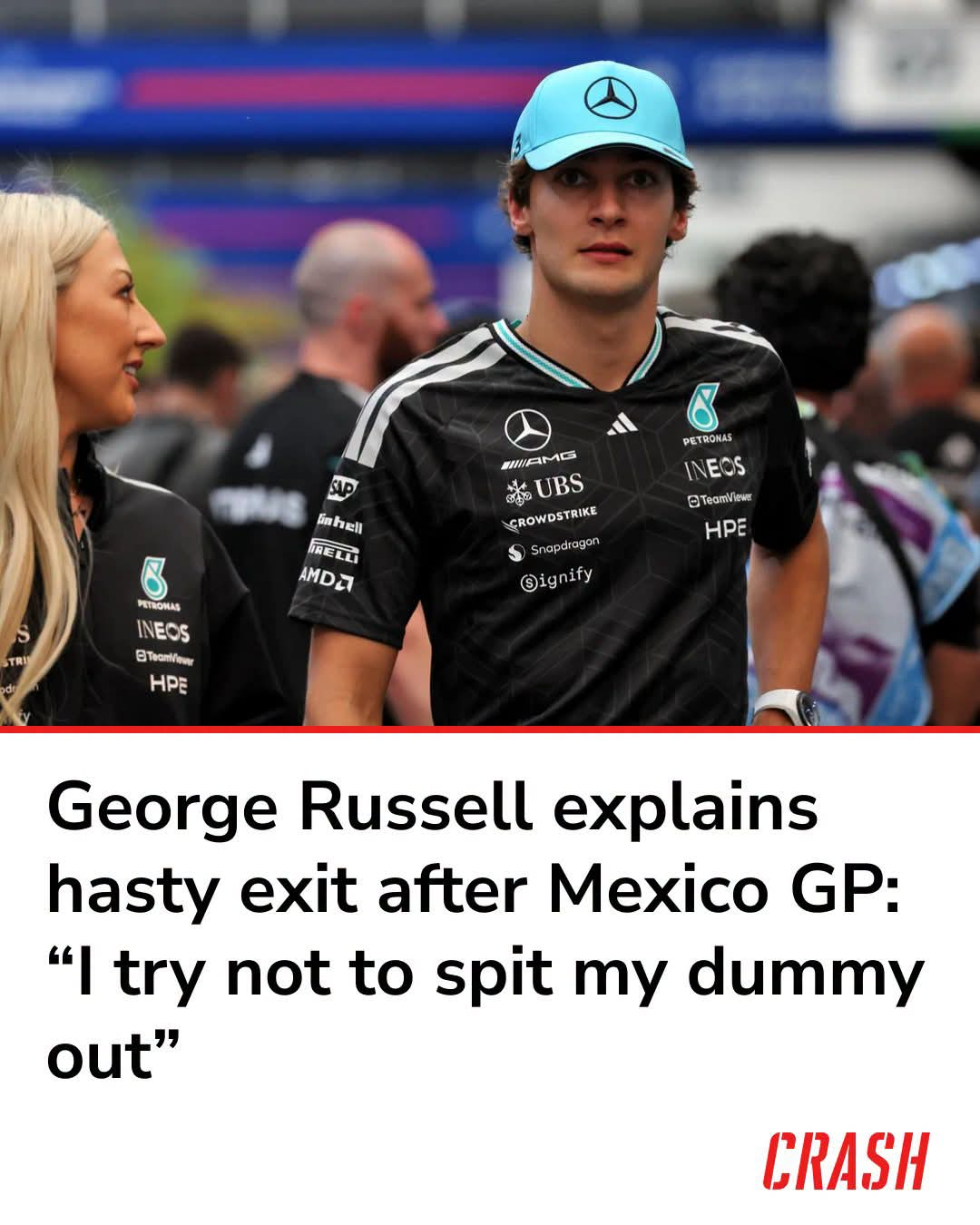
George Russell has finally opened up about his sudden departure from the Mexico City Grand Prix paddock, revealing the raw emotion that led him to skip post-race media duties and head for the airport while teammate Kimi Antonelli celebrated becoming Formula 1’s youngest world champion.
The Mercedes driver started second on the grid but saw his afternoon unravel almost immediately. An energy deployment issue robbed him of power on the long run to Turn 1, dropping him down the order. A later 10-second penalty for contact with Isack Hadjar sealed a sixth-place finish on a day when the championship was decided in the Silver Arrows’ favor—just not for him.
After offering congratulations to the 20-year-old Italian, Russell was excused from his media obligations. Mercedes accepted a €5,000 fine from the FIA. Team principal Toto Wolff described his driver as “distraught” and called it a “catastrophic moment” for a racing driver, while accepting that the team had let Russell down with the technical problem that compromised a race he had the pace to win.
“I NEEDED TO GET OUT OF THERE”
Speaking for the first time since the race, Russell kept the explanation straightforward. “I was just… in racing you always pick yourself back up and for me the best way to pick myself back up was getting out of there. It was as simple as that really,” he said.
He was not pretending the championship was still alive. That battle had already slipped away. What stung was the familiar pattern of a promising opportunity dissolving through circumstances beyond his control. “I was just very upset with missing out on the chance of a good result because the championship for me was already over but it was just… I just couldn’t believe how things had panned out again. In that moment, yeah, I just wanted to get out of there.”
Russell acknowledged he is professional the vast majority of the time and tries not to “spit my dummy out.” Skipping the press was “not ideal but not the end of the world.” Some moments, he admitted, you simply do not want to deal with in public.
A SEASON OF NEAR-MISSES AND HARD LESSONS
The Mexico result felt like a microcosm of Russell’s 2026 campaign. He opened the year with a victory in Australia and entered the season as Mercedes’ lead driver and a genuine title contender. Then the momentum shifted. Antonelli’s five consecutive wins built an insurmountable lead, while Russell’s season became defined by tough luck, technical gremlins, and performances that never quite matched the early promise.
In a heartfelt social media post shortly after the race, Russell described it as “the first proper season of my career where I’ve had more bad days than good.” He spoke of the difficulty of picking himself up week after week and the confusion that sometimes accompanied the results. “All I know is that I’ve given it my all and 2026 was not meant to be my year.” He still found space to congratulate Antonelli sincerely, calling the championship thoroughly deserved.
Wolff’s public support mattered. The Austrian has known Russell for years and understood the emotional weight of watching a younger teammate—someone Russell himself had helped bring into the team—seal the ultimate prize while his own day collapsed. “Him not doing the media work or leaving the track is absolutely understandable. Him staying would have actually surprised me,” Wolff said.
WHY THIS MOMENT MATTERS FOR RUSSELL, MERCEDES, AND THE SPORT
In the high-pressure environment of Formula 1, drivers are expected to deliver polished soundbites regardless of how the race unfolded. Russell’s decision to prioritize mental recovery over protocol highlights the human cost of a championship fight that slips away. It also underscores the challenge Mercedes faces managing two high-caliber drivers when one is writing history and the other is processing disappointment in real time.
For Russell, the early exit and subsequent honesty may prove useful. Public vulnerability can rebuild connection with fans who have watched him develop from Williams standout to Mercedes regular. It also draws a line under a difficult year and allows focus to shift toward the remaining races and the constructors’ battle, where every point still counts.
The broader industry impact is subtler. Antonelli’s title at 20 reinforces the sport’s youth movement and the rapid rise of academy drivers. Russell’s experience serves as a reminder that even established talents can face seasons where the car, the luck, and the teammate’s form combine to rewrite expectations. Reliability on energy systems and battery deployment remains a critical battleground in the current technical era; teams that solve those issues consistently will shape the next few seasons.
Looking ahead, Russell arrives in Brazil with clarity rather than unresolved frustration. The remaining races offer a chance to end the year on stronger form, support the team’s constructors’ ambitions, and begin the mental reset required for 2027. Drivers who process setbacks honestly often return sharper. Russell’s decision to leave Mexico early was not a loss of professionalism—it was a deliberate step toward recovery.
The story is not simply about a driver skipping media duties. It is about the emotional reality of elite motorsport when the dream of a title fades and the car fails at the worst possible moment. Russell’s candor gives fans a clearer view of that reality, and it leaves Mercedes with a clearer understanding of how to support both of its drivers as the season closes.