Ferrari team principal Fred Vasseur has been put under pressure to explain what is happening behind closed doors at Maranello after a damaging incident between the team’s drivers threatened to turn a promising Mexican Grand Prix into another weekend of frustration.
Lewis Hamilton’s furious radio message during the race raised serious questions about Ferrari’s ability to control its two drivers, particularly when a potential victory is at stake. Instead of securing a commanding one-two finish, the Scuderia watched its opportunity disappear following a controversial battle between Hamilton and Charles Leclerc.
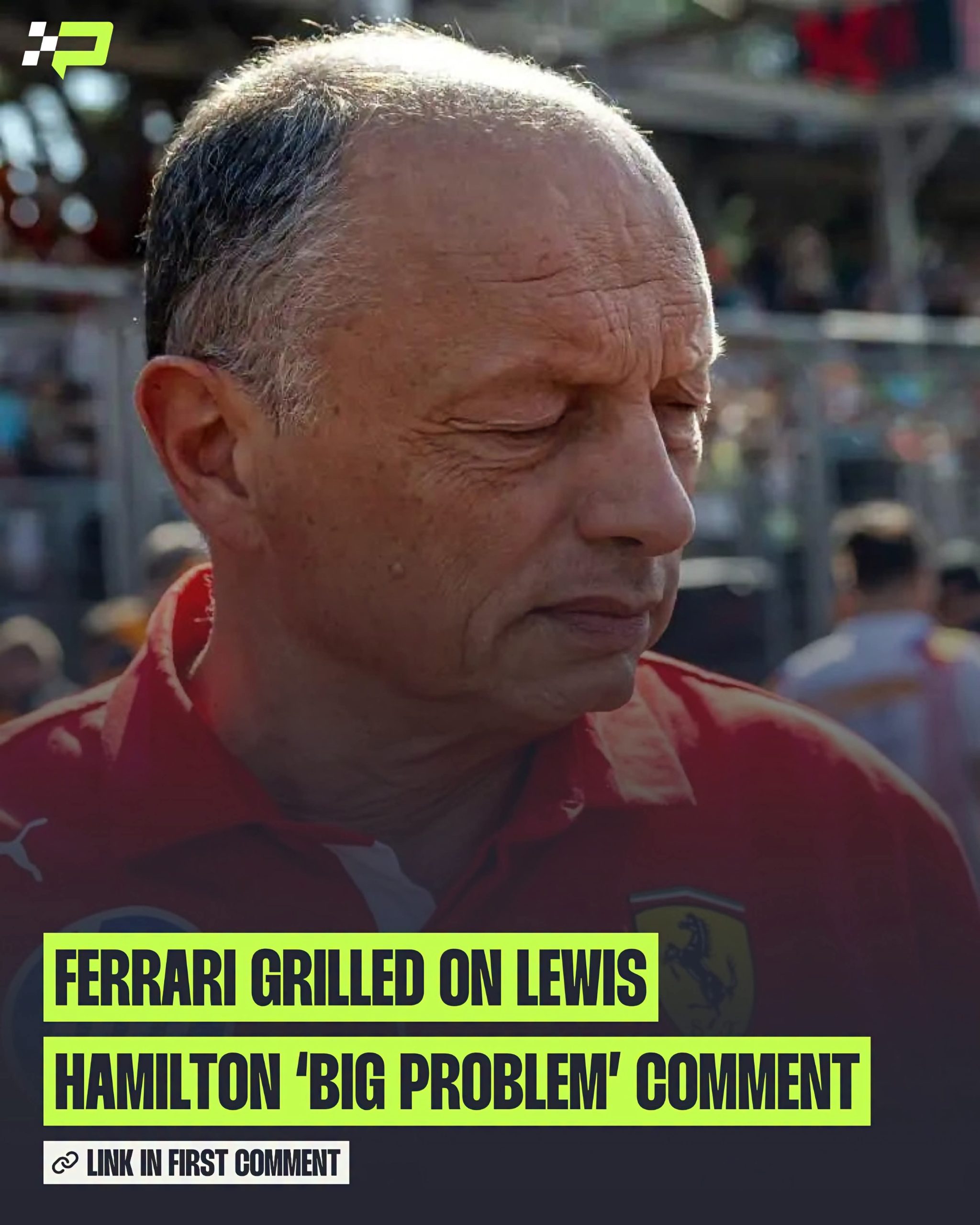
Vasseur has now addressed the situation, but his response has done little to provide clarity about what Ferrari intends to do next. The Frenchman made it clear that he would not publicly discuss the drivers’ private conversations, suggesting that the team would handle the matter internally.
However, with the Brazilian Grand Prix approaching, Ferrari cannot afford to allow another internal disagreement to damage its championship ambitions.
HAMILTON’S RADIO MESSAGE EXPOSES THE SCALE OF FERRARI’S PROBLEM
The tension became impossible to ignore during the opening stages of the Mexican Grand Prix.
Hamilton started from pole position and entered the first corner determined to maintain his advantage. Leclerc, meanwhile, was attempting to challenge his teammate and find an opportunity to move ahead.
After failing to complete a successful move through the opening complex, Leclerc launched an aggressive attempt around the outside at Turn 4.
The two Ferrari drivers ran off the track during the battle. Hamilton lost valuable momentum and eventually surrendered a position to Max Verstappen, while Leclerc was handed a five-second penalty for the incident.
The consequences were significant.
Ferrari had entered the race with the pace to potentially secure both leading positions, but its drivers’ confrontation compromised that opportunity before the race had properly developed.
When Valtteri Bottas’ heavy crash brought out the red flag, Hamilton delivered a radio message that immediately attracted attention.
“We’ve got big problems. Big, big problems,” the seven-time world champion told his team.
It was not an ordinary complaint about strategy or car performance. The timing and wording suggested that Hamilton believed something more serious needed to be addressed within Ferrari.
After the race, he reinforced that position by saying the incident had cost the team victory and that serious discussions were necessary behind closed doors.
FRED VASSEUR REFUSES TO REVEAL WHAT HAPPENED BEHIND CLOSED DOORS
Vasseur was questioned about Hamilton’s concerns and the internal disagreements that had affected Ferrari’s result.
Rather than openly criticising either driver, the team principal chose to keep the discussion private.
“We discussed it with them,” Vasseur explained.
When journalists attempted to get further clarification about the drivers’ radio comments and what had been agreed internally, Vasseur refused to interpret their statements publicly.
He made his position even clearer when pressed again.
“I won’t comment anymore on this situation. Let me discuss with them,” he said.
That response suggests Ferrari intends to address the matter internally rather than allow the disagreement to develop into a public confrontation.
From a management perspective, Vasseur’s approach is understandable. Publicly blaming one driver could create additional tension and make an already difficult relationship even harder to manage.
However, refusing to provide details also leaves an important question unanswered: what exactly will Ferrari change to prevent the same situation from happening again?
The team cannot rely on private discussions alone if its drivers continue making decisions that compromise valuable results.
FERRARI HAD THE PACE TO WIN BUT FAILED TO DELIVER
Perhaps the most frustrating aspect of the Mexican Grand Prix for Ferrari was that the team’s performance was strong enough to produce a much better result.
Hamilton had secured pole position, and the Ferrari appeared competitive throughout the weekend.
Vasseur acknowledged that the team had made progress in terms of pure performance and highlighted the points Ferrari had been collecting compared with its rivals over recent races.
He also admitted that the team’s pace had been good enough to fight for a one-two finish.
That makes the final outcome even more disappointing.
Ferrari’s biggest problem was not necessarily a lack of speed. It was the inability to turn that speed into the result its performance deserved.
In modern Formula 1, a team can spend months developing aerodynamic upgrades, improving tyre management and refining its power unit, only for a few seconds of unnecessary internal fighting to undermine the entire weekend.
That is the type of mistake championship-winning organisations must avoid.
Ferrari have invested heavily in building a competitive package, and the Mexican Grand Prix demonstrated that the car can challenge at the front. But the drivers and management must work together if the team is going to capitalise on that potential.
HAMILTON AND LECLERC’S RELATIONSHIP FACES AN IMPORTANT TEST
The incident has also placed renewed attention on the relationship between Hamilton and Leclerc.
Both drivers are fiercely competitive, and neither joined Ferrari to spend his career accepting a supporting role.
Hamilton arrived with an extraordinary record and years of experience fighting for world championships. Leclerc, meanwhile, has spent several seasons establishing himself as Ferrari’s leading long-term project.
Their combination gives Ferrari enormous potential, but it also creates a difficult management challenge.
When both drivers believe they have a genuine opportunity to win, disagreements over positioning and race strategy are almost inevitable.
The important difference is how those disagreements are handled.
A strong driver partnership can survive aggressive racing and occasional frustration. What becomes dangerous is when both sides begin questioning each other’s judgement or believing that the team is not protecting their interests.
Hamilton’s comments after Mexico suggest he wants Ferrari to address the situation before it becomes a recurring problem.
Leclerc will also want to ensure that he is not unfairly restricted from competing for victories simply because his teammate has greater championship experience.
Ferrari therefore have to establish clear expectations without destroying the competitive spirit that makes both drivers valuable.
MERCEDES PROVIDES A CONTRAST FERRARI CANNOT IGNORE
Ferrari’s difficulties have attracted comparisons with Mercedes, particularly because the German team has previously demonstrated a willingness to intervene when its drivers’ battles threaten the team’s overall result.
During the Dutch Grand Prix, Ferrari came under scrutiny after Hamilton lost significant time behind Leclerc following a stop for fresh tyres.
Mercedes, by contrast, showed little hesitation in issuing instructions when its own competitive interests required it.
That difference highlights an important aspect of modern team management.
Team orders are never popular with drivers who believe they have the pace to win, but they can protect a team’s larger objectives.
Mercedes have experienced intense internal rivalries, including the battles between Hamilton and Nico Rosberg. Those experiences showed how quickly two talented drivers can turn a successful team into the centre of a prolonged internal conflict.
Ferrari now face a similar challenge.
Vasseur must decide how much freedom to give Hamilton and Leclerc while ensuring that neither driver repeatedly compromises the team’s results.
If Ferrari want to return to consistent championship contention, there must be a clear understanding of when individual competition ends and team responsibility begins.
VASSEUR CHOOSES TO FOCUS ON THE POSITIVES
Despite the disappointment, Vasseur was keen to highlight Ferrari’s progress rather than allow the Mexican Grand Prix to become entirely defined by the Hamilton-Leclerc confrontation.
He pointed to the team’s improved performance and its recent ability to score more points than its competitors.
Ferrari’s pole position was another important positive, demonstrating that the SF-26 has the potential to compete at the front.
However, there is a danger in focusing too heavily on performance improvements while ignoring the operational mistakes that prevent those improvements from producing victories.
Ferrari do not simply need a faster car. They need a team capable of making the right decisions under pressure.
The Mexican Grand Prix showed that the machinery was competitive enough to fight for the win. What happened between the drivers demonstrated how quickly that advantage can disappear.
Vasseur’s challenge is to ensure that the next strong performance does not end with another uncomfortable post-race conversation.
BRAZILIAN GRAND PRIX COULD PROVIDE THE FIRST ANSWER
The Brazilian Grand Prix at Interlagos arrives at an important moment for Ferrari.
The team now has an opportunity to demonstrate that the Mexican incident has been addressed and that both drivers understand what is expected of them.
Hamilton will want to see evidence that his concerns have been taken seriously. Leclerc will be equally determined to compete without feeling that his opportunities are being unnecessarily restricted.
Vasseur must manage both sides carefully.
A clear agreement before the race could help prevent another damaging opening-lap confrontation. Ferrari will also need to establish how its drivers should respond when they are fighting for similar positions and the team’s wider result is at risk.
The last thing the Scuderia needs is another weekend in which its drivers become their own biggest opponents.
FERRARI’S BIGGEST CHALLENGE MAY NO LONGER BE SPEED
Hamilton’s warning has exposed a problem that Ferrari cannot solve through technical upgrades alone.
The team has shown that it can produce a competitive car, challenge for pole positions and fight for victories. But converting those opportunities requires discipline, communication and trust between everyone involved.
Vasseur’s refusal to discuss the details publicly may be the correct immediate response, but the real test will come on the track.
If Hamilton and Leclerc can put the Mexican incident behind them, Ferrari could still turn its improved performance into a successful finish to the season.
If the same disagreements continue, however, the team risks throwing away more opportunities that its rivals will gladly accept.
The Brazilian Grand Prix will not necessarily settle every question surrounding Ferrari, but it could reveal whether the discussions promised by Hamilton have produced any meaningful change.