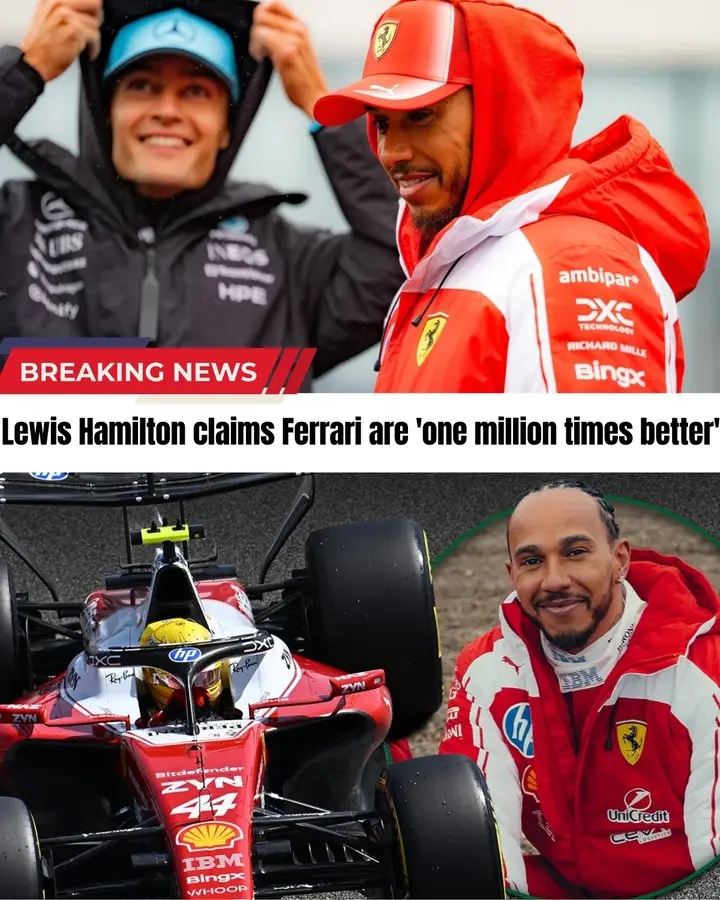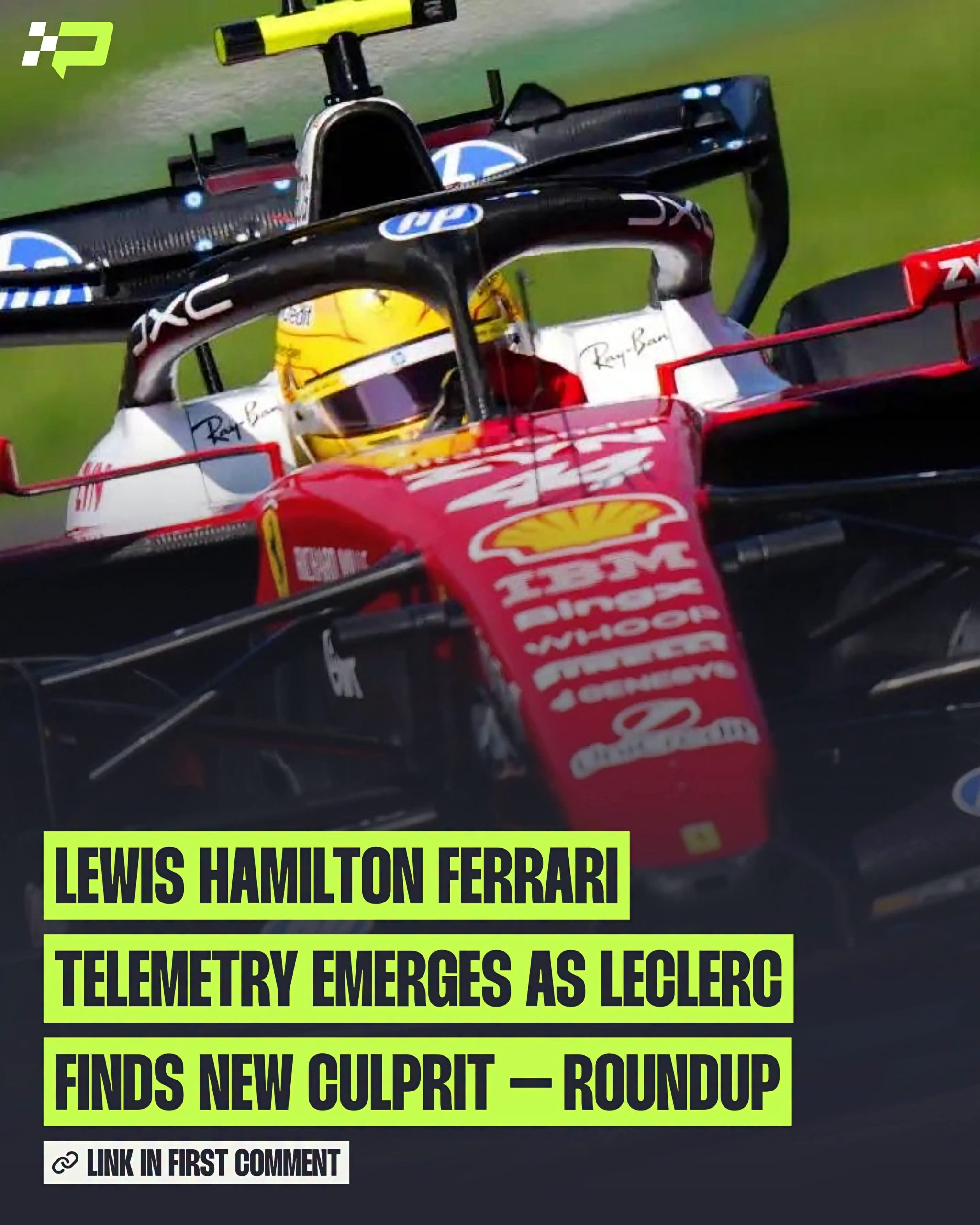
Ferrari’s internal tensions have taken another dramatic turn following the Mexican Grand Prix, with newly analysed telemetry data raising fresh questions about the controversial opening-lap confrontation between Lewis Hamilton and Charles Leclerc. Just when the Scuderia appeared ready to move forward from the incident, new details have brought the drivers’ actions back under the spotlight.
The controversy has become one of the biggest talking points ahead of the Brazilian Grand Prix, with both drivers facing scrutiny over how the battle unfolded at Turn 4. Hamilton believes the confrontation cost Ferrari a potential victory, while Leclerc has pointed towards the characteristics of the Autódromo Hermanos Rodríguez as part of the explanation for what happened.
Meanwhile, Max Verstappen has highlighted a deeper problem within Ferrari, suggesting that having two drivers who consider themselves number-one contenders can create precisely the kind of situation that unfolded in Mexico.
NEW TELEMETRY DATA REVEALS ANOTHER SIDE OF THE FERRARI CLASH
The battle between Hamilton and Leclerc has attracted considerable attention because of the potential consequences for Ferrari’s race result.
Both drivers went beyond the track limits at Turn 4 during the opening lap. Leclerc emerged ahead, while Hamilton lost ground to Verstappen, who capitalised on the confusion.
Leclerc subsequently received a five-second penalty, allowing Verstappen to strengthen his position and eventually secure victory.
However, PlanetF1’s analysis, featuring telemetry expertise from Uros Radovanovic, has introduced another dimension to the debate.
The data reportedly suggests that Leclerc never had a realistic opportunity to make the corner as he attempted the move. It also highlights a brief throttle input from Hamilton as an important detail in understanding how the confrontation developed.
These observations make the incident more complicated than a straightforward argument about which driver was responsible.
Telemetry can reveal speed, throttle application, braking and other aspects of a driver’s behaviour, but interpreting those details requires understanding the racing situation surrounding them.
The key question is whether Leclerc committed to a move that was never realistically going to work or whether Hamilton’s actions contributed to the situation becoming unavoidable.
Either way, Ferrari cannot afford to let the disagreement continue without establishing what went wrong.
CHARLES LECLERC POINTS TOWARDS THE MEXICO CIRCUIT
Leclerc has also offered another explanation for the controversial incident, shifting some attention towards the design of the Autódromo Hermanos Rodríguez.
The Ferrari driver has accepted only limited responsibility for the confrontation, with the circuit’s characteristics forming part of his argument.
Turn 4 is particularly challenging because of the way the opening section of the track unfolds. Drivers arrive at the corner following a fast sequence, and the available space can become extremely limited when several cars fight for position.
The situation becomes even more complicated when drivers are running alongside one another and attempting to avoid contact.
Before the race, competitors had been informed that gaining an advantage by leaving the track on the opening lap could result in a 10-second penalty.
However, the incident involved both Ferrari drivers going wide, with Hamilton also leaving the circuit during the confrontation. That circumstance was considered when Leclerc’s punishment was reduced to five seconds.
Leclerc’s explanation may provide useful context, but it does not completely remove the responsibility of the driver making the overtaking attempt.
Formula 1 drivers are expected to judge whether a move is possible, particularly when racing a teammate whose result directly affects the same team.
MAX VERSTAPPEN IDENTIFIES FERRARI’S BIGGEST WEAKNESS
While Ferrari continues to deal with the fallout, Verstappen has offered an assessment that could make uncomfortable reading for the Italian team.
The Red Bull driver suggested that incidents like the Mexico confrontation can happen when a team operates with two number-one drivers.
His comments point towards a fundamental difference between Ferrari’s driver arrangement and the structure at Red Bull.
At Red Bull, Verstappen has established himself as the team’s leading championship contender. That position gives the team a clearer reference point when difficult strategic decisions arise.
Ferrari, however, has two highly ambitious drivers with their own expectations.
Hamilton is a seven-time world champion who joined the Scuderia with the ambition of adding another title to his remarkable career. Leclerc has spent years building his reputation at Ferrari and naturally wants to establish himself as the team’s leading driver.
Neither wants to become a supporting act.
That competitive balance can be beneficial when both drivers push each other towards better performances. But it can also become a serious weakness when the team needs them to prioritise a shared objective.
Verstappen’s observation therefore raises an important question: can Ferrari successfully manage two drivers who both expect equal opportunities to fight at the front?
CHARLES AND ALEXANDRA LECLERC WELCOME THEIR FIRST CHILD
Away from the controversy surrounding the Mexican Grand Prix, Leclerc has also experienced one of the most important moments of his personal life.
Charles and Alexandra Leclerc announced the arrival of their first child, Bianca, on Tuesday, November 3.
The announcement attracted warm reactions from across the Formula 1 community, with fans and fellow personalities congratulating the couple.
The timing is particularly notable because the birth came between the Mexican and Brazilian Grands Prix.
Becoming a father represents a major new chapter for Leclerc, who must now balance the demands of an increasingly competitive Formula 1 career with his growing family responsibilities.
Ferrari has confirmed that Leclerc will miss Brazilian Grand Prix media duties and travel to Brazil later following the birth.
His absence from the media schedule does not automatically mean he will miss the race, but it gives the team an additional logistical consideration during an already busy weekend.
For the Monegasque, the Brazilian Grand Prix will be his first competitive outing following the arrival of Bianca.
MERCEDES LOST TWO SPONSORS AFTER SIGNING KIMI ANTONELLI
Elsewhere, Mercedes team principal Toto Wolff has revealed an unexpected consequence of the decision to promote Kimi Antonelli.
According to Wolff, the team lost two sponsors during the transition from Hamilton to Antonelli.
The departure of Hamilton was always going to represent a major change for Mercedes. The British driver had become one of the most recognisable figures in the team’s history, winning multiple championships and helping establish its global identity.
Replacing such an influential personality with a teenage rookie was a significant commercial and sporting decision.
Not every sponsor was immediately convinced by the change.
However, those who remained with Mercedes have now witnessed a remarkable outcome.
Antonelli became the youngest Formula 1 world champion in history after securing the title at the Mexican Grand Prix, delivering a historic achievement that has strengthened his position as one of the sport’s biggest emerging stars.
His success demonstrates the commercial potential of investing in young talent, even when the immediate decision appears risky.
Mercedes will now hope Antonelli can become the central figure of another successful era.
ANTONELLI RETURNS TO BRAZIL WITH A SPECIAL AYRTON SENNA TRIBUTE
Antonelli’s arrival in Brazil will carry additional significance because the newly crowned champion is preparing a special tribute helmet honouring Ayrton Senna.
Senna remains one of the most influential figures in Brazilian sporting history, and his legacy continues to inspire generations of Formula 1 drivers.
For Antonelli, paying tribute to the legendary Brazilian is an opportunity to recognise the influence of someone he has admired throughout his development.
The timing makes the gesture particularly meaningful.
Antonelli arrives at Interlagos as the reigning world champion after completing a remarkable title-winning campaign at just 20 years and 68 days old.
The Brazilian Grand Prix therefore represents more than another race weekend. It is the first opportunity for the young Italian to compete as a world champion, while carrying a tribute to one of the sport’s greatest legends.
FERRARI MUST SOLVE ITS DRIVER PROBLEM BEFORE IT COSTS MORE POINTS
The biggest concern for Ferrari is that the Mexico controversy has exposed a problem that cannot be solved through a single conversation.
Hamilton and Leclerc are both experienced enough to understand the importance of protecting their team’s interests. Yet their competitive instincts can become difficult to manage when they are fighting for the same position.
Ferrari must establish clear expectations before another confrontation occurs.
That does not necessarily mean imposing strict team orders or preventing the drivers from racing each other. Such an approach could create resentment and damage the competitive relationship between them.
Instead, the team needs clear boundaries regarding wheel-to-wheel battles, track limits and the risks each driver is permitted to take.
The consequences of failing to establish those boundaries are already visible.
Verstappen turned Ferrari’s opening-lap problems into a race victory, while Hamilton and Leclerc were left dealing with criticism rather than celebrating a stronger team result.
With the Brazilian Grand Prix approaching, the Scuderia has little time to allow the disagreement to grow.
THE BRAZILIAN GRAND PRIX COULD REVEAL WHETHER FERRARI HAS LEARNED ANYTHING
The upcoming race at Interlagos presents Ferrari with an important opportunity to move beyond the controversy.
Hamilton will want to demonstrate that his frustrations have been addressed, while Leclerc will be eager to return to competitive action following an eventful week away from the circuit.
Their relationship will inevitably attract attention, particularly during the opening laps if both drivers find themselves fighting for position.
Ferrari must ensure that the situation does not develop into another internal battle that benefits its competitors.
The telemetry analysis has added more questions to an already complicated incident, Leclerc has offered another explanation, and Verstappen has identified what he believes is a weakness in Ferrari’s driver structure.
The Scuderia now faces a choice: allow its two stars to continue fighting without clearer boundaries or introduce a system that protects the team’s overall ambitions.
The speed is there. The talent is there. But unless Ferrari can manage the rivalry between Hamilton and Leclerc, its biggest threat could continue coming from inside its own garage.